

Dr. Nguyen Thi Nghia, a gastroenterologist at Phuong Nam Hospital (a member of Phuong Chau Healthcare Group), answers: Hello and your family. First of all, please don't worry too much. Many patients who come to see me have the same feelings as your husband – prolonged stomach pain, positive HP test results, but unsure of the level of danger. That feeling is completely understandable. Helicobacter Pylori (HP) bacteria are classified by the World Health Organization (WHO) as a causative agent of gastric adenocarcinoma, and epidemiological studies show that 76% of gastric cancer cases globally are related to HP infection, and the HP infection rate is considered high in Vietnam (70%).
If left untreated, H. pylori infection can progress to cancer and can be chronic (on average 15-30 years), depending on many factors such as the strain of bacteria, individual constitution, diet, and environment.
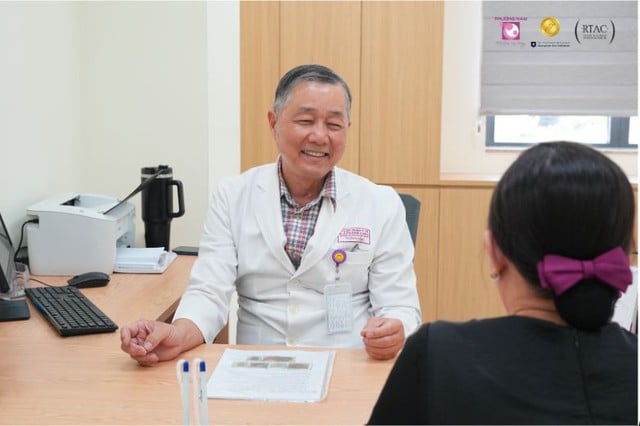
Master's degree holder and doctor Nguyen Thi Nghia advises on the patient's condition.
PRODUCT: NC
Some warning signs of stomach cancer
- H. pylori positive in patients with chronic gastric ulcers.
- Helicobacter pylori (HP) infection typically occurs in childhood, but stomach cancer usually appears in middle age or old age. Only about 1-3% of people infected with HP develop stomach cancer if left untreated. The risk is higher in people with virulent strains of the bacteria.
- Widespread mucosal atrophy and intestinal metaplasia, genetic factors or family history of gastric cancer, high-salt diet, smoking, alcohol consumption, etc.
- Unexplained weight loss, loss of appetite.
- Chronic anemia.
- There is a family history of stomach cancer.
- Stomach pain symptoms do not improve with medication to reduce stomach acid secretion; gastric and duodenal ulcers do not heal.
These signs aren't always cancerous, but they are "warning signs" that you should get your stomach checked. The most important thing for an accurate assessment is gastroscopy. Nowadays, gastroscopy is gentler because endoscopic systems use appropriately sized endoscopes and have supportive medications (anesthesia or sedation), so patients feel virtually no pain. Endoscopy allows doctors to clearly see lesions and detect early abnormalities in the stomach through histopathological examination, precancerous conditions, and biopsies when needed. Histopathology involves taking tissue samples from the stomach or colon lining for diagnosis under a microscope.
If the test shows a positive H. pylori infection, the patient simply needs to follow the treatment regimen prescribed by their doctor, which usually includes antibiotics and antacids for 7-14 days. H. pylori can be completely cured. Afterward, the doctor will schedule a follow-up test using a C13 breath test or stool test to ensure the bacteria have been successfully eradicated. The highest H. pylori success rate can be over 90% (a treatment regimen is considered effective when the rate is 80% or higher).
You shouldn't wait until you have severe symptoms before seeing a doctor.
Stomach problems can be symptomatic or asymptomatic, and may be related to the Helicobacter pylori (H. pylori) bacteria, or due to diet, lifestyle, habits, family history, etc. If H. pylori infection is detected or symptoms recur, it is best not to wait until the symptoms become severe before seeking medical attention.
Following the correct H. pylori treatment protocol, combined with a balanced diet, limiting alcohol consumption, regular check-ups, and endoscopy when necessary, is the safest way to protect your stomach and your health, as well as that of your family.
Source: https://thanhnien.vn/khi-nao-hp-duoc-xem-la-dau-hieu-canh-bao-ung-thu-da-day-185251215104114435.htm

![[Photo] Prime Minister Pham Minh Chinh receives the Governor of Tochigi Province (Japan)](/_next/image?url=https%3A%2F%2Fvphoto.vietnam.vn%2Fthumb%2F1200x675%2Fvietnam%2Fresource%2FIMAGE%2F2025%2F12%2F16%2F1765892133176_dsc-8082-6425-jpg.webp&w=3840&q=75)
![[Live] 2025 Community Action Awards Gala](/_next/image?url=https%3A%2F%2Fvphoto.vietnam.vn%2Fthumb%2F1200x675%2Fvietnam%2Fresource%2FIMAGE%2F2025%2F12%2F16%2F1765899631650_ndo_tr_z7334013144784-9f9fe10a6d63584c85aff40f2957c250-jpg.webp&w=3840&q=75)
![[Image] Leaked images ahead of the 2025 Community Action Awards gala.](/_next/image?url=https%3A%2F%2Fvphoto.vietnam.vn%2Fthumb%2F1200x675%2Fvietnam%2Fresource%2FIMAGE%2F2025%2F12%2F16%2F1765882828720_ndo_br_thiet-ke-chua-co-ten-45-png.webp&w=3840&q=75)
![[Photo] Prime Minister Pham Minh Chinh receives Lao Minister of Education and Sports Thongsalith Mangnormek](/_next/image?url=https%3A%2F%2Fvphoto.vietnam.vn%2Fthumb%2F1200x675%2Fvietnam%2Fresource%2FIMAGE%2F2025%2F12%2F16%2F1765876834721_dsc-7519-jpg.webp&w=3840&q=75)



















































![[Photo] Prime Minister Pham Minh Chinh attends the Vietnam Economic Forum 2025](https://vphoto.vietnam.vn/thumb/402x226/vietnam/resource/IMAGE/2025/12/16/1765893035503_ndo_br_dsc-8043-jpg.webp)



























Comment (0)