

Teacher shortage but recruitment bottleneck.
Mr. Do Duc Duy, Secretary of the Yen Bai Provincial Party Committee, stated that the province has proactively implemented the 2018 General Education Program and new textbooks. However, according to the reform roadmap, many localities in the province are facing a severe shortage of teachers, especially English teachers, concentrated in schools in the two mountainous districts of Tram Tau and Mu Cang Chai. The entire province currently only has 86.5% of the required number of teachers.

Prime Minister Pham Minh Chinh attended the Conference on the Implementation of Tasks for the 2023-2024 School Year.
VNA
According to Mr. Duy, the province has explored all possible solutions, such as seconding teachers from lowland areas to highland areas and receiving support from Nam Dinh province for online English teaching for students. However, despite having allocated positions and an incentive of 100 million VND for each English teacher, no new candidates have been recruited. Last academic year, when the recruitment targets for English teachers were announced, the number of applicants only reached over 53% of the target, and only over 50% of the applicants were recruited.
The Secretary of the Yen Bai Provincial Party Committee requested the Government to continue allocating teacher staffing quotas to ensure sufficient staffing levels, and to implement special policies to attract and retain teachers and staff in particularly difficult areas in order to recruit and retain them.
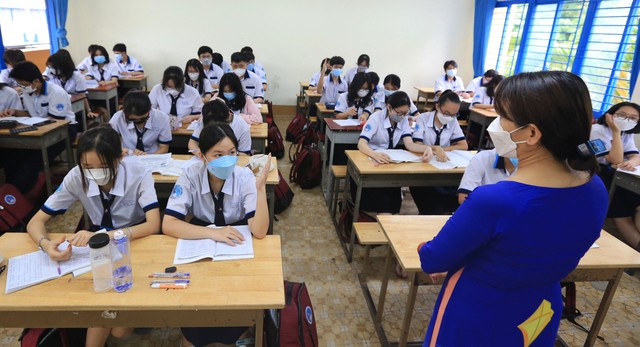
Teacher shortages are a challenge for schools as they enter the new school year.
NHAT THINH
Regarding ministries and departments, Mr. Duy proposed amending and replacing current circulars regulating the framework of job positions and staffing levels in public preschool and primary education institutions; and addressing difficulties in recruiting teachers from mountainous areas. In addition, he suggested considering adjustments to scholarship levels, policies, and social assistance for students.
Ms. Y Ngoc, Vice Chairman of the People's Committee of Kon Tum province, stated that the province still lacks 836 teachers, and the material and spiritual lives of most teachers working in remote and disadvantaged areas remain difficult. Therefore, Ms. Y Ngoc proposed a review and the issuance of specific policies and mechanisms for teachers working in difficult, remote, and ethnic minority areas.
Mr. Nguyen Minh Luan, Vice Chairman of the People's Committee of Ca Mau province, also expressed concern about the shortage of teachers, especially for subjects in the new curriculum, and the lack of recruitment sources. Mr. Luan suggested that central ministries and agencies consider resolving the difficulties in the current job position framework regulations, as the current coefficient of 1.2 teachers per class for one-session teaching and 1.5 teachers per class for two-session teaching is inappropriate when applied to the new general education program. He also pointed out difficulties in Decree 116 on teacher training programs, emphasizing the need for comprehensive regulations, particularly regarding housing for teachers, to ensure their peace of mind and commitment to teaching and work.
A long-term plan is needed for staff training.
Ms. Nguyen Thi Doan, former Vice President of Vietnam and President of the Central Committee of the Vietnam Association for the Promotion of Learning, cited the recent difficulties in implementing integrated subject teaching due to the lack of teachers trained to teach this subject. She suggested that the Ministry of Education and Training should have a long-term plan for training the teaching staff and invest carefully and systematically in teacher training to meet the requirements of reforming general education.
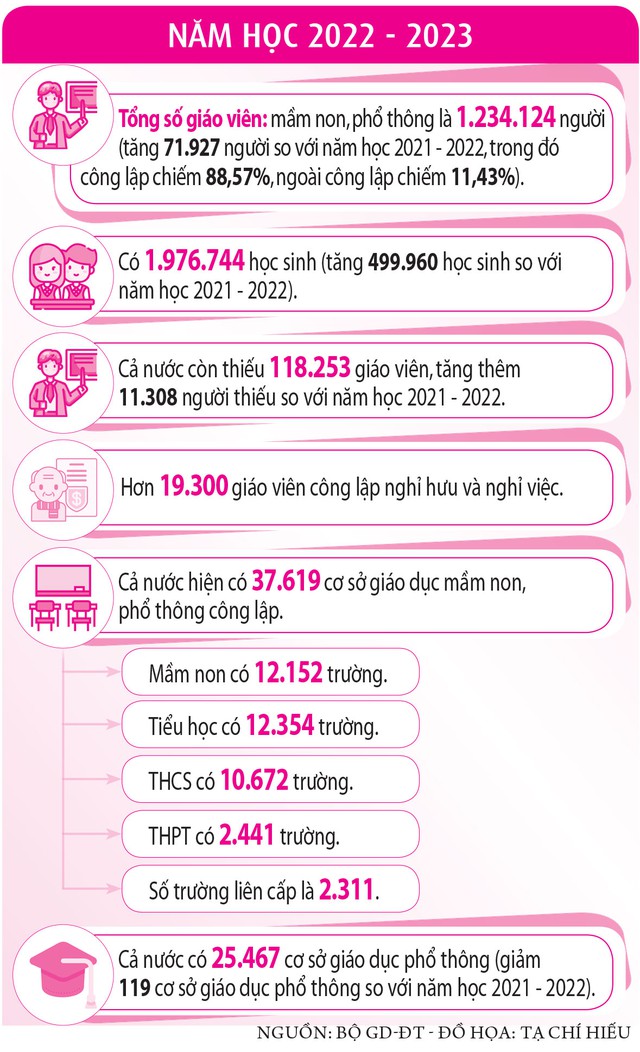
Mr. Trieu Van Cuong, Deputy Minister of the Ministry of Home Affairs, provided further information, stating that the current staffing level for the education sector in 2021 is 1,375,715 people, including 50,699 at the central level and 1,328,016 at the local level. The preschool and high school sector has 1,131,001 people. The additional staffing allocation for the 2022-2023 school year is 27,850. For the 2023-2024 school year, the Ministry of Home Affairs is coordinating with the Ministry of Education and Training to review and compare staffing levels based on needs and standards before submitting a proposal to the Government and relevant authorities for additional staffing.
Mr. Cuong also pointed out the reality that many places are experiencing localized teacher shortages and surpluses, as well as an imbalance in the teacher structure across subjects at the same educational level. The Ministry of Interior suggested that in the future, the Ministry of Education and Training could consider adjusting teacher staffing levels according to different regions.
To alleviate staffing pressure, Mr. Cuong also suggested that localities should accelerate the restructuring and reorganization of preschool and general education institutions in conjunction with improving educational quality; establish multi-level general education schools; and convert public preschool and high school institutions to private ones in areas where social mobilization is feasible.
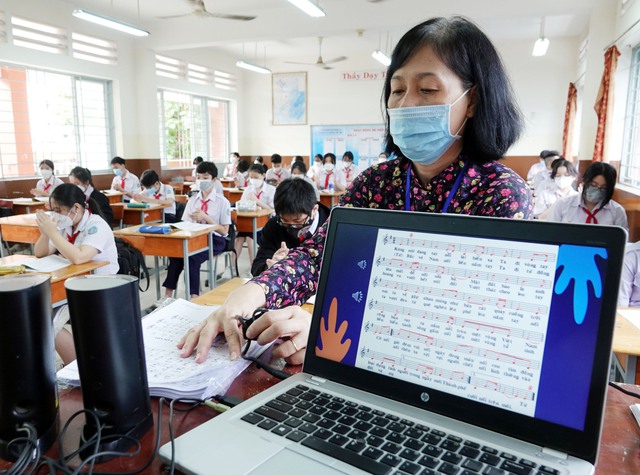
The shortage of teachers, especially in new subjects, was a pressing issue raised by localities at the conference summarizing the 2022-2023 school year and outlining tasks for the 2023-2024 school year.
JADE PEACH
Where there are students, there must be teachers in the classroom.
In his concluding remarks at the conference, Prime Minister Pham Minh Chinh stated that there is still a localized surplus and shortage of teachers, with inadequacies across different educational levels and geographical areas; many localities have not ensured sufficient teacher staffing according to regulations, especially for preschool teachers and teachers implementing the general education program. Policies and incentives remain inadequate, unattractive, and make it difficult to attract and retain teachers, especially high-quality personnel in large cities or disadvantaged areas.
The Prime Minister requested the Ministry of Interior, the Ministry of Education and Training, and local authorities to coordinate in inspecting and reviewing the recruitment of additional teachers for localities during the 2022-2026 period, ensuring the principle of "where there are students, there must be teachers in the classroom." However, the head of the government also emphasized that this principle must be appropriate in terms of student-to-class ratios, and that good planning of schools and classrooms is necessary, including the establishment of boarding schools for ethnic minority students and students in remote areas to avoid wasting resources.
The Prime Minister stated that having recently implemented a policy to increase allowances for healthcare workers, it is now necessary to capitalize on this success by immediately increasing allowances for teachers. Therefore, in the coming period, ministries and agencies need to accelerate the process of increasing allowances for teachers.
On the occasion of preparing for the new school year, the Prime Minister also shared his thoughts and requests with the teaching staff: "The task of 'revitalizing education' and carrying out the 'nurturing of human resources' is very glorious but also faces many difficulties and challenges. The Party, the State, the Government, and the Prime Minister understand, share, and will always stand alongside in resolving the difficulties and challenges of the education sector, as well as of more than 1 million teachers who are dedicating themselves day and night to the cause of 'nurturing human resources'."
The whole country is still short of 118,253 teachers.
According to preliminary statistics based on industry data, the country currently lacks 118,253 teachers, an increase of 11,308 compared to the 2021-2022 school year (7,887 more at the preschool level, 169 more at the primary school level, 1,207 more at the lower secondary school level, and 2,045 more at the upper secondary school level).
The structure of the teaching staff remains unbalanced across subjects within the same educational level and between regions with different socio-economic conditions; the surplus and shortage of teachers are still common in many localities, especially for teachers of new subjects (English, computer science, music, fine arts), but this situation is slow to be rectified; the teacher allocation quotas for most localities are lower than the actual needs.
Hanoi and Ho Chi Minh City propose a special mechanism regarding school standards.
At the conference, leaders of the Hanoi and Ho Chi Minh City People's Committees both proposed a special mechanism to address the problem of overcrowded schools caused by the rapid rate of population growth due to migration.
Ms. Vu Thu Ha, Vice Chairman of the Hanoi People's Committee, stated that the capital city is experiencing a high rate of population growth due to migration. Each year, the population increases by 50,000-60,000 students, equivalent to the need to build 30-40 new schools. However, some inner-city districts currently lack available land, so she requested that the authorities consider allowing the city to use the land area per student as a substitute for the land area per student. She also requested that the government allow Hanoi to increase the number of floors in existing school buildings and permit the construction of basements for schools in inner-city districts to utilize land resources more effectively.
The plan for the 2025 high school graduation exam will be announced soon.
The Prime Minister requested the Ministry of Education and Training to promptly announce the plan for the high school graduation exam starting in 2025 so that teachers and students have a clear direction for teaching, learning, and exam preparation, and to reassure parents and students.
"This is an issue that has received widespread attention from teachers, students, and parents. Reforming exams and graduation recognition, ensuring seriousness, streamlining, reducing pressure, and improving quality," the Prime Minister emphasized.
Source: https://thanhnien.vn/tang-phu-cap-uu-dai-cho-giao-vien-185230819025036865.htm




![[Photo] General Secretary and President To Lam presides over the meeting to approve the draft report on the results of the second inspection by the Politburo of the Standing Committee of the Hanoi City Party Committee.](https://vphoto.vietnam.vn/thumb/1200x675/vietnam/resource/IMAGE/2026/05/26/1779789811432_a2-bnd-4430-9620-jpg.webp)























































Comment (0)