

ANTD.VN - The Ministry of Finance has proposed adjusting the excise tax rates on certain items harmful to health, such as tobacco and alcoholic beverages, in order to limit their use.
The Ministry of Finance is seeking the Ministry of Justice 's assessment of the Government's submission regarding the proposed draft Law on Special Consumption Tax. This proposal suggests increasing tax rates on items harmful to health, such as tobacco and alcoholic beverages.
Increase taxes and apply a mixed tax calculation method to tobacco products.
The Ministry of Finance has proposed studying and adding the application of absolute tax and a mixed tax calculation method (proportional tax rate and absolute tax rate) to tobacco products.
According to the drafting agency, the World Health Organization (WHO) investigation report shows that approximately 90% of countries apply excise taxes on tobacco products. There is a growing trend of countries applying mixed taxes on this product (from 48 countries in 2008 to 61 countries in 2016).
Applying a mixed tax calculation method will ensure that the excise tax policy is effective in aiming to increase prices, contributing to directing a reduction in the consumption of cheap tobacco products (products with higher risks and harms to health compared to premium cigarettes); at the same time, it will limit access for young people, who are new smokers and often start with low-priced cigarettes.
According to the Ministry of Finance, countries are increasingly applying absolute taxes, mixed taxes, and attaching conditions on periodic tax increases at or above the inflation rate to ensure that cigarette prices increase at or above the rate of increase in income and purchasing power of smokers.
Therefore, it is necessary to revise the tax calculation method for this item to a mixed method in order to increase the effectiveness of the special consumption tax policy and align with global reform trends.
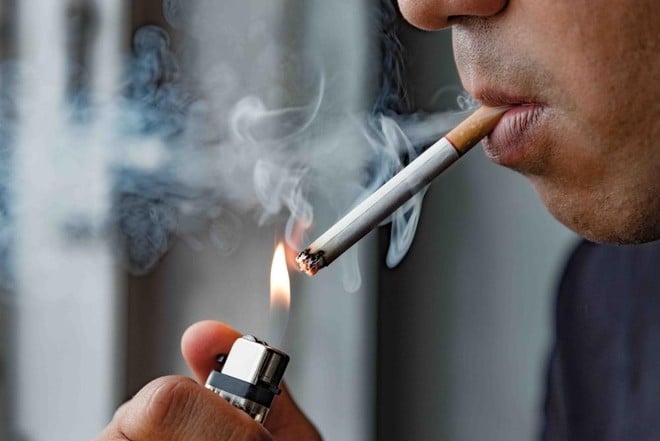 |
Excise tax on tobacco products is expected to increase sharply. |
Furthermore, the Ministry of Finance has also proposed increasing taxes on tobacco. The reason is that the current selling price of tobacco in Vietnam is still low because the tax rate on the retail price is only about 38.85%, while in other countries it is much higher. For example, Brunei is 81%, Thailand 70%, Singapore 69%, Malaysia 51%... and developed countries like Australia 62%, Germany 75%, France 80%...
Notably, the draft also proposes adding new tobacco products and new tobacco devices, components, and liquids to the list of taxable items.
The reason is that e-cigarettes, heated tobacco products, and shisha all contain harmful ingredients that are detrimental to both the smoker and those around them, just like traditional cigarettes (according to WHO and the Ministry of Health).
Although the excise tax rate on tobacco products was increased according to the roadmap from 2016 to 2019, the smoking rate in Vietnam remains high (decreasing from 45.3% in 2010 to 42.3% in 2020, but failing to achieve the target of reducing it to 37% by 2020).
"Therefore, tobacco use needs to be further controlled, and the excise tax increase roadmap over the past period has not yet achieved the goal of reducing use as planned," the Ministry of Finance stated.
Increase taxes on alcohol and beer.
The Ministry of Finance stated that, despite the increase in excise tax rates on beer and spirits according to the roadmap from 2016 to 2018, alcohol consumption in Vietnam remains high and is trending upwards rapidly.
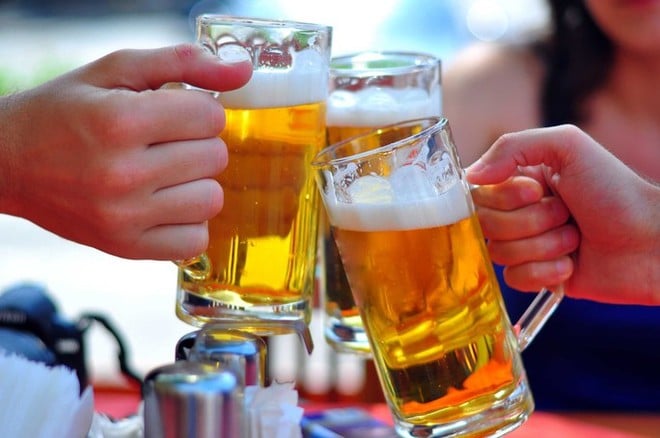 |
Vietnam is one of the countries with the highest rates of alcohol consumption. |
Specifically, Vietnam is the highest beer consumer in Southeast Asia and the third highest in Asia, after Japan and China. In 2019, the average beer consumption per person was 47.6 liters, 1.2 times that of 2015. The average consumption of spirits and liquor was 3.4 liters, 1.02 times that of 2015.
Alcohol ranks fifth among the top 15 health risk factors and causes many serious social consequences, including traffic accidents, injuries, domestic violence, public disorder, and widening wealth inequality. Alcohol is also one of the three leading causes of traffic accidents among men aged 15-49; therefore, alcohol consumption needs to be controlled.
According to the WHO, tax policy is one of the most effective measures to control the harms of alcohol, reducing the burden of disease and death caused by alcohol.
Many countries around the world also apply excise taxes on alcoholic beverages. Meanwhile, the current tax on alcohol in Vietnam is still low, only accounting for 30% of the retail price, while in many countries it ranges from 40% to 85%.
Therefore, the Ministry of Finance believes that further research is needed to increase the excise tax rate on this item, ensuring that the price increase of alcoholic beverages after adjustment keeps pace with the increase in income and inflation.
Source link
![[Photo] The General Secretary, President and his wife begin their state visit to the Philippines.](https://vphoto.vietnam.vn/thumb/1200x675/vietnam/resource/IMAGE/2026/05/31/1780230559452_anh-man-hinh-2026-05-31-luc-19-28-11.png)
![[Photo] Solemn bathing ceremony and Buddha procession in Hue](https://vphoto.vietnam.vn/thumb/1200x675/vietnam/resource/IMAGE/2026/05/31/1780228263543_1-jpg.webp)


![[Photo] Admire the coral "masterpiece" amidst the million-year-old heritage of Dak Lak province.](https://vphoto.vietnam.vn/thumb/1200x675/vietnam/resource/IMAGE/2026/05/31/1780221235105_anh-man-hinh-2026-05-31-luc-16-53-27.png)

















![[Video] Sunset at Lap An Lagoon – Where the sun sets over the fishing nets](https://vphoto.vietnam.vn/thumb/340x192/vietnam/resource/IMAGE/2026/05/31/1780192137701_beach-landscape-sea-water-nature-grass-745871-pxhere-com.jpeg)

































![[Photo] Admire the coral "masterpiece" amidst the million-year-old heritage of Dak Lak province.](https://vphoto.vietnam.vn/thumb/402x226/vietnam/resource/IMAGE/2026/05/31/1780221235105_anh-man-hinh-2026-05-31-luc-16-53-27.png)































Comment (0)