

The night-time economy not only expands consumption spaces and increases revenue from tourism and services, but also contributes to reviving cultural values, positioning brands, and creating new growth drivers for Hanoi.
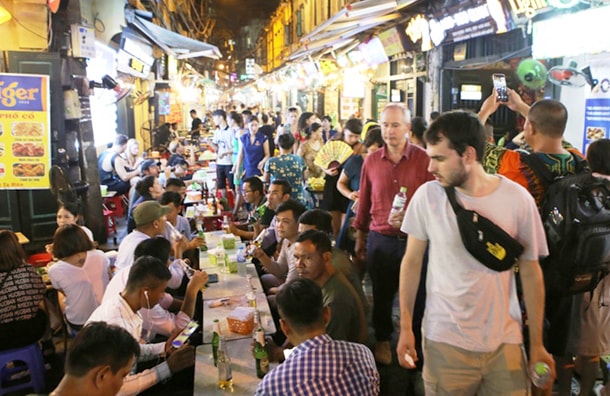
When culture, tourism , and cuisine speak up together.
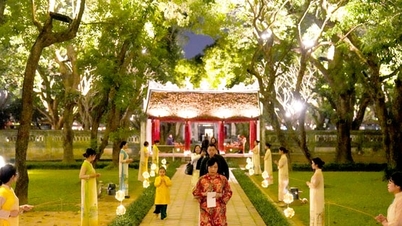
In early May, at Ho Van Lake (part of the Van Mieu - Quoc Tu Giam historical complex), the Van Mieu - Quoc Tu Giam Cultural and Scientific Activities Center, in collaboration with Upleaf Vietnam Trading and Services Joint Stock Company, organized the "Ho Van - Van Mieu Lantern Festival." This is a new nighttime cultural and tourism product, connecting art, cuisine, and spiritual life. Here, visitors can immerse themselves in traditional art, enjoy vegetarian food, and release lanterns to express their wishes.
According to Le Xuan Kieu, Director of the Van Mieu - Quoc Tu Giám Cultural and Scientific Activities Center, the program contributes to realizing Hanoi's night-time cultural experience model.
In recent years, Hanoi has been gradually changing its approach to developing its night-time economy. Instead of focusing solely on traditional shopping and dining activities, the city is expanding its experiential ecosystem with a variety of distinctive cultural, tourism, entertainment, and service products, helping to extend visitor stays and increase spending. The capital's nightlife is also becoming increasingly diverse with the emergence of many new cultural, tourism, and entertainment products.
Pedestrian streets around Hoan Kiem Lake (Hoan Kiem Ward), Tran Nhan Tong Street (Hai Ba Trung Ward), Son Tay pedestrian street (Son Tay Ward)... have become open cultural spaces with street art performances for the community, showcasing local OCOP (One Commune One Product) products, creating a unique atmosphere for Hanoi on weekends.
The capital's theaters are also striving to keep the lights on with many high-quality artistic programs such as: water puppet performances at the Thang Long Water Puppet Theater; modern and classical music performances at the Hanoi Grand Opera House, Ho Guom Theater, National Convention Center… contributing to making Hanoi's nightlife even more attractive.
Cuisine is also a significant highlight in Hanoi's night-time economic landscape. Food streets such as Ta Hien, Tong Duy Tan, the Dong Xuan night market area, and the Trinh Cong Son creative cultural space have become familiar destinations for both domestic and international tourists.
Furthermore, cultural heritage spaces have also been "illuminated" with a new look. Night tours at Hoa Lo Prison, Temple of Literature, Thang Long Imperial Citadel, Vietnam Literature Museum, Vietnam Fine Arts Museum, etc., have offered visitors a different perspective on Hanoi's history and culture.
Ms. Nguyen Thanh Hai (Khuong Trung ward) shared: “Previously, my family and I mainly visited historical sites during the day, but now many nighttime activities are offering exciting experiences. The stories of history and culture are told through light and technology in the evening, creating a unique and novel feeling.”
According to Nguyen Tien Dat, Vice President of the Hanoi Tourism Association, with its diverse culture, numerous historical sites and relics, and many new creative spaces, Hanoi has many advantages for developing its night-time economy. "Developing the night-time economy is not simply about extending operating hours, but also about creating added value for the economy," Mr. Nguyen Tien Dat stated.
The solution to the night-time economy problem.
According to the Hanoi Department of Tourism, the city currently has more than 20 night-time tourism products with many innovative and attractive models. This is contributing significantly to encouraging tourists to extend their stay in the capital. However, according to experts, Hanoi's night-time economy is still in the process of formation and development, and its full potential has not yet been exploited.
Regarding this issue, the Chairman of the Vietnam Tourism Association, Vu The Binh, noted that one of the easily noticeable limitations, not only in Hanoi but also in other localities, is that nighttime tourism products are not yet truly diverse. Many current activities are still isolated, lacking linkages between the fields of tourism, culture, shopping, entertainment, and services. Many destinations mainly focus on food and beverage or purely performance activities, failing to create products with depth and lasting appeal.
According to Nguyen Tien Dat, Vice President of the Hanoi Tourism Association, although many unique night-time cultural and tourism models have been developed, Hanoi still lacks uniformity in infrastructure and management. Environmental sanitation, noise pollution, traffic, urban order, and service quality sometimes fail to meet the expectations of residents and tourists. Furthermore, infrastructure supporting the night-time economy is also a matter of concern. Public transportation at night is not yet truly convenient, parking facilities are limited, while supporting services such as signage and information points for tourists are still lacking.
To develop the night-time economy effectively, Mr. Nguyen Tien Dat suggested that Hanoi needs a specific plan for night-time economic development areas to ensure a balance between economic development goals and the quality of life for residents. Each area should clearly define its function and product orientation, rather than developing in a scattered manner.
Regarding this issue, the Chairman of the Vietnam Green Tourism Association, Phung Quang Thang, suggested that the city needs to strengthen linkages between management agencies, businesses, and the community to form a synchronized product chain. Encouraging businesses to invest in nighttime entertainment, culture, and arts will contribute to creating more resources for development. At the same time, Hanoi needs mechanisms to encourage businesses to invest and innovate. Because the night economy is not simply activities that take place after sunset, but is becoming a new direction in modern urban development. Economic activities are only effective when products and services generate clear revenue and benefits.
It is clear that when cultural values are revived, experiences are renewed, and products and services are invested in systematically, the night-time economy will not only generate revenue but also contribute to positioning Hanoi as a dynamic, modern city that still retains its rich cultural identity.
Source: https://hanoimoi.vn/tao-dong-luc-tang-truong-moi-cho-thu-do-976044.html
![[Image] Pleasant weather helps students enter the 10th grade entrance exam with confidence.](https://vphoto.vietnam.vn/thumb/1200x675/vietnam/resource/IMAGE/2026/05/29/1780034401612_ngay-1-thi-lop-10-minh-duy-8-5009-jpg.webp)
![[Photo] Ba Lang An Lighthouse - the "eye of the sea" amidst the "rock museum" of Quang Ngai province.](https://vphoto.vietnam.vn/thumb/1200x675/vietnam/resource/IMAGE/2026/05/29/1780038698840_anh-man-hinh-2026-05-29-luc-14-10-42.png)

























































Comment (0)