


A plate of delicious and attractive Cu De River noodle salad - Photo: Provided by the author
In the lower reaches of the Cu De River, where freshwater mixes with the salty waters of the Nam O Sea, each year has its own unique season. Around the beginning of summer, from March to early April, a special aquatic species appears. Locals simply call it "river noodles."
Strange season at the bottom of the river
Not everyone knows about this dish. Even many long-time residents of Da Nang have only heard about it. River noodles are not available year-round; their availability depends entirely on natural conditions. Some years they are available, some years they are not. Some years there are many, some years there are few. Therefore, anyone who gets to enjoy them is considered fortunate.
According to residents of Truong Dinh village, Hai Van ward, the Cu De River is rich in resources. For a long time, it has been home to jellyfish, fish, and snails. But river vermicelli is different. Only in the last ten years or so has this species become clearly visible seasonally. This year, with favorable weather, little rain, and clean, clear water, river vermicelli has flourished, creating a rare "gift from nature."

Cu De river rice noodles must be washed thoroughly many times.
The mystery of aquatic species
The name "river noodles" easily leads people to think of a type of plant like seaweed. However, there is still no consensus. Some believe it is a small, filamentous animal that moves like a jellyfish. Others suggest it is a filamentous microorganism, possibly belonging to the algae or aquatic fungus group.
Locals aren't too concerned with the scientific name. They identify it by experience. When diving to the bottom of the deep river, they see clusters of soft, long fibers, bundled together like noodles. They are pale green or slightly yellow, shimmering in the sunlight. When brought up from the water, they curl up like handfuls of egg noodles.
What's special about river snails is that they only live in clean, flowing water. The brackish water where rivers meet the sea creates an ideal environment. If the water is murky or polluted, this species cannot survive. Therefore, the presence of river snails is also a sign that a river still retains its purity.

After rinsing the rice noodles one last time, blanch them in boiling water.
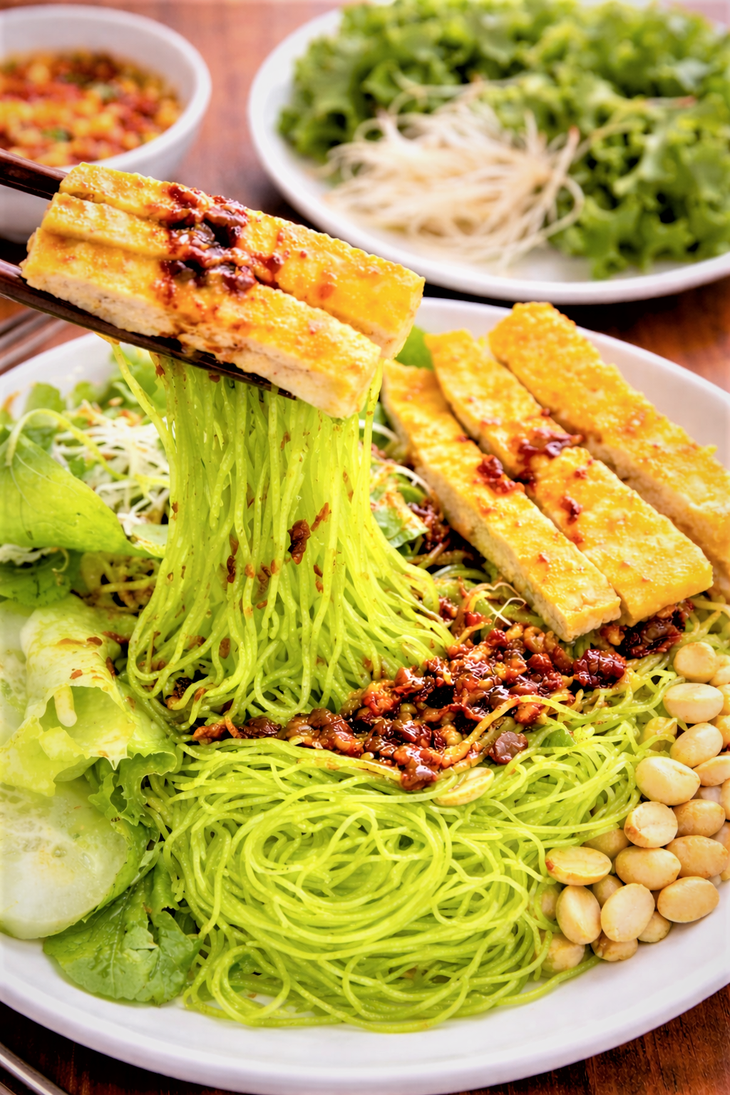
In the early summer sunshine, a plate of river noodle salad served with grilled rice paper becomes an unforgettable experience.
The profession of "hunting for noodles" at the bottom of the river.
During the peak season for river noodles, the Cu De estuary becomes bustling. Boats and canoes come and go. People dive and collect noodles. The scene resembles a floating market in the middle of the river.
Harvesting river noodles is not easy. Those who do the job must be in good health. They dive more than 5 meters to the riverbed. Each dive only yields a small amount, averaging only 1 to 2 kg per trip. The work requires stamina and experience.
After being harvested, the river rice noodles are placed in a basket and rinsed thoroughly several times to remove sand and impurities. They are then soaked overnight to reduce the saltiness. Once processed, the noodles retain a light green color with characteristic tiny dots.
Any noodles that have changed color or are less fresh are discarded. The locals are very meticulous in their selection process. This is what gives the dish its unique quality.
The price of river rice noodles ranges from 100,000 to 120,000 VND per kilogram. They are not always available. Due to limited supply, they are usually ordered in advance by restaurants and hotels to serve their customers.

Cu De River rice noodles after initial processing.
From hunger-fighting meals to culinary specialties
In the past, for the people of Thuy Tu region, river noodles were just a simple dish. When times were tough, they would dive into the river, scoop them up, and mix them with peanuts to eat for a meal. It wasn't fancy, and there were no complicated seasonings.
Today, vermicelli noodles have become a specialty. They appear on the menus of many restaurants in Da Nang, especially in salads.

The main ingredients for making Cu De River noodle salad.
The preparation is not too complicated. Boil pork belly until cooked, then chop it into small pieces. Clean fresh shrimp. Finely chop shallots. Marinate the shrimp and pork with seasonings such as fish sauce, pepper, and seasoning powder until well absorbed. Then sauté the shallots in peanut oil, add the shrimp and pork mixture and stir well.
After initial preparation, the rice noodles are mixed with fresh ingredients such as pineapple, cucumber, banana blossom, raw vegetables, and herbs. Crushed roasted peanuts are added. All these ingredients combine to create a delicious salad.
The special thing is that you don't need to season too much when mixing. The shrimp and meat are already flavorful enough. The river rice noodles provide crispness, coolness, and a unique taste.

The Cu De River noodle salad dish is visually appealing with its many colors.
An unforgettable taste
Looking at a plate of river noodle salad, one is easily captivated by the colors. The light green of the noodles. The yellow of the pineapple. The orange of the carrots. The green of the herbs. All create a harmonious whole.
When you taste it, the first sensation is a coolness. The noodles are soft but have a crisp texture like jelly. Unlike seaweed or sea grapes, river noodles have a slightly salty taste, mixed with a natural sweetness.
When combined with shrimp, the rich and savory flavors spread throughout. Pineapple adds a touch of sourness. Fresh vegetables enhance the freshness. Peanuts provide a nutty crunch. All these elements blend together to create a unique flavor.
In the early summer sunshine, a plate of river noodle salad served with grilled rice paper and a little light wine becomes an unforgettable experience. The dish is not only delicious but also brings a feeling of relaxation.
Source: https://tuoitre.vn/thang-tu-an-goi-bun-song-20260411211921335.htm

![[Image] Nearly 125,000 Hanoi students completed the Literature exam for the 10th grade entrance exam.](https://vphoto.vietnam.vn/thumb/1200x675/vietnam/resource/IMAGE/2026/05/30/1780117233041_ndo_br_thiet-ke-chua-co-ten-2-png.webp)












![[Video] Fire at electric vehicle storage facility in Gia Lai extinguished promptly](https://vphoto.vietnam.vn/thumb/402x226/vietnam/resource/IMAGE/2026/05/30/1780155054964_dung00-58-34-23still007-png.webp)











































































Comment (0)