

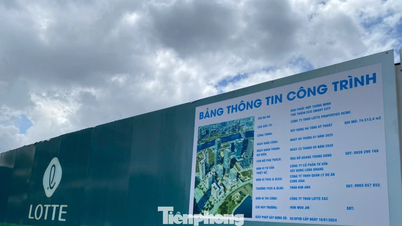
In reality, many projects, especially in the real estate and infrastructure sectors, are delayed, with numerous multi-billion dollar projects stalled. At many National Assembly sessions, representatives have expressed impatience and voiced their concerns about this situation, as stalled projects and delays in implementation cause significant waste of resources and negatively impact the investment environment. This is also a major obstacle to socio -economic development. One of the reasons for this situation is the obstruction of legal regulations.
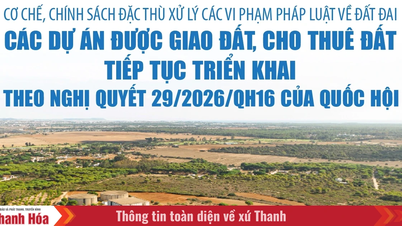
To address the difficulties and obstacles faced by long-standing and unresolved projects, Resolution No. 29/2026/QH16 of the National Assembly stipulates the handling of projects that have been granted land use certificates improperly. Accordingly, for projects that have been granted land use certificates improperly, the provincial People's Committee shall review the planning in accordance with the law on urban and rural planning, ensuring independence, objectivity, and transparency. After the review, if the project conforms to the planning with a land use function for housing construction, the provincial People's Committee shall determine the land use fee and land lease fee of the project based on the policy and land price at the time the State adjusted the improperly granted land use certificate to residential land. This will determine the amount to be collected from the difference in land use fee and land lease fee at the time the certificate was adjusted, as stipulated in this Resolution. Investors and project owners must fulfill their financial obligations to state agencies and ensure the capacity to continue implementing the project in accordance with the law... The resolution also allows for handling the continued allocation and leasing of land for projects that violate regulations on investor selection, land management, and land use; handling investment projects on land that the State has reclaimed but which do not fall under the cases of land reclamation as stipulated by law; and handling investment projects in cases of violations regarding land use purposes.
Furthermore, the Resolution also stipulates the handling of power grid construction investment projects that are currently under construction but have not yet undergone the investment policy approval procedure. Accordingly, for power grid construction investment projects subject to investment policy approval or investment policy decisions according to the law, which are currently under construction but have not yet undergone the investment policy approval procedure, the investment policy approval procedure does not need to be repeated…
According to the Ministry of Agriculture and Environment , as of March 30, 2025, the whole country had 4,489 projects and land issues facing difficulties and obstacles, with a total area of over 198,000 hectares and a total investment of over 3,352,946.9 billion VND. This shows that the number of projects and land issues still facing difficulties and obstacles is very large. Therefore, a policy mechanism is urgently needed to promptly resolve these cases.
The National Assembly's issuance of the resolution is a timely decision aimed at fundamentally addressing major institutional bottlenecks to resolve outstanding projects. This is one of the effective solutions to bring these stalled projects into operation and use as soon as possible to serve economic and social development, avoiding the waste of resources. Not only does it resolve the bottlenecks for stalled projects, but what voters and the people highly appreciate is that during the handling process, the National Assembly requires adherence to the principle of not legitimizing violations, preventing the emergence of new violations; and strictly inspecting, supervising, and handling organizations and individuals who exploit the implementation of this Resolution for corruption, waste, negative practices, or covering up violations. Furthermore, the handling must be consistent with objective reality and specific historical circumstances. Ensuring a harmonious balance between the interests of the State, the legitimate rights and interests of relevant entities, and the legitimate interests of bona fide third parties within the overall national interest as stipulated by law.
To ensure the National Assembly's resolution is implemented promptly, the Government is currently urgently drafting a guiding decree. It is believed that completing this legal gap will both address existing projects and land issues from the past and unlock resources for development. This is a crucial legal foundation, a "new legal space," contributing to the efficient use of land resources and promoting sustainable development in the future.
Source: https://daibieunhandan.vn/thao-go-vuong-mac-cho-du-an-ton-dong-keo-dai-10415992.html

![[Image] Hanoi's urban life under the challenge of a "scorching hot" environment](https://vphoto.vietnam.vn/thumb/1200x675/vietnam/resource/IMAGE/2026/05/25/1779706979265_nang-nong-t5-2026-minh-duy-7-4636-jpg.webp)


![[Image] Close-up view of the interchange connecting the two expressways and Long Thanh Airport.](https://vphoto.vietnam.vn/thumb/1200x675/vietnam/resource/IMAGE/2026/05/25/1779703378210_ndo_br_z7863716673926-224453a31600126cce10622af6290afd-4549-jpg.webp)















































































Comment (0)