

These cultural institutions are increasingly becoming spiritual "pillars," contributing to preserving identity and fostering community cohesion in the capital city.
Bustling activity from clubs to cultural centers.
Every Friday evening, the Folk Song Club of Moc Village (Thanh Xuan Ward) comes alive with the sounds of folk songs. In a simple setting, those who love traditional melodies, from the elderly to students, enthusiastically practice and perform. For over a decade, the club has not only preserved folk melodies but also become a space for community bonding.
In Thuong Phuc commune, nearly 30 members of the Nghiem Xa village Cheo Club regularly gather twice a week to practice familiar traditional Cheo melodies. According to Le Van Them, the club's chairman, there's no large stage or professional lighting, but these activities keep the community alive and vibrant. Pham Anh Hoa, a member of the Nghiem Xa village Cheo Club, shared: "Participating in the club makes me feel more relaxed and happy because I can still contribute a small part to the community's activities."
Not only are clubs thriving, but many cultural centers in Hanoi are also becoming familiar community spaces for residents. At the Long Phu village cultural center in Phu Cat commune, people come every day to practice sports and participate in cultural activities after work. According to Hoang Quoc Cuong, Vice Chairman of the Phu Cat Commune People's Committee: "The commune always prioritizes investing in and improving cultural facilities to create favorable conditions for the development of mass cultural, artistic, and sports movements."
Similar to the Long Phu village cultural center, the Cong Xuyen village cultural center in Thuong Phuc commune is also regularly bustling with activities such as health exercises, folk dances, volleyball, badminton, poetry, and performing arts. According to the head of Cong Xuyen village, Nguyen Van Thuong, the cultural center is not only a place for physical exercise but also a space for people to meet and socialize, contributing to strengthening community bonds.
Over the past period, Hanoi has consistently prioritized investment in a comprehensive system of grassroots cultural institutions. The city has invested in and completed many large-scale, key cultural and sports facilities, totaling nearly 400 projects; over 85% of villages and residential areas have cultural centers or community activity points, gradually meeting the increasingly high cultural needs of the people.
Laying the foundation for a civilized community.
When people actively participate in cultural and sports activities, the atmosphere in residential areas becomes more vibrant. This is an important foundation for building a sustainable grassroots cultural life. Along with maintaining activities at cultural institutions, many communes and wards in Hanoi also focus on building environmental landscapes, creating green, clean, and beautiful living spaces associated with building a civilized lifestyle in residential areas.
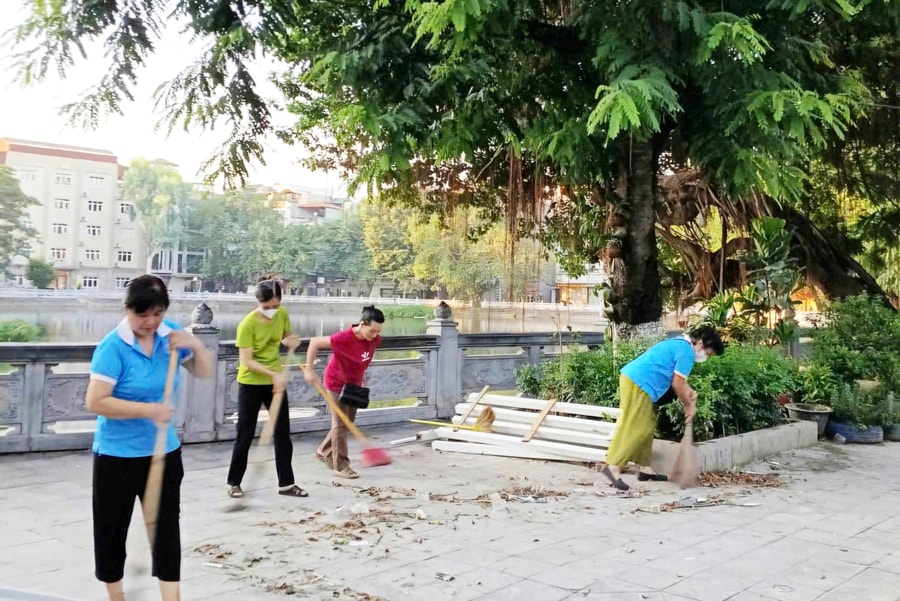
In Phu Cat commune, while many roads used to be littered with trash and overgrown with weeds, they have now been renovated to be clean and beautiful with a system of trees and flowers along the roadside. This is the result of the widespread movement to build flower-lined roads, clean up the environment, and beautify village roads and alleys, implemented by the Women's Union of the commune. According to Hoang Quoc Cuong, Vice Chairman of the Phu Cat Commune People's Committee, building a beautiful environment is an important part of improving the quality of cultural life at the grassroots level.
In Hai Ba Trung ward, recognizing the development of grassroots culture as a crucial task in building a civilized urban environment, in addition to maintaining sports and arts activities at clubs, the ward has also implemented the "Healthy People - Clean Streets" model. Members both walk to improve their health and pick up and collect household waste on streets, alleys, residential areas, and public playgrounds.
According to Nguyen Thanh Tu, Standing Vice Chairman of the Vietnam Fatherland Front Committee of Hai Ba Trung Ward and President of the Hai Ba Trung Ward Women's Union, the "Healthy People - Clean Streets" self-governing team model not only contributes to improving the landscape and living environment but also creates positive living habits for the people.
According to Vu Le Son, Deputy Secretary of the Party Committee of Ung Thien commune, the locality will continue to focus on improving the quality of grassroots cultural movements, avoiding formalism, increasing the ability to attract people's participation, and creating a strong community spirit.
Building a cultural environment is not just about investing in infrastructure, but also about creating a shift in community awareness. Combining the development of cultural institutions with the creation of a civilized living environment has yielded clear results. However, alongside these positive outcomes, many grassroots cultural institutions still face difficulties regarding operating funds, lack of equipment, and activities that are not truly engaging for young people. Some cultural centers have received substantial investment, but their effectiveness in utilizing resources is not commensurate with their potential…
Therefore, many localities are focusing on innovating the content of activities, diversifying community cultural models, and linking them to the actual needs of the people so that grassroots cultural institutions can truly function effectively...
From folk music clubs to models for building civilized living environments, grassroots cultural institutions are becoming a close spiritual anchor for the people of Hanoi, creating enduring vitality for the Hanoi community today.
Source: https://hanoimoi.vn/thiet-che-van-hoa-khoi-suc-song-cong-dong-750014.html
















































































Comment (0)