

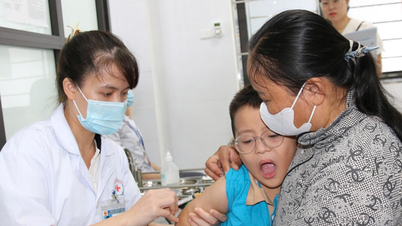
Vietnam has received 17 out of 21 million doses of measles vaccine and distributed them to provincial Centers for Disease Control and Prevention. From April to June, sufficient measles vaccine was supplied for the expanded immunization program, ensuring that 7.5% of children receive the measles vaccine each month.
Regarding the information that measles vaccination has been interrupted for the past three months, Dr. Hoang Minh Duc, Director of the Department of Preventive Medicine, Ministry of Health, stated that the budget for purchasing vaccines for 2024 will only be decided at the end of 2023. Therefore, the bidding process will only be completed at the end of 2023.
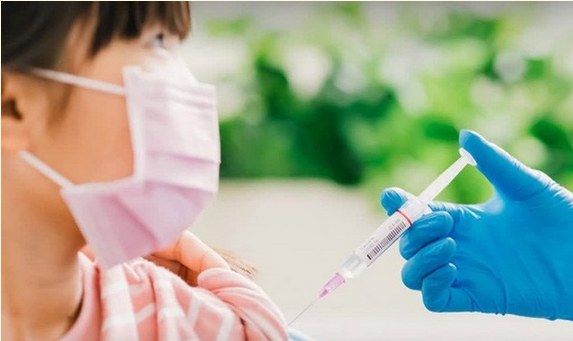 |
| Measles outbreaks are on the rise in several provinces and cities. |
In early January-February 2024, the new vaccines were completed and are now being delivered in batches to localities for vaccination from now until October 2024.
Mr. Duc said that, to date, Vietnam has received 17 out of 21 million doses of measles vaccine and distributed them to the Centers for Disease Control and Prevention in the provinces. From April to June, sufficient measles vaccine was supplied for the expanded immunization program, ensuring that 7.5% of children receive the measles vaccine each month.
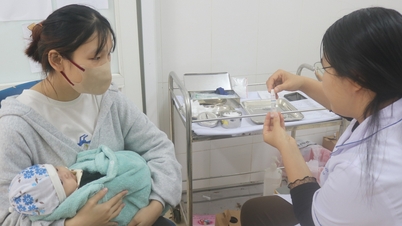
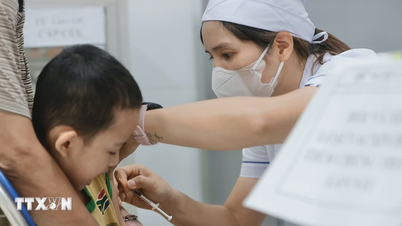
The Department of Preventive Medicine has advised the Ministry of Health to review all children nationwide who have not been vaccinated against measles. Localities with children who have not received all the required doses will organize catch-up and supplementary vaccinations to prevent an increase in measles outbreaks.
Recently, many provinces and cities in the South have been recording a resurgence of measles, while some provinces in the North have experienced a resurgence of whooping cough due to gaps in vaccination programs.
Measles and whooping cough, which were thought to be under control, are recently showing signs of resurgence due to vaccination gaps.
According to a report from the Ho Chi Minh City Center for Disease Control (HCDC), there are currently 16 confirmed cases of measles in the city, distributed across 4 out of 22 districts. Meanwhile, in Kien Giang province, statistics show that from April 7th to June 8th, the locality recorded 159 consecutive cases of fever and rash suspected to be measles, of which 95 were confirmed cases (accounting for 60%).
In Ben Tre province, from April 29th to June 7th, 12 cases of fever and rash suspected to be measles were recorded. Eight of these 12 cases were tested, with four testing positive for measles.
Ho Chi Minh City is known to consistently be one of the leading localities in the Southern region in terms of vaccination rates. However, due to the impact of the Covid-19 pandemic and disruptions to the expanded immunization program, the vaccination rates for all types of vaccines in general, and measles vaccines in particular, have been low in recent years.
As of the end of April 2024, the percentage of children who received both doses of the measles vaccine for those born in 2018, 2019, 2020, and 2021 in the area was 93.2%, 90.1%, 91.7%, and 93.6%, respectively.
Not only in Ho Chi Minh City, but also in the southern region, the measles vaccination rate in the community has been low and uneven in recent years. A survey by the Pasteur Institute of Ho Chi Minh City shows that from 2021 to the present, the measles vaccination rate in the southern region has been very low.
In 2021, the measles vaccination rate in the southern region reached only 83.2% for the single measles dose and 75.6% for the combined measles dose (measles, mumps, rubella vaccine).
In particular, Binh Duong has a very low measles vaccination rate, reaching only 52%. Several other localities such as Dong Thap, Dong Nai , Soc Trang, etc., also have vaccination rates below 70%.
Experts are concerned about the risk of measles spreading in the community in the coming period, especially in crowded places such as schools, daycare centers, and healthcare facilities. Therefore, localities need to review vaccination status, assess risks, and immediately carry out catch-up and supplementary vaccinations for children to limit the risk of measles outbreaks.
Previously, in late March 2024, the World Health Organization (WHO) warned of the resurgence of measles. According to the WHO, in the Western Pacific region, the number of measles cases had increased by 255% from 2022 to 2023.
According to the WHO, in Vietnam, the impact of the Covid-19 pandemic and the disruption of vaccine supply under the 2023 Expanded Immunization Program have affected the vaccination rate of children nationwide.
Many children have not been vaccinated according to schedule or have not received all the necessary doses of vaccines in recent years, which is a risk factor for disease outbreaks, including measles.
Besides measles, whooping cough is also on the rise again. According to the Hanoi Center for Disease Control, this year, the number of whooping cough cases shows signs of increasing compared to previous years, due to the impact of the recent Covid-19 pandemic, which resulted in less than 100% of children receiving vaccinations, leading to a lower vaccination rate. Specifically, according to the Hanoi Department of Health, from May 24th to 31st, there were 16 new cases of whooping cough in the city, an increase of 14 cases compared to the previous week.
According to the Hanoi CDC, due to periods when Vietnam experienced vaccine shortages in its Expanded Immunization Program, some groups of children had their vaccinations discontinued or did not receive enough doses, resulting in inadequate immunity.
Currently, new cases of whooping cough are being recorded sporadically in some localities, not yet in concentrated areas. However, if children are not fully vaccinated and do not have sufficient immunity, the infection can accumulate, easily creating immunity gaps, which can then become outbreaks.
Source: https://baodautu.vn/thieu-vac-xin-soi-bo-y-te-noi-gi-d217888.html
























































































Comment (0)