


Some stocks are attracting attention with their divestment stories - Photo: QUANG DINH
Recent developments in several stocks linked to state divestment news have quickly attracted attention not only from large capital flows but also from many individual investors, especially in the context of the market searching for new stories after the upgrade wave.
Key features of PET, GTD, and CMN.
Numerous successful share auctions have taken place in quick succession towards the end of the year, helping to revive a topic that had been "dormant" for the past few years.
Specifically, the Vietnam Oil and Gas Group successfully auctioned off 23.2% of its stake in Petrosetco (PET) on December 11, 2025, expected to generate over 900 billion VND.
Meanwhile, the Hanoi People's Committee has also successfully sold nearly 69% of the shares of Thuong Dinh Footwear Joint Stock Company (GTD), expected to generate 1,379 billion VND.
And Colusa - Miliket Foodstuff Joint Stock Company (CMN) is expected to help Vinataba earn more than 200 billion VND after selling all 960,000 shares.
The stories of brand value and prime real estate are seen as the driving force behind the attractiveness of the aforementioned deals. Simultaneously, these expectations have translated into significant price movements in the stock market.
Most notably, GTD shares increased by 117% in November 2025 and further increased by 196.52% from the beginning of December to the trading session on December 19th.
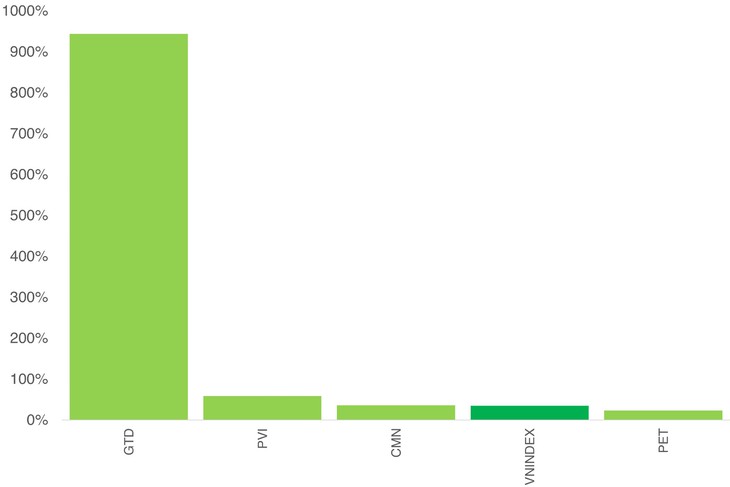
Cumulatively since the beginning of 2025, GTD has increased 10.4 times.
Previously, this stock also experienced a sharp increase of 109.52% in August 2025, indicating that investors had anticipated the divestment story early on.
Meanwhile, CMN has seen consecutive price increases over the past three months, bringing its full-year growth to 36.67%.
Overall, the wave of state divestment is showing signs of returning and is beginning to create an effect on the secondary market.
Will state divestment become a "public playing field"?
The vibrancy of these new deals also brings to mind stories that once "heated up" the market in the past, such as SAB, VCG, or DIG - where a segment of investors made profits by anticipating and seizing opportunities presented by state-owned capital divestments.
However, according to Mr. Nguyen The Minh, Director of the Individual Customer Research and Development Division of Yuanta Securities Vietnam, the phenomena at CMN or GTD are short-term and not suitable for the majority of investors in the market.
"These are event-driven opportunities with high profit margins but also high risks, requiring analytical skills and the ability to withstand volatility," Mr. Minh commented.
However, Mr. Minh noted that these developments could be the initial signs of a new wave of divestment, potentially becoming a major market theme in 2026.
Meanwhile, Mr. Bui Van Huy, Director of Research at FIDT, looked back at the 2016-2018 cycle and stated that the wave of equitization and divestment of state capital in large enterprises created a strong impetus for the stock market. Not only did this bring revenue to the budget, but it also listed many enterprises with large assets and revenues, thereby establishing a new market capitalization level for the VN-Index.
"Entering the 2026 period, if the restructuring of state capital is implemented more decisively, this could be one of the overarching themes of the market," Mr. Huy commented.
However, Mr. Huy emphasized that the key factor remains the quality of implementation. "If divestment is carefully prepared in terms of valuation, information transparency, and protection of minority shareholders' rights, investors will see this as a real opportunity, not just internal transfer deals," he said.
Could upcoming divestment deals be different from previous ones?
The Ministry of Finance is currently proposing a new mechanism for divestment, focusing on SCIC and HFIC. The draft is currently open for public comment and is expected to bring about many groundbreaking changes.
Some key points in the draft include:
Granting greater autonomy to SCIC and HFIC: Allowing them to independently determine the method, timing, and starting price for divestment based on market principles, significantly reducing their dependence on multi-layered administrative processes. Divestment will therefore shift from a "public asset management" mechanism to an investment-business mindset.
Flexibility in starting price: The draft allows for a maximum of three reductions in the starting price, each by a maximum of 10%. For loss-making businesses or those that have failed to win multiple auctions, the selling price may be lower than the par value, provided it is not lower than the book value after provisions or the average reference price over 30 days (if already listed).
Allowing block sales and sales bundled with underperforming assets : A new mechanism allowing block sales of multiple businesses (combining good and bad businesses), sales bundled with accounts receivable, or share swaps has been formalized, aiming to solve the problem of businesses that remain unsold.
Source: https://tuoitre.vn/thoai-von-nha-nuoc-co-tro-thanh-san-choi-dai-chung-20251221203909363.htm
































![[Photo] Reception to welcome General Secretary and President To Lam and his wife on their State visit to the Philippines](https://vphoto.vietnam.vn/thumb/1200x675/vietnam/resource/IMAGE/2026/06/01/1780295488620_vna-potal-chieu-dai-chao-mung-tong-bi-thu-chu-tich-nuoc-to-lam-va-phu-nhan-tham-cap-nha-nuoc-toi-philippines-8798060-7855-jpg.webp)








































































Comment (0)