

Mr. Phan Van Bit cultivated a 7-hectare custard apple orchard, with each fruit averaging 500-700 grams, yielding over 300 tons and generating more than 10 billion VND in revenue annually.
In early February, Mr. Bit, 62 years old, residing in Long Hung ward, O Mon district, Can Tho city, was busy with nearly 10 workers tending to, pollinating, fertilizing, spraying pesticides, watering, and harvesting his 7-hectare Thai custard apple (Queen custard apple) orchard, which was at its fruiting age.

"This Tet holiday, about five tons of custard apples are supplied to the market for people to display on their five-fruit trays, priced at 50,000 VND per kg. After that, there will be over 50 tons for the Lantern Festival (15th day of the first lunar month) at 60,000 VND per kg," Mr. Bit said, explaining that the high price lasts until mid-April in the lunar calendar because the supply of custard apples at that time is mainly from the Mekong Delta, making them unique to other regions. Prices are lower (30,000-35,000 VND per kg) during the rainy months and start to rise during the dry season.
Wiping away the sweat from his face, the sturdy, quick-moving farmer explained that the alluvial soil along the Hau River is very good and suitable for many crops. However, like many other farmers, his family has been growing watermelons, pomelos, longan, etc., for decades, but the income is only enough to live on and have a little extra. While rice farming is also profitable, it's not enough to cover household expenses.
In 2014, through an acquaintance's introduction, Mr. Bit went to the seedling capital of the Western region in Cho Lach district, Ben Tre province, to buy 250 custard apple saplings to plant interspersed in his family's 7,000 m2 (7 công) pomelo orchard. He was also the first farmer in the area to plant this new fruit tree variety, amidst skepticism and curiosity from many others.
After two years of care, the trees began to bear fruit, but because he didn't know how to manage them to produce the desired yield, he only harvested the first 5 tons of produce, selling it at 55,000 VND per kilogram.
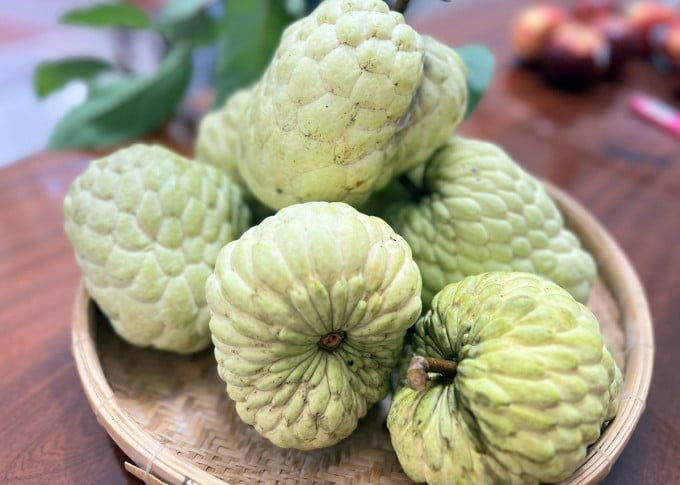
"Many other fruit trees only need chemical fertilizers to stimulate flowering and fruit setting for high efficiency. But for the custard apple, this method is not feasible; instead, pruning, shaping, and manual pollination techniques are necessary to determine yield and efficiency," he said. The orchard owner himself researched and learned from the internet, combined with visits to learn from custard apple orchards in the North, and based on the actual conditions in the locality, developed his own treatment methods.
"Harvest timing and pollination support are key factors in the success or failure of the crop," Mr. Bit affirmed, adding that it is necessary to calculate the ripening time for custard apples and harvest them from around the 15th day of the first lunar month to the middle of the fourth lunar month to fetch a high price.
Using this technique for pollinating custard apples, this farmer selects pollen grains from fully bloomed flowers that are yellowish-white in color, with stamens that have turned creamy white and anthers about to burst. He then uses a syringe to collect pollen grains and applies them to newly bloomed flowers, whose petals have just separated to produce fruit.
"You have to inject and rotate the syringe to get the pollen grains to stick to the stigma, and about a week later, young fruit forms," he said, adding that because of concentrated pollination, the fruits are round, large, well-proportioned, and very beautiful, weighing 400-700 grams each. It takes 95-110 days from pollination to harvest for custard apples. Common pests affecting custard apples are mealybugs and red spider mites. He has to check regularly to treat them early, preventing fruit from being attacked, which can lead to deformities and reduced quality.
By doing this, in the second harvest year, the farmer harvested 12 tons, selling them at 60,000 VND per kg. The product was of good quality, fragrant and delicious, and traders came directly to the farm to buy it at a high price, supplying the markets in Hanoi and Ho Chi Minh City.
Later, his family decided to gradually expand the area for growing this highly productive crop to 5 and 7 hectares of land, which had previously been used to grow watermelons and pomelos.
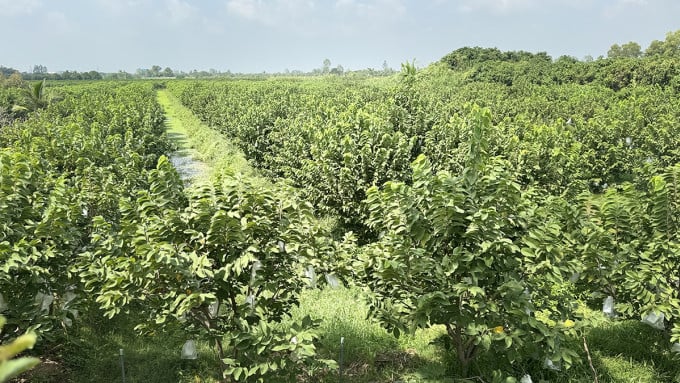
In subsequent harvests, yields gradually increased to 100, then 200 tons. "In 2024, when all 4,500 custard apple trees bear fruit, my family will harvest 250 tons. With an average selling price of 40,000-45,000 VND per kg, the revenue will be approximately 10 billion VND," Mr. Bit said. After deducting investment costs (seeds, fertilizers, pesticides, labor, etc.) of about 400 million VND per hectare, he earned a profit of over 6 billion VND.
This farmer has now leased an additional two hectares of land from local residents to continue growing custard apples, bringing his total area to 9 hectares. He also sells seedlings and provides technical guidance to local farmers. In the future, he aims to implement clean agricultural production methods to produce products that meet export standards...
Mr. Nguyen Van Thang, Chairman of the Long Hung Ward Farmers' Association, said that the locality has more than 1,100 hectares of agricultural land, mainly planted with fruit trees. Of that, more than 30 hectares are planted with Queen custard apple trees, yielding very good results, surpassing mangoes, longan, and oranges, and 5-10 times more profitable than rice cultivation. Each hectare of land planted with custard apple trees brings in a profit of 30-40 million VND per year, while rice cultivation yields less than 5 million VND. Among these, Mr. Bit is the pioneer in planting the Queen custard apple variety, achieving the highest yield and efficiency.
According to Mr. Thang, this crop brings high profits to farmers, and the market is stable. With favorable climate and soil conditions, the local authorities are encouraging the establishment of cooperatives, mobilizing people to invest in developing clean agriculture, registering growing areas, and building brands to enable export, expand markets, and increase profits for farmers.
Source
![[Photo] First session of the 14th Congress of the Vietnam Trade Union](https://vphoto.vietnam.vn/thumb/1200x675/vietnam/resource/IMAGE/2026/06/03/1780465947883_ndo_br_img-3852-jpg.webp)
![[Photo] General Secretary and President To Lam presides over a meeting with the Central Organizing Committee.](https://vphoto.vietnam.vn/thumb/1200x675/vietnam/resource/IMAGE/2026/06/03/1780482764658_a1-bnd-4741-3342-jpg.webp)
![[Photo] Secretary of the National Assembly Party Committee, Chairman of the National Assembly presides over the meeting of the Standing Committee and Executive Committee of the National Assembly Party Committee.](https://vphoto.vietnam.vn/thumb/1200x675/vietnam/resource/IMAGE/2026/06/03/1780480353201_ndo_br_bnd-2585-jpg.webp)










































![[Video] Sunset at Lap An Lagoon – Where the sun sets over the fishing nets](https://vphoto.vietnam.vn/thumb/1200x675/vietnam/resource/IMAGE/2026/05/31/1780192137701_beach-landscape-sea-water-nature-grass-745871-pxhere-com.jpeg)






























Comment (0)