

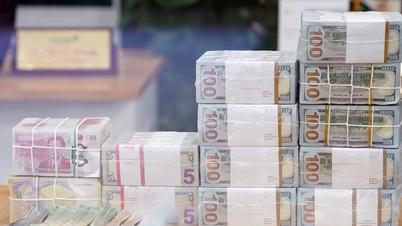
That's the paradox currently existing in the market: the two main sources of capital, public investment, are experiencing slow disbursement, while credit within the banking system remains constrained.
While the biggest challenge in Q1 2023 was accelerating the disbursement of public investment to create "seed capital" to stimulate aggregate supply and demand in the economy , currently, the banking sector is also concerned about a surplus of capital.
This sounds a bit strange because since the end of last year, businesses have been complaining bitterly about not being able to borrow money, with many companies on the verge of collapse due to a lack of capital. Recently, Prime Minister Pham Minh Chinh even had to speak out, urging banks to consider loosening monetary policy to provide capital to businesses. However, on the other hand, banks are also saying they are desperately searching for customers without success.
Why is it that supply and demand exist but cannot meet? Do banks really want to lend?
The answer is that banks naturally want to lend, because that is their most basic operation; they mobilize funds to lend, profiting from the interest rate differential. A large part of the banks' profits also comes from this. It's just a pity that in a special, unique context, lending conditions remain normal, so capital cannot flow out. Specifically, the economy, people, and businesses have gone through more than three consecutive years of difficulties, facing the pandemic and then the impact of the Russia-Ukraine conflict causing disruptions to global supply chains, not to mention domestic difficulties...
We all agree that the current difficulties are unprecedented. However, people and businesses wanting loans still need collateral, primarily real estate. Some banks are even stricter, only accepting real estate in Ho Chi Minh City as collateral, not in other localities. As for feasible projects and signed contracts with partners, forget about it; don't have any hope. Businesses also need to be profitable within one, two, or six months, but as mentioned above, the difficulties have entered their fourth year, so at this point, most businesses are just trying to survive, not hoping for profits. Therefore, loan applications are rejected before they even reach the banks. Gradually, businesses give up, doing whatever they can, and if things get too difficult, they temporarily suspend operations.
The consequence is a decrease in workers' incomes, an increase in unemployment, and a weakening of purchasing power. And weak purchasing power means even less demand for business expansion and increased production... So, at this point, saying that businesses are too weak to absorb capital is true, but that's the essence and the process. Simply summarizing it in one sentence isn't accurate.
In particular, the credit crunch will tighten even further when Circular 06 of the State Bank of Vietnam comes into effect in September, adding four more categories of entities ineligible to borrow from banks... Circular 06 has been analyzed by experts and businesses regarding its irrationality and the consequences of its implementation. More importantly, Circular 06 contradicts the government 's recent request to loosen monetary policy.
To reiterate, the lack of capital in banks will remain a paradox unless the barriers that the industry has erected for itself are removed. In this unique and special context, special thinking and solutions are needed. Otherwise, all efforts will fail to achieve the desired results if we ourselves are tying our own feet.
Source link





























































































Comment (0)