

| Export businesses are holding their breath, closely monitoring order situations. Businesses in Vietnam with women as owners account for 51%. |
In a recent interview with the Industry and Trade Newspaper, a representative of a business operating in the supporting industries sector stated that the opportunities for domestic businesses to participate in global supply chains are immense, especially given that many large corporations worldwide have chosen Vietnam as a "destination," investing billions of USD, even many billions of USD, in Vietnam to build factories and considering Vietnam as an important production "base" in their global supply chains.
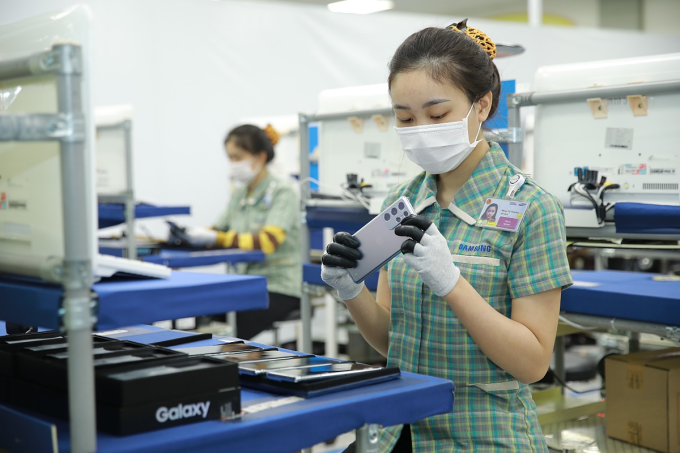 |
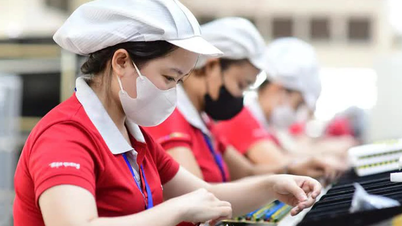
| Many global corporations choose Vietnam as a "destination" (Photo: SEVT) |
In particular, during the investment and business operations in Vietnam, many large global corporations have expressed their desire to find domestic suppliers of components and parts to reduce costs in terms of money and time for businesses that would otherwise be spent importing parts from abroad. A prime example is Samsung Group from South Korea, which has invested nearly $20 billion in Vietnam and has a presence in many provinces and cities such as Bac Ninh, Thai Nguyen, Hanoi , and Ho Chi Minh City.
In particular, the corporation is also very keen to find domestic manufacturers of components and accessories. To realize this desire, Samsung has collaborated with the Ministry of Industry and Trade in developing supporting industrial enterprises through the Smart Factory Development Cooperation Project in 2023 for businesses in the provinces of Bac Ninh, Hanoi, Ha Nam, Hung Yen, and Vinh Phuc. Prior to that, in 2020, Samsung Vietnam collaborated with the Ministry of Industry and Trade to launch the Southern Region Business Improvement Consulting Project in Vietnam...
It can be said that opportunities for Vietnam's supporting industries are wide open; however, seizing these opportunities is not simple, especially since, according to statistics from the Ministry of Planning and Investment, over 97% of Vietnamese businesses are small and medium-sized enterprises (SMEs). They are weak and lacking in many aspects, and as Dr. Nguyen Hoa Cuong – Deputy Director of the Central Institute for Economic Management Research (CIEM) – stated, "the first problem is where the money comes from" – a significant challenge for the SME sector.
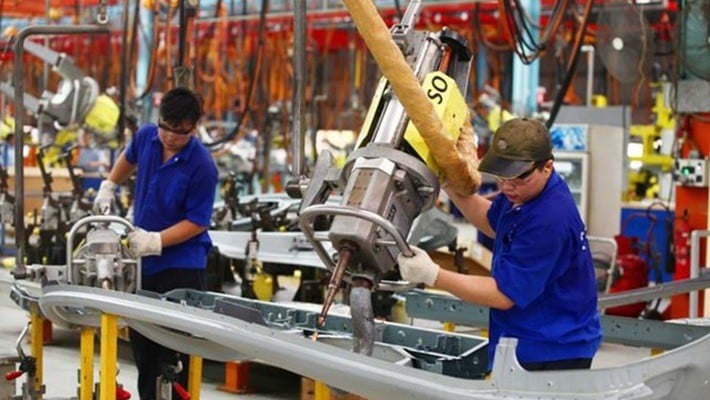 |
| Lack of capital causes businesses to miss opportunities to participate in global supply chains (Illustrative image) |
Mr. Luu Van Dai, Director of Metal Heat Vietnam Joint Stock Company, stated that: How to participate in the global supply chains of large corporations is a problem that many Vietnamese mechanical engineering businesses are struggling to solve. Businesses see many opportunities, but lack the capital to invest, and therefore lack the capacity to do so.
This challenge becomes even more difficult when products entering the supply chains of large corporations must meet at least two criteria: quality and price. This requires businesses to have good technology and find optimal production methods to reduce production costs and lower product prices. Good technology optimizes production, creating product lines with good quality and reasonable prices.
Many businesses believe that accessing or learning advanced technologies from around the world is not difficult for Vietnamese businesses, but capital is the biggest problem facing domestic mechanical engineering companies. Investing in new technologies requires significant funds, and small businesses often lack the financial resources to do so. Startups face even greater challenges in accessing such technologies.
Small and medium-sized enterprises (SMEs) in Vietnam often lack sufficient capital to invest in new technologies. Borrowing from banks presents numerous obstacles, not only due to high interest rates but also the requirement for collateral. Where would small businesses and startups find such collateral? How many businesses would dare to invest in new technologies under such circumstances? Furthermore, high bank interest rates necessitate higher selling prices, thus diminishing the competitiveness of domestic businesses compared to foreign companies.
In reality, the government has implemented many policies to support small and medium-sized enterprises (SMEs) with capital. However, in practice, businesses still face many difficulties and obstacles in accessing capital from banks, or even if they do access it, it incurs significant costs in terms of time and missed opportunities.
Accordingly, removing capital obstacles for small and medium-sized enterprises (SMEs) is currently considered one of the optimal solutions to create opportunities for businesses in particular and the economy in general. Businesses are the backbone of the economy, not only generating GDP growth but also creating jobs for workers.
Source
![[Photo] National Assembly Chairman Tran Thanh Man attends the groundbreaking ceremony for the National Highway 1A spatial axis project.](https://vphoto.vietnam.vn/thumb/1200x675/vietnam/resource/IMAGE/2026/05/19/1779161360398_ndo_br_bnd-1412-jpg.webp)
![[Photo] General Secretary and President To Lam presides over a meeting on the implementation of Directive No. 34-CT/TW of the Party Central Committee.](https://vphoto.vietnam.vn/thumb/1200x675/vietnam/resource/IMAGE/2026/05/19/1779187768672_a1-bnd-2350-631-jpg.webp)

![[Photo] Capturing the moment the tide recedes at Yen Binh Son rapids - a million-year-old scenic spot in Quang Ngai.](https://vphoto.vietnam.vn/thumb/1200x675/vietnam/resource/IMAGE/2026/05/19/1779175463885_yen9-1199-jpg.webp)




















































![[Photo] General Secretary and President To Lam receives Indian Defense Minister Rajnath Singh](https://vphoto.vietnam.vn/thumb/402x226/vietnam/resource/IMAGE/2026/05/19/1779184046302_anh-man-hinh-2026-05-19-luc-16-46-58.png)























Comment (0)