

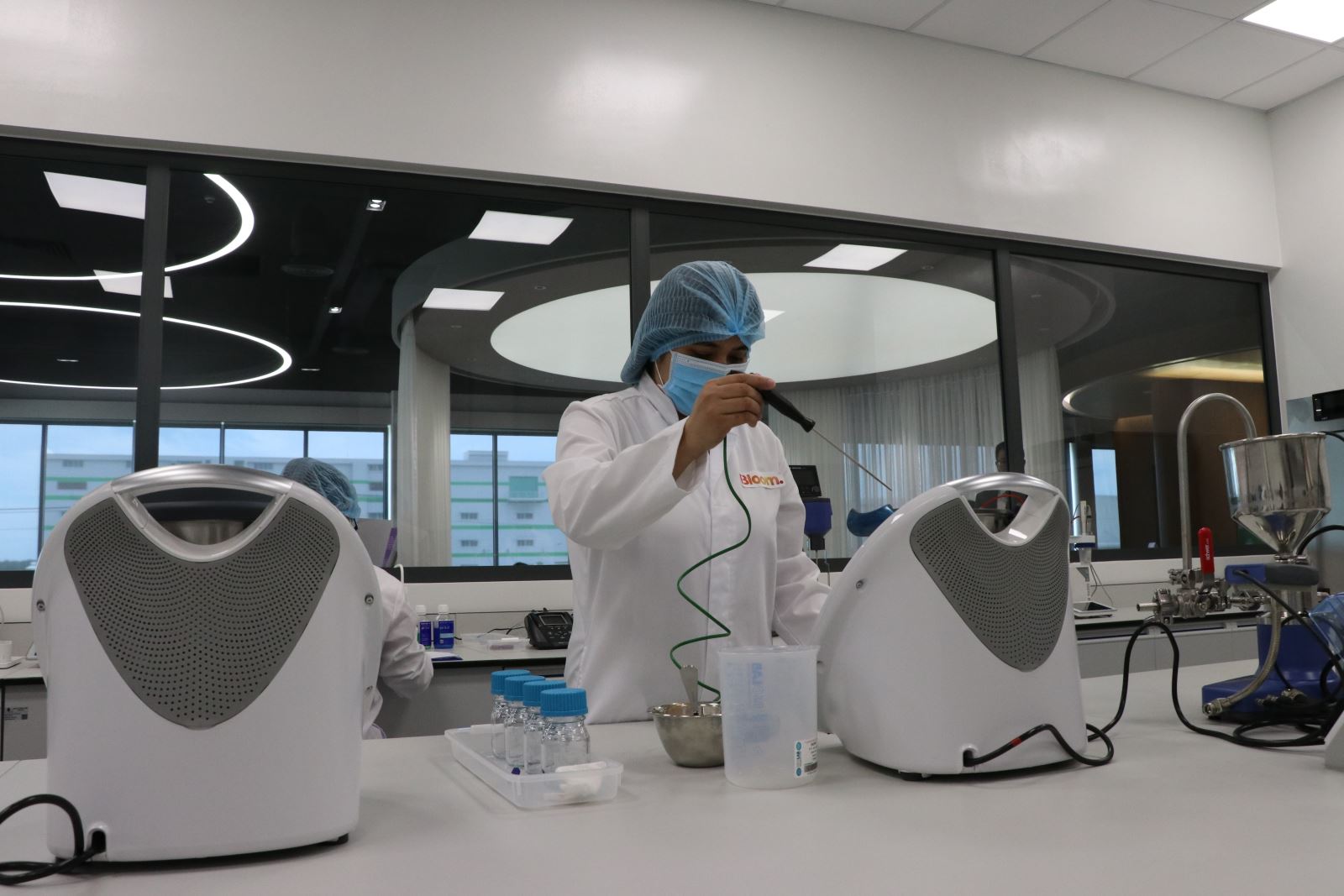
Vietnam's 10-year Socio -Economic Development Strategy 2021-2030 sets the goal of increasing average social labor productivity by over 6.5% per year. Vietnam has defined its perspective on reforming the growth model towards "gradually shifting from relying on increasing the quantity of production inputs to relying on increasing labor productivity and quality, applying science and technology, and innovation."
Recently, Resolution 57 of the Politburo on breakthroughs in national science, technology, innovation, and digital transformation set the following goals for 2030: The potential and level of science, technology, and innovation will reach advanced levels in many important fields, ranking among the leading countries in upper-middle income; the level and capacity of technology and innovation in enterprises will be above the world average; and some fields of science and technology will reach international standards. To achieve this goal, solutions to improve labor productivity and quality must be implemented and put into practice as soon as possible.
Factors that determine the competitiveness of an economy.
According to Dr. Tran Hau Ngoc, Vice Chairman of the National Committee for Standards, Metrology and Quality, in the context of international integration and fierce competition, labor productivity is the decisive factor in the competitiveness of the economy and individual businesses.
Data from the Vietnam Productivity Institute (National Committee for Standards, Metrology and Quality) shows that in the three years from 2020 to 2023, the labor productivity growth rate decreased compared to the previous period due to the impact of COVID-19 on business production, along with some political instability in the region and the world . During the period 2016-2023, Vietnam had an average labor productivity growth rate of 5.6% per year, which was recognized as one of the leading productivity growth rates in the Asian region. During this period, the average labor productivity growth rate of some countries was as follows: Singapore 3.3%/year, Malaysia 2.6%/year, Thailand 2.6%/year, Indonesia 2.4%/year, Philippines 2.8%/year, Brunei 2.5%/year, South Korea 3.8%/year, and Japan 0.2%/year.
The Secretary-General of the Asian Productivity Organization (APO), Dr. Indra Pradana Singawinata, noted that Vietnam currently faces many challenges in its development process, including a shortage of human resources, limited management capacity, and modest investment in research and development (R&D). While the overall plan to improve labor productivity through science, technology, and innovation has seen significant growth, limitations still remain.
According to Associate Professor, Dr. Vu Minh Khuong, Vietnam has made significant progress in boosting labor productivity in recent years. However, the current rate of productivity growth is still slow and not commensurate with its potential. Without a significant acceleration in productivity growth, Vietnam will find it difficult to achieve high-income status by 2045.
Making productivity the driving force for development.
Dr. Indra Pradana Singawinata believes that Vietnam has important foundations to continue improving productivity and achieving more development achievements in the future: a hardworking and diligent population; political, social, and economic stability; and a thriving economy with effective plans and roadmaps to achieve development goals by 2030 and 2045.
In the coming period, Vietnam needs to leverage its inherent advantages; build policies for human resource development, and create a favorable environment not only for domestic but also for foreign businesses to thrive. In addition, it is necessary to increase investment in research and development; strengthen linkages between research institutions and businesses, and support research and innovation activities. Furthermore, it is essential to standardize training programs, ensure equal access to quality human resources, and enhance transparency.
Vietnam also needs to build a national productivity improvement movement suitable to the new context, combining the restructuring of the productivity program content to suit the stages of development: "Productivity awareness - Support for productivity improvement - Self-investment in productivity improvement". Based on this, relevant agencies should develop productivity enhancement support programs that are focused and prioritized, and concentrate funding to achieve the best results.
Sharing the strategies and policies that the National Standards and Quality Measurement Committee is implementing to promote national productivity, Dr. Tran Hau Ngoc stated that, to concretize the guidelines in the Party Congress resolution, the Government and the Prime Minister have issued and organized the implementation of mechanisms, policies, strategies, and plans related to promoting productivity. Specifically, the National Program to Support Businesses in Improving Productivity and Product Quality in the period 2021-2030 (issued under Decision No. 1322/QD-TTg of the Prime Minister dated August 31, 2020 - Program 1322) aims to support businesses in improving productivity and product quality based on the application of solutions regarding technical standards and regulations, management systems, and productivity and quality improvement tools; This contributes to increasing the proportion of total factor productivity (TFP) in economic growth, improving the productivity, quality, efficiency, and competitiveness of the economy.
Alongside this is the Master Plan for Enhancing Productivity Based on Science, Technology, and Innovation for the period 2021-2030 (Decision No. 36/QD-TTg of the Prime Minister dated January 11, 2021), aiming to make productivity a crucial driving force for development in various sectors and fields. Simultaneously, the National Program on Increasing Labor Productivity by 2030 (Decision No. 1305/QD-TTg of the Prime Minister dated November 8, 2023) also sets the goal that by 2030, labor productivity will become a key driver for rapid and sustainable growth, effectively leveraging the opportunities of the Fourth Industrial Revolution; in which, improving the quality of market economic institutions, enhancing the quality of human resources, promoting regional linkages, developing science and technology, innovation, and digital transformation are the main pillars.
Recently, Resolution No. 57 of the Politburo set very specific goals for improving productivity and labor quality, such as: the contribution rate of total factor productivity (TFP) to economic growth should be above 55%. Currently, the Prime Minister has issued Resolution 03/NQ-CP to implement Resolution 57 of the Politburo. The Ministry of Science and Technology has also proactively developed a program to implement this Government Resolution.
In addition, the National Committee for Standards, Metrology and Quality has assigned the Vietnam Productivity Institute to research input factors to achieve future TFP growth, contributing to sustainable socio-economic development. Regarding specific solutions to improve national productivity, Dr. Tran Hau Ngoc suggested strengthening the development of institutional policies and laws, including the Law on Standards and Technical Regulations and the Law on Product Quality. It is expected that these two laws will be submitted to the National Assembly for approval at the 5th Session of the 15th National Assembly in 2025.
Source: https://doanhnghiepvn.vn/cong-nghe/thuc-day-nang-suat-quoc-gia-tu-loi-the-von-co/20250220101639908
































![[Photo] Reception to welcome General Secretary and President To Lam and his wife on their State visit to the Philippines](https://vphoto.vietnam.vn/thumb/1200x675/vietnam/resource/IMAGE/2026/06/01/1780295488620_vna-potal-chieu-dai-chao-mung-tong-bi-thu-chu-tich-nuoc-to-lam-va-phu-nhan-tham-cap-nha-nuoc-toi-philippines-8798060-7855-jpg.webp)



































































Comment (0)