

This afternoon (August 28th), the Vietnam Green Finance 2025 Conference was held, jointly organized by S&I Ratings Joint Stock Company and Fitch Ratings Inc - one of the three largest credit rating companies in the world .
Businesses are increasingly interested in ESG.
Globally, ESG (environmental, social, and corporate governance) has transcended mere trends to become a cornerstone of the business strategies of major corporations.
A 2023 report from McKinsey shows that 83% of the 2,000 global executives surveyed stated they had integrated ESG into their business strategy, not only for legal compliance but also to increase long-term value.
In Vietnam, green finance is considered key to realizing the green growth and sustainable development strategy. Although still a relatively new concept, Vietnam has made significant progress, especially in the context of economic integration and international commitments such as Net Zero 2050 at COP26.
According to PwC Vietnam, in 2022, only 35% of companies listed on the HoSE (Ho Chi Minh City Stock Exchange) had specific ESG plans. However, by 2023, this number had surged to 66% according to a KPMG survey, reflecting a significant shift in the awareness and actions of Vietnamese businesses.
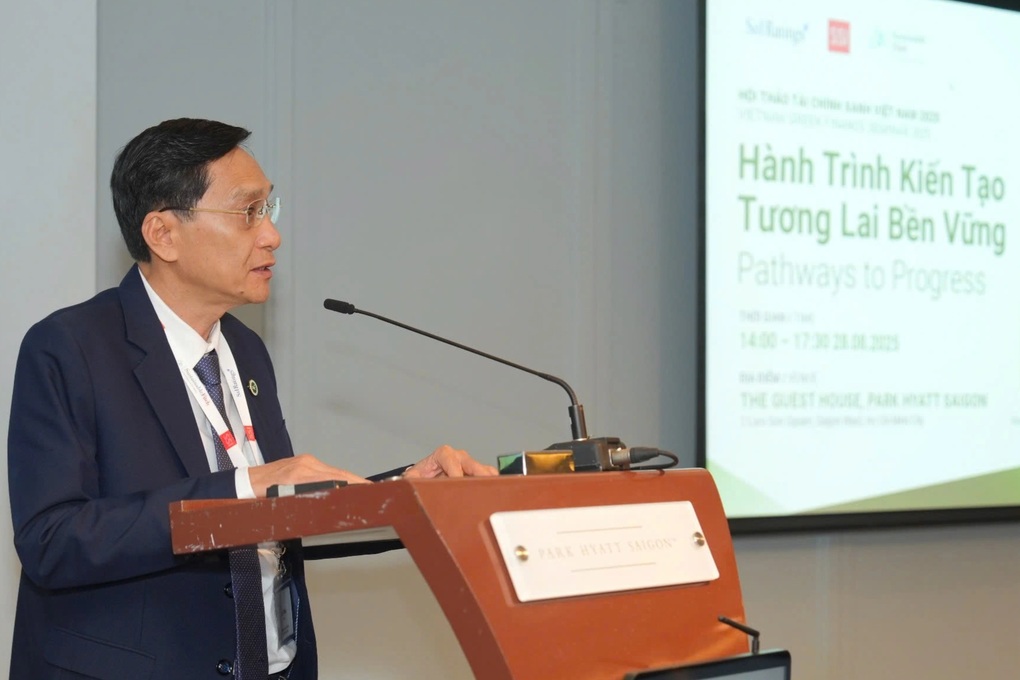
A representative from the State Securities Commission stated that green bonds are a unique financial instrument that helps businesses raise capital for green projects (Photo: Ministry of Finance).
Speaking at the seminar, Mr. Le Nhi Nang - Head of the Ho Chi Minh City office of the State Securities Commission (SSC) - acknowledged that in recent years, Vietnam has demonstrated a strong commitment to the international community on green development, especially the goal of achieving net-zero emissions by 2050 as stated in the declaration at COP26.
One of the green financial instruments currently being codified in the Environmental Protection Law is green credit and green bonds. Green bonds, as a specific financial instrument, not only help businesses raise capital for environmentally friendly projects but also create ripple effects for the community, contributing to the promotion of economic restructuring towards greening.
Mr. Nang stated that state management agencies have made many efforts in perfecting the legal framework. In particular, the promulgation of the Green Classification List under Decision No. 21/2025 of the Prime Minister is an important institutional step, helping to direct capital flows into priority sectors.
The State Securities Commission of Vietnam (UBCKNN) is also updating the Green Bond Handbook to address difficulties in accessing and implementing green financial instruments. These instruments are still relatively new and complex for many businesses, particularly regarding ESG disclosure requirements and post-issuance monitoring.
Sharing the same view, Ms. Hoang Viet Phuong, General Director of S&I Ratings, said that the business community's interest in green finance is also increasing. Banks are also actively working to provide capital with attractive incentives for businesses implementing ESG or complying with green regulations.
Businesses in the energy sector have the most access to green finance, followed by expectations of expansion into infrastructure, logistics, real estate, agriculture, and many other industries.
Challenges that need to be overcome
However, representatives from the State Securities Commission also frankly acknowledged the challenges existing in the green finance market. The cost of issuing green bonds is still not truly attractive compared to conventional bonds. The supporting ecosystem, including independent verification, green finance databases, and the application of digital technology in monitoring capital utilization, is still in the process of being formed.
To gradually resolve these obstacles, the Government recently issued Decree No. 119/2025, effective from August 1st, clarifying the scope of application and refining regulations for the development of the carbon quota and credit market in Vietnam, which is expected to be piloted in the near future.
Meanwhile, Ms. Viet Phuong argues that when accessing green funding, businesses must also invest costs and need a third party to verify compliance with ESG standards. Large businesses have implemented ESG because they recognize the long-term benefits.
She argued that if the business community continues to adhere to ESG standards and receives supportive policies from the government, it will gradually have a ripple effect. At that point, smaller businesses will also become interested and gradually adopt the ESG approach to access capital at lower costs.
At the same time, this individual also suggested that the government provide interest rate subsidies for loans to pioneering businesses implementing ESG, or continue to offer stronger tax incentives.
Source: https://dantri.com.vn/kinh-doanh/thuc-thi-esg-giup-doanh-nghiep-tiep-can-von-voi-chi-phi-thap-20250828191600395.htm
![[Photo] General Secretary and President To Lam presides over a meeting with the Central Organizing Committee.](https://vphoto.vietnam.vn/thumb/1200x675/vietnam/resource/IMAGE/2026/06/03/1780482764658_a1-bnd-4741-3342-jpg.webp)
![[Photo] Secretary of the National Assembly Party Committee, Chairman of the National Assembly presides over the meeting of the Standing Committee and Executive Committee of the National Assembly Party Committee.](https://vphoto.vietnam.vn/thumb/1200x675/vietnam/resource/IMAGE/2026/06/03/1780480353201_ndo_br_bnd-2585-jpg.webp)

![[Photo] First session of the 14th Congress of the Vietnam Trade Union](https://vphoto.vietnam.vn/thumb/1200x675/vietnam/resource/IMAGE/2026/06/03/1780465947883_ndo_br_img-3852-jpg.webp)


























































![[Video] Sunset at Lap An Lagoon – Where the sun sets over the fishing nets](https://vphoto.vietnam.vn/thumb/1200x675/vietnam/resource/IMAGE/2026/05/31/1780192137701_beach-landscape-sea-water-nature-grass-745871-pxhere-com.jpeg)







































Comment (0)