

Over the past century, the world has witnessed numerous technological breakthroughs that have altered the destiny of humanity and created immense wealth. But none have been as powerful, rapid, and focused as the current artificial intelligence (AI) revolution.
"Looking at over 100 years of data, no wealth has ever been created so quickly and on such a large scale," commented Andrew McAfee, principal investigator at the Massachusetts Institute of Technology (MIT). "There is no precedent."
McAfee's assessment is not an exaggeration. The AI craze is rapidly becoming the biggest wealth-generating boom in recent history. According to CB Insights, there are currently 498 AI "unicorns" (private companies valued at $1 billion or more) with a total market capitalization of $2.7 trillion. Even more astonishing, 100 of them were founded as early as 2023.
Massive funding rounds for startups like Anthropic, Safe Superintelligence, OpenAI, and Anysphere have created dozens of "paper" billionaires in just one year. This isn't just about numbers; it's about the rise of a new generation of tech elites who hold the key to shaping the future.
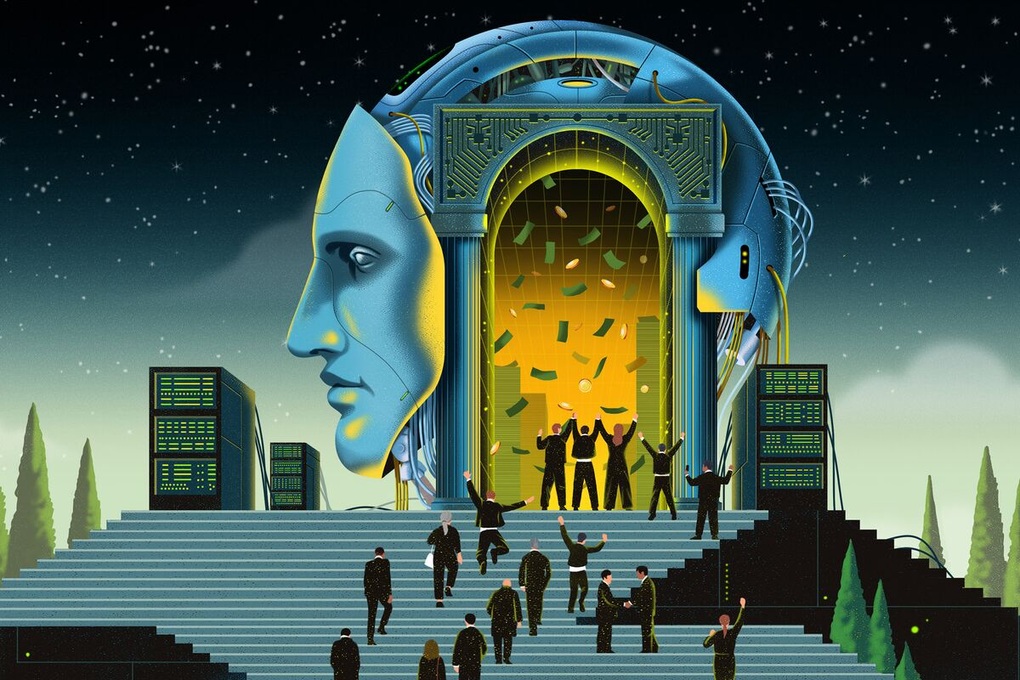
The artificial intelligence craze is rapidly becoming the biggest wealth-generating boom in recent history (Photo: Bloomberg).
Portraits of the new "gods" in the AI temple.
Unlike previous waves of technology, the AI billionaire empire is built on many different pillars, from those who create the hardware platform and develop groundbreaking language models, to those who apply AI to specific fields.
Hardware king: Jensen Huang ($113 billion)
Leading the pack and far surpassing the rest is Jensen Huang, CEO of Nvidia. If the AI revolution were a gold rush, Huang would be the one selling the pickaxes and shovels. Nvidia's graphics processing units (GPUs) have become the heart, the indispensable computing power, of every AI model.
The booming demand has pushed Nvidia's valuation to $4 trillion by July 2025, placing Huang among the top 20 richest people on the planet. He is the clearest example of the philosophy that in an arms race, the richest are the arms manufacturers.
AI pioneers who created these companies: Sam Altman ($1.9 billion) and Dario Amodei ($1.2 billion)
Sam Altman, CEO of OpenAI, is perhaps the most familiar face. While he doesn't directly own shares in OpenAI (a company valued at $300 billion), Altman's $1.9 billion fortune comes from his keen investment vision in startups like Stripe and Reddit, and his earlier sale of Loopt. He is an icon of leadership and vision in the AI era.
Meanwhile, Dario Amodei, who left OpenAI to found Anthropic, represents a different path: developing safe and ethical AI. With a company valuation of $61.5 billion, Amodei's $1.2 billion fortune is directly derived from his efforts to build a more responsible AI.
The young "gold digger" generation: Alexandr Wang ($2.7 billion)
At 26, Alexandr Wang is the world's youngest self-made AI billionaire. He realized that even the most intelligent AI models need carefully "labeled" data to learn from. Founded Scale AI at age 19, Wang focused on this fundamental yet crucial work, serving over 300 giant clients such as Google, Meta, and General Motors.
Owning a 14% stake in a $14 billion company, Wang is a role model for the younger generation of entrepreneurs who know how to find lucrative niche markets in a major revolution.
The disruptors and the smart applicators
The game isn't just for those who create platform models.
In China, DeepSeek's Liang Wenfeng ($1 billion) caused a sensation by launching a language model that could compete with ChatGPT but reduce computing costs by up to 80%, a move that sent Nvidia's stock plummeting 17% in a single day.
Yao Runhao (US$1.3 billion), CEO of Paper Games, demonstrates that AI can create entirely new entertainment experiences. His interactive dating game "Love and Deepspace" has attracted over 6 million monthly users by leveraging AI for storytelling, specifically targeting female gamers.
Even in a traditional industry like translation, Phil Shawe ($1.8 billion), co-CEO of TransPerfect, has turned AI into a core growth driver, helping the company achieve $1.3 billion in annual revenue.
Anatomy of a Boom: Paper Wealth and the Resurgence of Silicon Valley
One of the biggest differences between the AI craze and the dot-com bubble of the late 1990s is the way assets are created and held.
Much of the wealth of today's AI billionaires remains "locked" in private companies. Instead of rushing into IPOs, AI startups today can maintain their private status for longer thanks to abundant capital flows from venture capital funds, sovereign wealth funds, and family offices. Massive funding rounds are being conducted one after another, driving valuations to astronomical figures. Anthropic is negotiating to raise $5 billion with a valuation of $170 billion. OpenAI is proposed to be valued at $500 billion in a secondary share sale.
This creates a paradox: founders are billionaires on paper but may not have much cash on hand. However, a thriving secondary market is addressing this issue, allowing shareholders and employees to sell shares to other investors to create liquidity.
This craze is also dramatically reviving Silicon Valley. The AI wave has completely reversed the narrative of San Francisco's "declining spiral" just a few years ago.
Last year, Silicon Valley companies raised more than $35 billion in venture capital. San Francisco now has 82 billionaires, officially surpassing New York (66 billionaires). The millionaire population in the Bay Area has doubled in the past 10 years. Sales of homes priced over $20 million in San Francisco last year reached an all-time high, and the real estate market as a whole is recovering strongly.
McAfee commented: “What’s remarkable is how intensely concentrated this wave of AI is in one geographic area. For the past 25 years, many have argued that Silicon Valley is past its prime, but it remains true Silicon Valley.”
The future of AI assets: A historic opportunity and new challenges.
As AI companies begin their IPOs, a massive amount of assets currently held by private companies will become more liquid. This opens up a historic opportunity for the asset management industry. Private banks, brokerage firms, and consultants are scrambling to reach the AI elite to capture these potential clients.
However, these won't be easy customers to win over. Simon Krinsky, CEO of Pathstone, predicts this generation of AI billionaires may follow the path of those who rose to wealth during the dot-com era: initially, they will invest in similar technology companies through their networks. Many may even create their own AI-powered asset management tools, challenging traditional models.
But ultimately, after experiencing market fluctuations and realizing the risks of concentrating assets in a single industry, they will turn to professional services.
“After the crash of the early 2000s, many in the dot-com generation began to value diversification and hire professional management to protect themselves,” Krinsky said. “I predict the AI group will follow a similar trend.”
The AI revolution has only just begun. The billionaire-making machine is accelerating, and the people it is "producing" are not only shifting the balance of economic power, but may also redefine how the world perceives assets, investments, and wealth for decades to come.
Source: https://dantri.com.vn/kinh-doanh/thung-lung-silicon-tai-sinh-con-sot-ai-duc-nen-the-he-ty-phu-moi-20250810230752810.htm
![[Photo] Secretary of the National Assembly Party Committee, Chairman of the National Assembly presides over the meeting of the Standing Committee and Executive Committee of the National Assembly Party Committee.](https://vphoto.vietnam.vn/thumb/1200x675/vietnam/resource/IMAGE/2026/06/03/1780480353201_ndo_br_bnd-2585-jpg.webp)
![[Photo] General Secretary and President To Lam presides over a meeting with the Central Organizing Committee.](https://vphoto.vietnam.vn/thumb/1200x675/vietnam/resource/IMAGE/2026/06/03/1780482764658_a1-bnd-4741-3342-jpg.webp)




















![[Photo] First session of the 14th Congress of the Vietnam Trade Union](https://vphoto.vietnam.vn/thumb/1200x675/vietnam/resource/IMAGE/2026/06/03/1780465947883_ndo_br_img-3852-jpg.webp)


















![[Video] Sunset at Lap An Lagoon – Where the sun sets over the fishing nets](https://vphoto.vietnam.vn/thumb/1200x675/vietnam/resource/IMAGE/2026/05/31/1780192137701_beach-landscape-sea-water-nature-grass-745871-pxhere-com.jpeg)






























Comment (0)