

The team of scientists conducted an experiment called "Earthquake Fault Activation" (FEAR-2) at BedrettoLab – a laboratory located 1.5 km underground, utilizing the ventilation tunnel system leading to the Furka railway tunnel through the Alps. This was considered an ideal location for research because experts could directly access and closely observe how fault lines move.
Accordingly, scientists successfully triggered 8,000 small earthquakes in a monitored environment in southern Switzerland to gain further understanding of seismic activity, thereby helping to mitigate risks from natural and man-made disasters.
During a four-day test phase at the end of April, a team of dozens of European scientists pumped approximately 750 cubic meters of water into deep boreholes in the cliff face to stimulate the movement of an existing fault line, aiming to create a magnitude 1 earthquake.
As a result, the research team successfully triggered 8,000 small earthquakes in a highly monitored environment ranging from -5 to -0.14 on the Richter scale. Although the earthquakes did not reach the target magnitude of 1 on the Richter scale, the project leader, Professor Domenico Giardini at the Swiss Federal Institute of Technology (ETH Zurich), said this was a major success because the research was unprecedented in scale and depth in the history of geology.
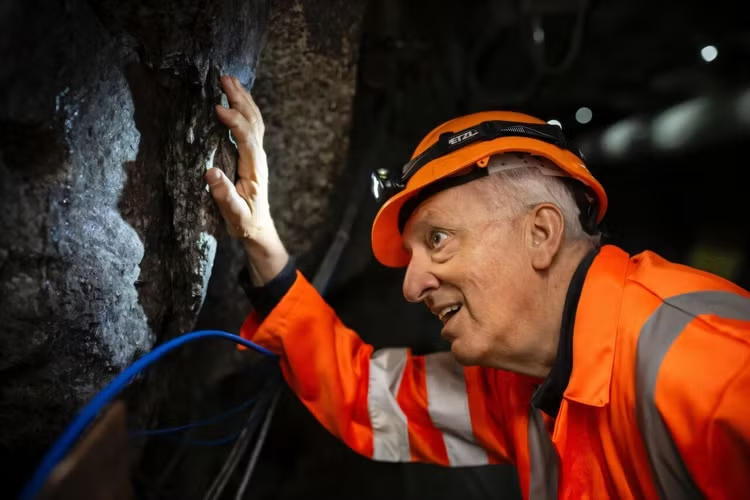
Typically, experts wanting to study earthquakes would place sensors near natural fault lines and wait. However, at BedrettoLab, the team installs sensors and other equipment in a pre-selected location, then attempts to trigger an earthquake within a monitored environment. They can proactively adjust technical parameters to study the Earth's crust's response to an earthquake. The entire operation is conducted remotely to ensure the absolute safety of the experts and scientists.
According to scientists, earthquakes below 0 on the Richter scale can still be felt. Anyone standing near the fault during the strongest earthquake triggered in the monitored environment, at -0.14, would feel an acceleration of "1.5 G," which is 1.5 times the standard acceleration due to gravity.
Experts say they will conduct another test at BedrettoLab next June to successfully trigger a magnitude 1 earthquake for further study and to gather more information about geological activity.
Professor Giardini stated that understanding how earthquakes are created on a certain scale could help find ways to prevent them from happening unintentionally. He also affirmed that the experiment in the Alps was completely safe and had no impact on the surface, as the research team only created about 1% more risk compared to natural disturbances.
Explaining the importance of this research, Professor Giardini said that understanding the mechanisms leading to earthquakes will help people better control future seismic risks and develop underground activities such as mineral extraction and geothermal energy development in a safer direction.
Source: https://khoahocdoisong.vn/thuy-si-kich-hoat-thanh-cong-8000-tran-dong-dat-nho-post2149099986.html


![[Photo] General Secretary and President To Lam presides over the meeting to approve the draft report on the results of the second inspection by the Politburo of the Standing Committee of the Hanoi City Party Committee.](https://vphoto.vietnam.vn/thumb/1200x675/vietnam/resource/IMAGE/2026/05/26/1779789811432_a2-bnd-4430-9620-jpg.webp)






![[GALLERY] USB-C AA batteries are causing a sensation because they're so convenient for tech enthusiasts.](https://vphoto.vietnam.vn/thumb/402x226/vietnam/resource/IMAGE/2026/05/26/1779798818575_p-png.webp)







![[GALLERY] Ubisoft suffers record losses, cancels 7 games, shocking the gaming industry.](https://vphoto.vietnam.vn/thumb/402x226/vietnam/resource/IMAGE/2026/05/26/1779805711288_uni-2-png.webp)








































































Comment (0)