


The inheritance and transformation between cultures have created a process of adaptation, shaping the identity of the Tra Kieu region - a multi-layered cultural space where traces of the past are still present in contemporary life.
A space where ancient cultures intersect.
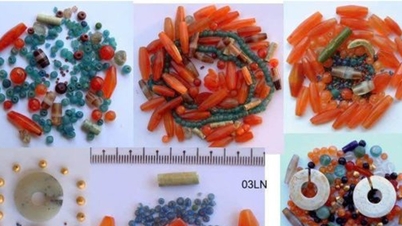
Archaeological excavations from the late 19th century to the present day reveal that Tra Kieu was one of the important cultural centers in Central Vietnam. At many sites such as Ma Voi Hill, Mieu Ong Hill, Bo Rang Hill, etc., researchers have discovered a system of burial jars along with many burial artifacts. These relics have been identified as belonging to the Sa Huynh culture, dating back approximately 2,000 - 2,500 years.
Through the study of artifacts in the cultural layer, archaeologists believe that the Sa Huynh people in the Thu Bon River basin had reached a relatively high level of economic and technological development. This created important prerequisites for the formation of political and economic centers in later periods. The artifacts discovered at Sa Huynh sites in the Tra Kieu area, such as pottery with square patterns in the Han style, bronze arrowheads, bronze spears, bronze mirrors, and ceramic seals (a type of sealing device from the Han dynasty), show an interaction between Sa Huynh culture and Han and Dong Son cultures.
In the early years of the Common Era, building upon the foundations of the Sa Huynh culture, rudimentary political entities emerged in the central region of Vietnam. From the late 19th to the early 20th centuries, French archaeologists studied the Tra Kieu area. In 1927-1928, J.Y. Claeys organized a large-scale excavation of Tra Kieu, through which he outlined the scale of the site and proved that Tra Kieu was indeed the Simhapura capital of the Champa kingdom.
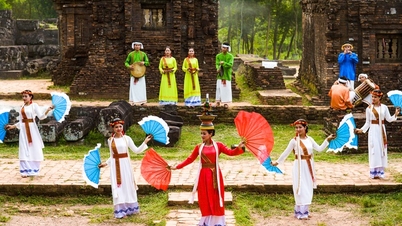
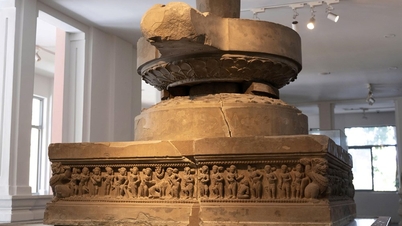
During the Champa period, this area contained many important religious structures. Archaeological evidence shows that at Tra Kieu there were temples and towers dedicated to Hindu deities alongside early Buddhist structures. Notably, the Indian religious elements did not exist in their original form but were localized and combined with the folk beliefs of the Champa people. This fusion created a distinctive religious form of the Champa kingdom.

From Simhapura to the Five Villages of Tra Kieu - Inheritance and Transformation
In 1471, following King Le Thanh Tong's southward expansion, many Vietnamese migrants from Thanh Hoa and Nghe An followed the troops to explore and cultivate new lands. Among those who pioneered the settlement, 13 were allowed to bring their families to settle and cultivate the land of the ancient Champa capital, forming Tra Kieu commune - an early village community in Quang Nam province. The initial boundaries of Tra Kieu commune were very wide, believed to be: South bordering Tao Son mountain (South encompassing Hon Tau mountain), North bordering Sai Thuy river (North blocking Cho Cui river), East bordering Que Son, West bordering Tung Son mountain (West bordering Duong Thong mountain).
During the process of cultural exchange and transformation, the Vietnamese people absorbed many handicraft skills and production experiences from the Champa people. Famous weaving villages such as Ma Chau, Thi Lai, and Dong Yen... inherited Champa weaving techniques, combining them with traditional Vietnamese weaving experience to create distinctive silk fabrics. Duy Xuyen silk not only served domestic needs but also participated in international trade routes in Southeast Asia.
After the Vietnamese settled, religious institutions characteristic of Vietnamese culture gradually formed and stabilized in community life. Among them, the village communal house and the ancestral temple of the Five Villages of Tra Kieu served as places to honor and commemorate the ancestors who contributed to the reclamation and establishment of villages in this area. In addition, Buddhism also developed quite extensively in the spiritual life of the Vietnamese people, as evidenced by the village temple of Tra Kieu. During the process of cohabitation and cultural exchange, the Vietnamese also worshipped some Champa deities.
By the 17th and 18th centuries, with the spread of Christianity by Western missionaries, Tra Kieu gradually became one of the important Catholic centers in Central Vietnam. Notably, the Christian faith in Tra Kieu was not separate from the local traditional culture. Within the Catholic community, many traditional Vietnamese customs, practices, and festivals were maintained alongside religious activities. This represented a harmonious blend of Western religious elements with the local cultural foundation.
***
From the Sa Huynh to Champa eras, followed by integration into the Dai Viet cultural space and later contact with Western culture, each historical period has left distinct imprints on the cultural structure of the Tra Kieu region.
Over five centuries have passed since this land belonged to Dai Viet, and despite many social changes, the close-knit traditions of the people of the Five Villages of Tra Kieu have been steadfastly maintained. The Five Villages of Tra Kieu Ancestral Temple remains a shared spiritual space for the community, a place of worship for the ancestors who contributed to the reclamation, establishment, and founding of the village. Every year, during the third lunar month, generations of the Five Villages' residents return here to offer incense, commemorate, and express gratitude for the merits of their ancestors.
Source: https://baodanang.vn/tiep-bien-van-hoa-บน-dat-tra-kieu-3330146.html
![[Photo] National Assembly Chairman Tran Thanh Man working with the Standing Committee of the Law and Justice Committee](https://vphoto.vietnam.vn/thumb/1200x675/vietnam/resource/IMAGE/2026/05/21/1779378929214_ndo_br_1-4610-jpg.webp)

![[Photo] General Secretary and President To Lam presides over a working session with the Central Policy and Strategy Committee on the development of the materials industry.](https://vphoto.vietnam.vn/thumb/1200x675/vietnam/resource/IMAGE/2026/05/21/1779359935432_a3-bnd-3129-1412-jpg.webp)






















































Comment (0)