
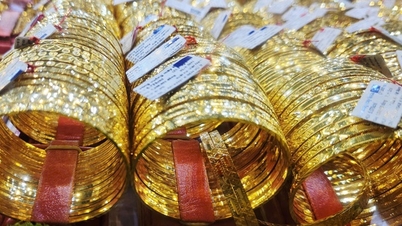
Jewelry crafted from gold and precious stones, found at the Lai Nghi archaeological site in Dien Ban Dong ward, is evidence of historical trade in Quang Nam province.
1. Quang Nam province is situated in a unique geographical location, nestled between the curved coastline of Southeast Asia jutting out into the open sea. It is bordered by deep bays and protected by islets and peninsulas. This natural characteristic has made Quang Nam a destination for travelers journeying from East to West, from islands to the mainland.
Several thousand years before Christ, migrations of Austronesian language groups from southern China to the Pacific islands resulted in a branch drifting ashore on the mainland of what is now Quang Nam province, creating early contact with the indigenous inhabitants speaking Austroasiatic languages.
Next came the reverse migrations of islanders to the mainland in the first few centuries AD, creating a multilingual, multi-ethnic community in central Vietnam in general and the Quang region in particular.
Merchants from South India, on their voyages to the Chinese market, also stopped along the coast of Quang Nam province, leaving behind their expertise in crafting jewelry from precious stones and glass beads, which became a distinctive feature of Quang Nam province during the early historical period.
In the era when sea travel was heavily dependent on monsoon winds and had to follow the continental coast, fleets of ships traveling from the Mediterranean and South India to China, or vice versa, had to stop at ports in central Vietnam, especially at Cua Han and Cua Dai, safely sheltered by the Son Tra peninsula and Cu Lao Cham island.
Jia Dan, a traveler of the Tang Dynasty (8th century, China), recorded his sea voyage from Guangzhou southward as follows: “From Guangzhou, traveling southeast by sea for two hundred miles, one reaches Mount Dunmen. With favorable winds, one travels west for two days to Jiuzhou Rock, then two more days to Elephant Rock. Continuing southwest for three days, one reaches Mount Zhanbulao, a mountain in the sea, two hundred miles east of the Huan Kingdom.”
“Chiêm Bất Lao” (占不勞) is the Chinese transliteration of “cham(pa)pura”; “Hoàn Vương” (環王) is a title used by Chinese historians to refer to a small kingdom in the ancient Quảng region (the Champa kingdom).

Jewelry crafted from gold and precious stones, found at the Lai Nghi archaeological site in Dien Ban Dong ward, is evidence of historical trade in Quang Nam province.
2. The Chiêm Bất Lao mountain range, located in the sea east of Hoàn Vương, is what is now Cù Lao Chàm. Numerous archaeological findings in Cù Lao Chàm and the coastal area of Hội An indicate that this area was once a resting place and a source of fresh water for passing ships in ancient times.
The fleets didn't just stop by, rest, and then leave. They came to exchange resources, bringing goods produced in distant lands to trade for gold, agarwood, and medicinal herbs—products native to the mountains and forests of Quang Nam province.
Merchants and clergy who arrived in the central coastal region of Vietnam in the early centuries AD also brought with them the influence of Hinduism, encouraging the emergence of a kingdom that tended to break away from the then-current Chinese cultural sphere of influence.
A culture that combined indigenous elements with Indian civilization, known as Champa, has left a rich cultural heritage in what is now Quang Nam province – not only in its temple architecture and religious sculptures, but also in its customs, beliefs, and way of life.
The conquests of the Đại Việt dynasties in the second millennium transformed Quảng province into a stepping stone for further southward expansion.
The marriage of Chế Mân and Huyền Trân in the early 14th century created a buffer zone in Quảng Nam, where strong interaction and transformation took place between the Champa and Đại Việt communities. Two hundred years later, the Nguyễn lords chose Thanh Chiêm Citadel as the capital for successive princes, with a vision of a Quảng Nam region extending to Đồng Nai .
From there, merchants from Japan and China stopped at Cua Dai, creating a bustling trading town in Hoi An. Western missionaries stopped at Cua Han and Thanh Chiem, leaving behind a system of Vietnamese writing, creating a turning point in the Vietnamese language and literature.
During the anti-colonial movement of the early 20th century, revolutionary activist Phan Boi Chau (from Nghe An province) stopped in Quang Nam province. Along with more than 20 intellectuals from various localities, they secretly met at the private residence of Tieu La Nguyen Thanh (Thang Binh commune) to establish the Duy Tan Society, initiating the Dong Du movement (Eastward Movement), with the aspiration to build an independent and powerful Vietnam.
Quang Nam's natural location has shaped it as a stopping point on historical journeys. These encounters and clashes have forged its resilient and adaptable character, making it tolerant and creative. Entering a new era, can Quang Nam leverage the legacy of this historical stopping point to prepare itself for its journey into the future?
Source: https://baodanang.vn/tram-tich-nhung-hanh-trinh-3324145.html





























































































Comment (0)