

What is AGI and how does it differ from current AI?
AGI (Artificial General Intelligence) is a term used to describe an AI system capable of understanding, learning, and performing a wide range of tasks, similar to humans. This concept emerged early in research to distinguish it from "narrow AI"—a type of AI that excels at only one specific task.
To put it simply, AI is currently generally divided into three levels. The most common is Narrow AI, which refers to systems that only handle a specific task, such as chatbots, image recognition, or language translation. This group can operate effectively within its trained scope but lacks flexibility when faced with new situations. Higher up is AGI – general artificial intelligence, which is expected to be able to perform many different types of tasks, with learning, reasoning, and adapting capabilities comparable to many human skills. However, there is still no consensus that AGI has actually emerged. At the highest level is ASI – Artificial Superintelligence, a concept referring to systems with intelligence surpassing humans in most areas. This remains a hypothesis and does not yet exist in reality.
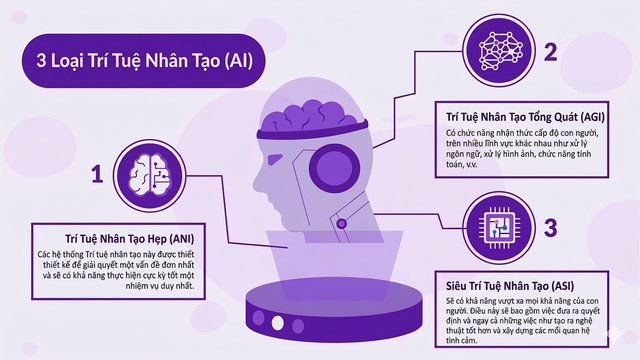
Classifying AI levels
PHOTO: CREATED BY AI
Meanwhile, AGI is expected to have more general capabilities. An ideal AGI system can learn new skills on its own without needing to rebuild from scratch, understand broad context, and apply knowledge across different fields. For example, instead of just writing content or analyzing data, AGI could simultaneously plan business strategies, develop products, and run an organization.
Simply put, if current AI is like a "one-task specialist," then AGI is like a "well-rounded human." However, to reach that level, the system needs to meet many criteria such as reasoning ability, adaptability to new situations, and continuous learning from experience.
Why is AGI still controversial?
These criteria make determining whether "AGI has been achieved" a controversial issue. Recently, Nvidia CEO Jensen Huang stated that AGI has emerged, but also acknowledged that current systems have not yet fully reached human capabilities. Examples given, such as AI platforms that create automated application-building agents or digital communities, show great potential but are not yet stable. Many projects only attract users for a short time before quickly losing momentum.
Furthermore, current AI still has clear limitations. These systems can generate misinformation, lack the ability to understand context deeply, and do not yet possess independent awareness. They also rely on large amounts of data and computing resources, rather than forming their own knowledge like humans do.
AGI remains a crucial goal in the technology industry. This concept is not only technically significant but also directly related to business strategy, investment, and competition among large companies. Many collaboration agreements even tie to "achieving AGI" milestones, demonstrating the significant influence of this term.
If AGI truly emerges, the impact could be far-reaching. This technology could dramatically increase labor productivity, automate many industries, and transform how businesses operate. At the same time, it also raises questions about control, safety, and the role of humans in the new work environment.
Source: https://thanhnien.vn/tim-hieu-ve-agi-cap-do-tiep-theo-cua-ai-185260329090532314.htm












































































































Comment (0)