|
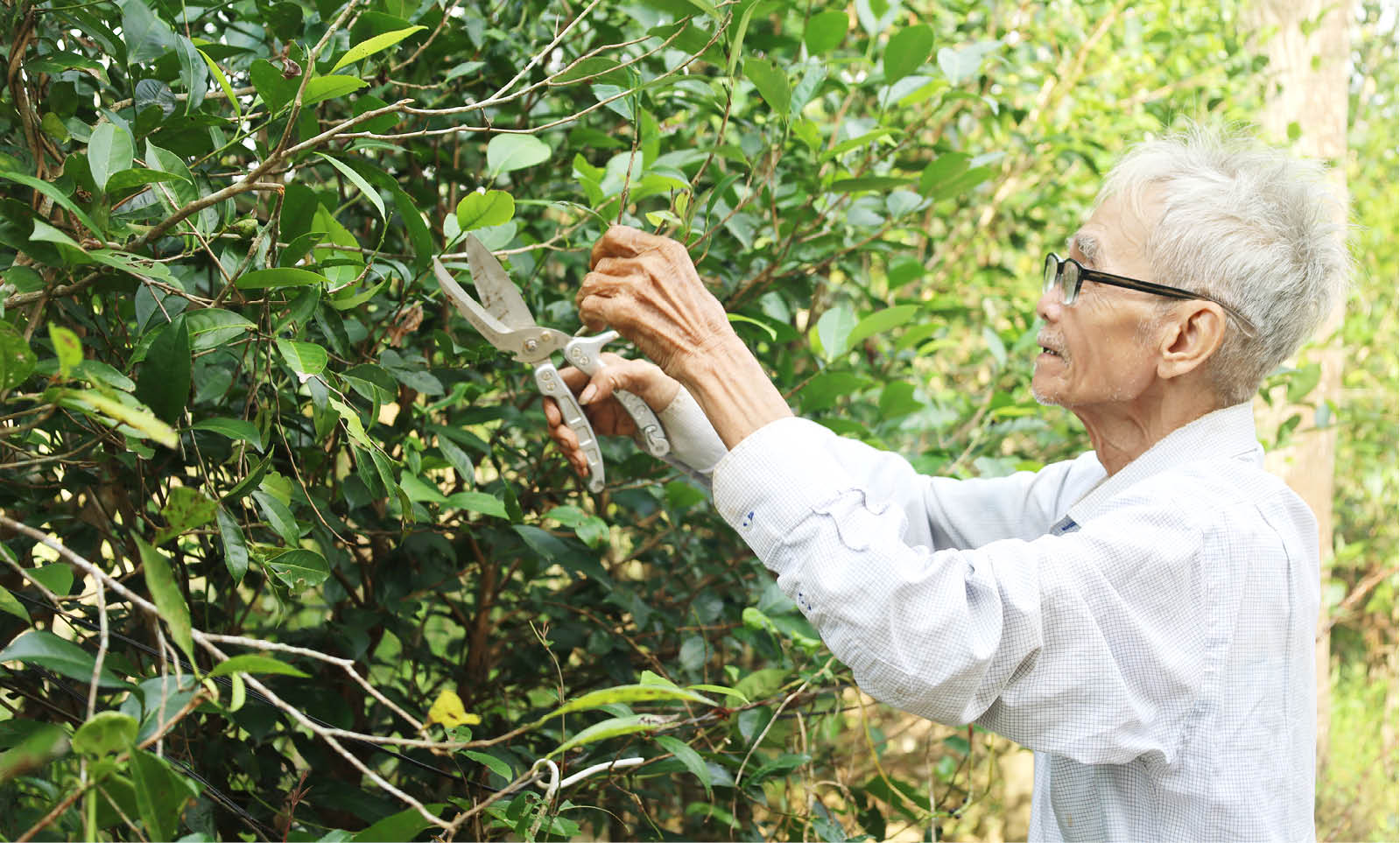
Mr. Nguyen Phan next to his tea garden. |
The area is gradually shrinking.
Early in the morning in Truoi, dew still clings to the tea buds. The once verdant green covering the hillsides is now thinning. In his garden of over 1.5 acres, 77-year-old Nguyen Phan and his wife meticulously pick handfuls of tea leaves and place them into a conical hat. Their calloused fingers seem to be touching a lifetime of connection with tea plants. "Back then, we made gold thanks to tea. So many people got an education because of tea. Now… we can't make a living from tea anymore," Mr. Phan said softly, his eyes distant.
Fresh tea leaves cost only 7,000-10,000 VND per kilogram, so cheap that only elderly people like Mr. Phan can afford to work with tea plants. However, even he once had to cut down 5 acres of tea plants to grow something else, a decision he described as "painful like cutting off a part of my memory."
As someone deeply attached to his homeland, Mr. Truong Thanh Tin, Head of the Economic Department of Loc An commune, is also very concerned. Before 2010, Truoi commune once had more than 10 hectares of tea plantations. "The saddest thing is that the tea area is shrinking day by day. On the old slopes, acacia trees are growing rapidly, replacing the lush green tea fields of the past," Mr. Truong Thanh Tin lamented.
The locals cherish the tea plants, but they face the worries of food, clothing, and money, forcing them to make a comparison: A day's work harvesting timber or stripping bark from melaleuca trees earns 300,000 dong; while a day of picking tea, from picking and bundling to selling at the market, only brings in about 100,000 dong. What was once a lucrative profession has become a means of survival, a job for the elderly who still cling to the past.
The main challenge for Truoi tea has been finding a market for many years. Fresh tea is only sold at local markets, harvested manually, resulting in low yields. To enter supermarkets or modern distribution channels, the tea needs to be processed and preserved for a longer period. For the locals, who are accustomed to harvesting and selling directly, processing technology remains a distant dream. Consequently, the ancient tea gardens, a treasure of generations' memories, face the risk of gradually shrinking.
According to Mr. Tin, the tea plantation area is now only about 5 hectares, a decrease of half in 15 years. The peak was in 2023, when people started selling tea tree stumps: each stump fetching 500,000 to 1 million dong. Elderly people in Truoi lament: At that time, seeing the tea tree stumps dug up felt heartbreaking, as if an entire heritage of their homeland had been reduced to a few banknotes. On the newly planted acacia hills, the old tea tree stumps remain, silently and sadly, as witnesses to a time of lush greenery.
Deep processing, increasing value.
Nevertheless, there are still people quietly seeking ways to "save" Truoi tea. One of them is Mr. Hoang Viet Thang. While many others abandoned tea cultivation, he began his journey of processing dried tea. In his Truoi An Linh tea production facility, machinery has been invested in. Tea leaves are imported, sorted, cleaned, enzyme-deactivated, rolled, dried, and then sorted again. Each batch of packaged tea is fragrant. "Truoi tea is very precious, so it needs a new path," Mr. Thang said, not forgetting to affirm his willingness to share his knowledge and guide others in investing in machinery. He believes that only when tea can reach further markets will growers be able to preserve their craft.
Not only did he find a solution for drying tea, Bui Nguyen Phuc, who has always been concerned about the tea plants of Truoi region, chose a bolder path. While the market price for tea is currently 7,000-10,000 VND/kg, he buys it at 15,000 VND/kg to encourage people to preserve the ancient tea gardens. From that tea, he researched and developed soap, matcha powder, and tea bags – modern products that meet customer needs. Bui Nguyen Phuc shared that once the process is complete, he will begin the procedures to apply for licenses to bring the products to market.
Not only focusing on commercial products, Mr. Phuc also proposed another direction: integrating Truoi tea into experiential tourism . He explained: Chan May Port, Bach Ma Mountain, Truc Lam Bach Ma Zen Monastery… all lie on a convenient route. If the ancient tea gardens are preserved, connected to tours, and the stories of the local people are told, Truoi tea will not only be an agricultural product but also a part of the culture. European tourists are fascinated by peaceful villages and traditional crafts; who knows, a new tourist destination might be formed from these old tea plantations.
Currently, local authorities are persistently encouraging people to preserve tea cultivation as a way of preserving their traditional heritage. Tea is not only a livelihood but also a memory, a legacy passed down through generations. For a long time, the area under tea cultivation has been affected by unstable product markets. When Truoi tea finds a new direction, expanding beyond traditional markets, people will be ready to return to tea cultivation, as if returning to the memories of their childhood.
Source: https://huengaynay.vn/kinh-te/tim-huong-di-cho-che-truoi-160551.html




























![[Photo] Reception to welcome General Secretary and President To Lam and his wife on their State visit to the Philippines](https://vphoto.vietnam.vn/thumb/1200x675/vietnam/resource/IMAGE/2026/06/01/1780295488620_vna-potal-chieu-dai-chao-mung-tong-bi-thu-chu-tich-nuoc-to-lam-va-phu-nhan-tham-cap-nha-nuoc-toi-philippines-8798060-7855-jpg.webp)
























































Comment (0)