

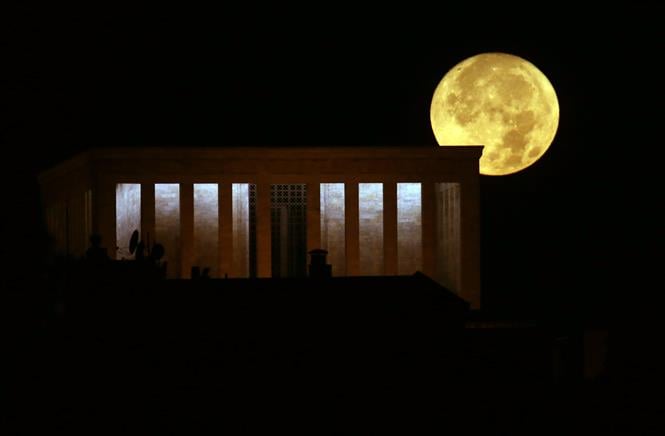
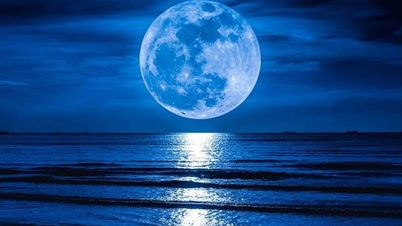
A Super Blue Moon in the sky over Ankara, Türkiye, on August 19, 2024. Photo: THX/VNA
On Sunday, May 31st (or April 15th in the lunar calendar), a rare phenomenon will appear in the night sky – the "blue micromoon". Let's find out what this term means and how to observe it, according to information from The Guardian (UK).
What does "Blue Moon" mean?
There are many ways to define a "blue moon".
“Perhaps the most common and simplest understanding today is what is called a ‘monthly blue moon.’ That’s when two full moons appear in the same calendar month,” said Dr. Greg Brown, an astronomer at the Royal Greenwich Observatory.
This is quite rare because the Moon takes about 29.5 days to complete a lunar phase cycle – the different shapes we observe from Earth. Therefore, there is usually only one full moon per month.
"But sometimes there are two, and the second full moon is called a Blue Moon," Brown said, adding that the phenomenon occurring on the 15th day of April falls under that category of Blue Moon.
Another type is called a "seasonal blue moon".
In this case, the term refers to the "extra" full moon that occurs within an astronomical season – the period between a solstice and an equinox, or between an equinox and a solstice.
“During those three months, there are usually three full moons, but sometimes there are four,” Brown explained. “And for some reason, the third one is called the blue moon.”
What is a micromoon?
This concept relates to the apparent size of the Moon as observed from Earth.
"The Moon isn't always at the same distance from Earth. Its orbit is elliptical," Brown said.
"If a full moon appears when the Moon is at its closest point to Earth, we call it a supermoon. If it appears when the Moon is at its farthest point from Earth, we call it a micromoon."
Although the name might lead many to imagine the Moon looking incredibly small in the sky, that's not actually the case.
Brown said the micromoon is only about 14% smaller than a supermoon and about 6% smaller than a regular full moon.
How rare are ultra-small blue moons?
"Blue moons" appear about once every few years, while "micromoons" occur two or three times a year.
According to Dr. Brown, this means that the "micro-blue moon" phenomenon only occurs about once every few decades.
However, they do not occur in a regular cycle. Sometimes the two phenomena happen closer together, and sometimes they are further apart.
Additionally, Brown stated that differences in time zones and the International Date Line can lead to disagreements among different regions of the world regarding whether a full moon should be considered a blue moon.
Based on the same definition applied to the upcoming phenomenon, Brown said the next occurrence in the UK could be in 2066. However, some other places in the world, including the US, will see the phenomenon sooner, in 2053.
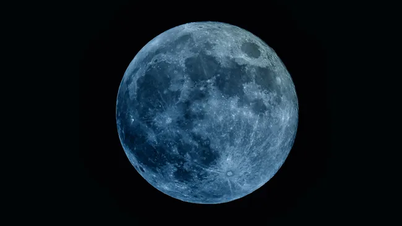
Is the Moon really blue?
The answer is no. However, there is another, unrelated phenomenon that could make the Moon appear blue.
According to Brown, this can happen when there are large wildfires or powerful volcanic eruptions.
"At that time, dust in the atmosphere could create a light scattering effect, causing the Moon to appear a pale blue," he said.
When is the best time to observe the "miniature blue moon"?
The exact time of the full moon on May 31st is 9:45 AM BST (UK Summer Time), which is 3:45 PM on the same day in Vietnam.
In England, the moon had long since set by then.
However, Brown said: "It will be almost indistinguishable from a full moon throughout the night before and almost all of the night after."
In other words, for the best viewing angle, astronomy enthusiasts should observe the moon on Saturday evening, May 30th, or Sunday evening, May 31st.
In the Northern Hemisphere, according to Dr. Brown, the Moon will be relatively low in the sky throughout the night, while in the Southern Hemisphere, the Moon will appear very high.
Could this phenomenon be related to the idiom "Once in a blue moon" (meaning "very rarely (does something happen)"?
It's difficult to confirm a connection. "It's true that Blue Moons are relatively rare, but occurring every few years isn't that unusual," Brown said.
He suggested that the idiom might originate from a much rarer phenomenon, when the Moon actually appears blue due to smoke or ash in the atmosphere.
Source: https://suckhoedoisong.vn/trang-xanh-sieu-nho-trong-ngay-ram-thang-tu-co-gi-dac-biet-169260531055757281.htm

![[Photo] Delegation attending the 14th Congress of the Vietnam Trade Union visits the Mausoleum of President Ho Chi Minh.](https://vphoto.vietnam.vn/thumb/1200x675/vietnam/resource/IMAGE/2026/06/03/1780451842301_ndo_br_img-3824-jpg.webp)
































































































Comment (0)