

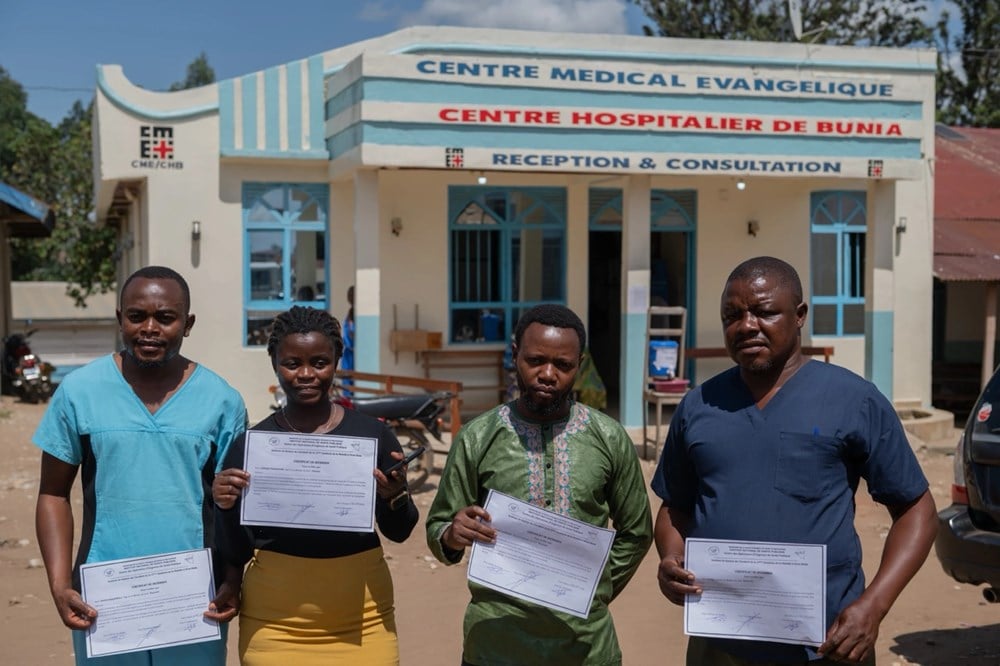
The Ebola outbreak is primarily concentrated in Ituri province in eastern Democratic Republic of Congo. The country has also reported more than 1,000 suspected cases of the Bundibugyo virus. Currently, there is no approved treatment or vaccine specifically for this strain of the virus.
According to health authorities in both countries, the outbreak has killed 42 people in the Democratic Republic of Congo and one person in Uganda.
Government data shows the outbreak has spread to 22 health areas across three eastern provinces of Congo. Meanwhile, the World Health Organization (WHO) is trying to highlight positive signs, such as the delivery of new shipments of medical supplies to health centers that are severely understaffed.
The Democratic Republic of Congo's Ministry of Health stated that the biggest challenge in controlling the outbreak in this remote area is the ability to detect and isolate cases early, trace contacts thoroughly, organize safe burials, and strengthen infection prevention and control measures in health facilities.
Meanwhile, the Coalition for Epidemic Preparedness Innovations (CEPI) announced it will commit up to $62 million in funding to accelerate the development of three experimental vaccines targeting the Bundibugyo virus strain.
Healthcare workers are a group facing a very high risk of infection. Over the weekend, the World Health Organization (WHO) reported that five healthcare workers had recovered from Ebola during a visit by WHO Director-General Tedros Adhanom Ghebreyesus. This also marked the opening of a new Ebola treatment center in Bunia, the capital of Ituri province.
Recent news has also brought many hopeful stories from recovering healthcare workers. One nurse said she felt "an indescribable joy" at having overcome the disease.
According to the World Health Organization (WHO), the Ebola virus spreads through close contact with the bodily fluids of infected or deceased individuals. Current treatment focuses primarily on controlling and alleviating symptoms.
“Your courage gives hope, and your stories of survival show that this outbreak is entirely containable,” WHO Director-General Tedros Adhanom Ghebreyesus emphasized during his visit to the Democratic Republic of Congo.
According to Dr. Dieudonne Mwamba Kazadi, Director-General of the National Institute of Public Health of Congo, this is a strong message showing that people can absolutely recover after contracting Ebola.
During this outbreak, Uganda recorded nine cases of Ebola and decided to close its border with Congo to limit the risk of spread. Although Congo and Uganda have experienced more than 20 Ebola outbreaks in the past, the Bundibugyo strain of the virus is still considered relatively rare.
Source: https://baovanhoa.vn/doi-song/so-ca-mac-ebola-tai-chdc-congo-len-toi-hon-300-nguoi-233595.html


![[Photo] First session of the 14th Congress of the Vietnam Trade Union](https://vphoto.vietnam.vn/thumb/1200x675/vietnam/resource/IMAGE/2026/06/03/1780465947883_ndo_br_img-3852-jpg.webp)






































































Comment (0)