

Tan Thanh commune has nearly 8,000 hectares of forest and forestry land, accounting for over 88% of its total natural area. Of this, nearly 2,300 hectares are planted forests. Most villages in the commune have planted forests, but they are mainly concentrated in Sy, Thanh Long, and Kien Trinh villages.
Sy village is considered the "capital" of planted forests in Tan Thanh commune, with over 1,000 hectares. The villagers began planting forests in the early 2000s when many households from Kien Trinh village settled there and were allocated land for production by the government.
Village head Sy Dinh Huu Linh said: “In the past, the lives of the villagers were very difficult, mainly relying on slash-and-burn farming, with unstable incomes. When they were allocated land and forest, people started planting acacia and eucalyptus trees. Initially, the scale was small, but after seeing the effectiveness, they gradually expanded. To date, many households in the village have 10-15 hectares of planted forest, with an average annual income of 300-400 million VND.”
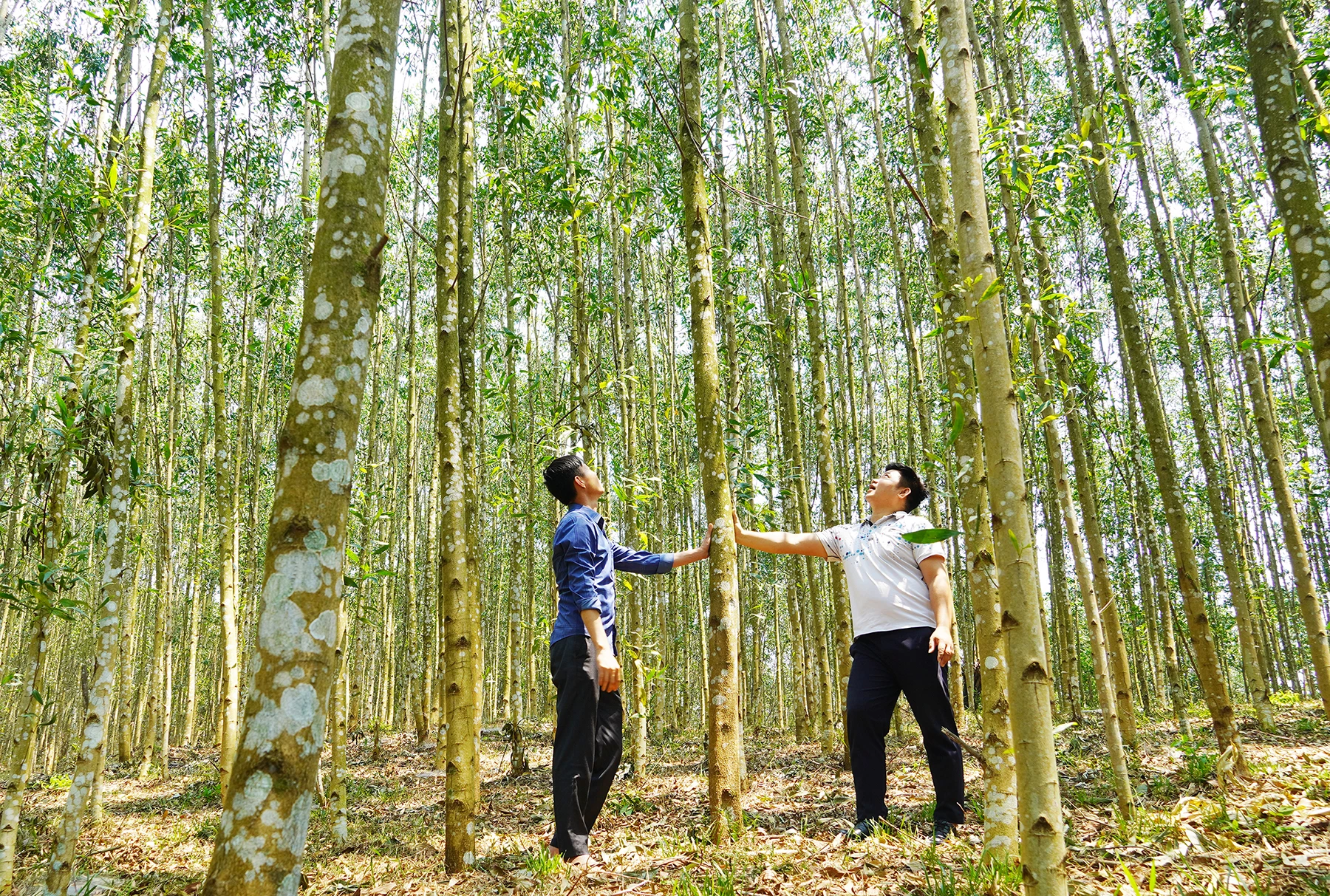 |
| The planted forests are bringing high income to the people of Tan Thanh commune - Photo: XV |
According to Mr. Linh, the encouraging thing is that many households have focused on improving the quality of their planted forests, such as investing in planting forests using tissue culture, and switching to planting large timber forests to increase economic value and extend the harvesting cycle. Many households invest in good care, keeping the forest for a few more years to sell at a higher price. Thanks to forest planting, most people in the village have been able to build spacious houses, buy many expensive items, and the number of poor households has decreased significantly compared to before.
The family of Mr. Dinh Thanh Hung is one of the exemplary households in forest economic development in Sy village. He currently owns about 15 hectares of planted forest, mainly acacia and melaleuca trees, yielding an average income of about 400 million VND per year. “Previously, our family's finances were difficult. Since planting the forest, my family has had a stable income. Now I am gradually shifting to planting tissue-cultured trees, extending the harvesting period to develop larger timber forests so that we can sell them at higher prices,” Mr. Hung shared.
Not only in Sy village, but the reforestation movement in Thanh Long village is also thriving. The locality has nearly 160 hectares of planted forest, creating stable livelihoods for many households. Mr. Dinh Quy Quyen, a resident of Thanh Long village with 5 hectares of planted forest, said: “Previously, my family was in difficult circumstances, with our main source of income relying on unskilled labor. After many years of investing in reforestation, our family's economy has gradually stabilized, and we have been able to build a decent house.”
To develop the forest economy in a sustainable direction, the People's Committee of Tan Thanh commune is encouraging people to switch from planting short-cycle forests to planting large-timber forests, using high-quality seedlings; coordinating with relevant units to issue forest certificates to people; developing economic models under the forest canopy, such as: livestock farming, beekeeping for honey production, and growing medicinal plants to increase income. Along with that, the locality is also focusing on forest protection and forest fire prevention and control.
Chairman of Tan Thanh Commune People's Committee, Dinh Van Chinh, stated: “We have determined that developing the forest economy is not only aimed at increasing people's income but also at protecting the ecological environment, reducing the risk of natural disasters, protecting water resources, and creating a foundation for long-term sustainable socio-economic development. Therefore, the locality will continue to leverage its land advantages, promote production linkages, develop forest product processing, replicate economic models under the forest canopy, and create value chains in forestry production.”
It can be affirmed that, thanks to the lush green forests, the lives of the people of Tan Thanh are gradually changing. Forestry-based economy not only helps many households rise out of poverty and achieve legitimate wealth, but also contributes to creating a vibrant new rural landscape, aiming for long-term sustainable development.
Viet Ha
Source: https://baoquangtri.vn/kinh-te/202606/trong-rung-theo-huong-ben-vung-e97479b/
![[Photo] First session of the 14th Congress of the Vietnam Trade Union](https://vphoto.vietnam.vn/thumb/1200x675/vietnam/resource/IMAGE/2026/06/03/1780465947883_ndo_br_img-3852-jpg.webp)












































![[Video] Sunset at Lap An Lagoon – Where the sun sets over the fishing nets](https://vphoto.vietnam.vn/thumb/1200x675/vietnam/resource/IMAGE/2026/05/31/1780192137701_beach-landscape-sea-water-nature-grass-745871-pxhere-com.jpeg)


























Comment (0)