


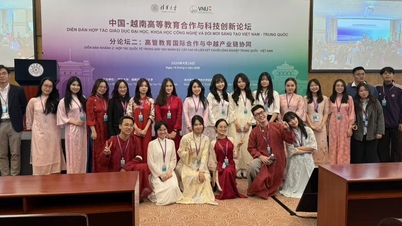
According to the Chinese Ministry of Education , prior to the Covid-19 pandemic, China attracted over 490,000 international students from approximately 200 countries and territories, ranking first in Asia and among the world's largest study destinations. After a period of decline due to border closures during the Covid-19 pandemic, China is now accelerating the recovery of international student flows by expanding scholarships, easing visa requirements, and developing English-language training programs.
In 2025, China continued to increase its education budget to over 4% of GDP, prioritizing artificial intelligence, semiconductors, robotics, new energy, and biomedicine. A number of universities, such as Tsinghua University, Peking University, and Zhejiang University, continuously improved their positions in international rankings. In the QS World University Rankings 2025, many Chinese universities entered the top 50 globally in engineering, computer science , and technology.
One of China's major advantages is its competitive cost of education. University tuition for international students typically ranges from $2,000 to $6,000 per year, significantly lower than in the US, UK, or Australia. The cost of living in many cities outside Beijing and Shanghai is also considerably lower than in Western educational hubs. Furthermore, China maintains tens of thousands of government scholarships each year for students from Asia, Africa, and Latin America.
United Nations data shows that Asia is becoming a new hub for international education as the demand for technology-related skills increases sharply. China wants to capitalize on this trend to compete directly with traditional destinations. It has already signed hundreds of agreements on degree recognition and training cooperation with many countries under the Belt and Road Initiative. Besides education, the strategy to attract international students is also linked to the need for high-quality human resources for its technology-driven economy. China is currently a major market for electric vehicles, e-commerce, artificial intelligence, and smart manufacturing.
However, China's internationalization of education still faces many challenges. Language barriers and cultural differences continue to limit its ability to attract students from the West. Furthermore, geopolitical competition and debates related to the academic environment also affect the image of Chinese education in some developed countries. Nevertheless, the trend of expanding China's educational influence is becoming increasingly evident, and the country could become a new growth pole for global higher education in the next decade.
Source: https://www.sggp.org.vn/trung-quoc-day-manh-mo-cua-giao-duc-bac-cao-post851759.html
![[Image] Close-up view of the interchange connecting the two expressways and Long Thanh Airport.](https://vphoto.vietnam.vn/thumb/1200x675/vietnam/resource/IMAGE/2026/05/25/1779703378210_ndo_br_z7863716673926-224453a31600126cce10622af6290afd-4549-jpg.webp)


![[Image] Hanoi's urban life under the challenge of a "scorching hot" environment](https://vphoto.vietnam.vn/thumb/1200x675/vietnam/resource/IMAGE/2026/05/25/1779706979265_nang-nong-t5-2026-minh-duy-7-4636-jpg.webp)









































































Comment (0)