

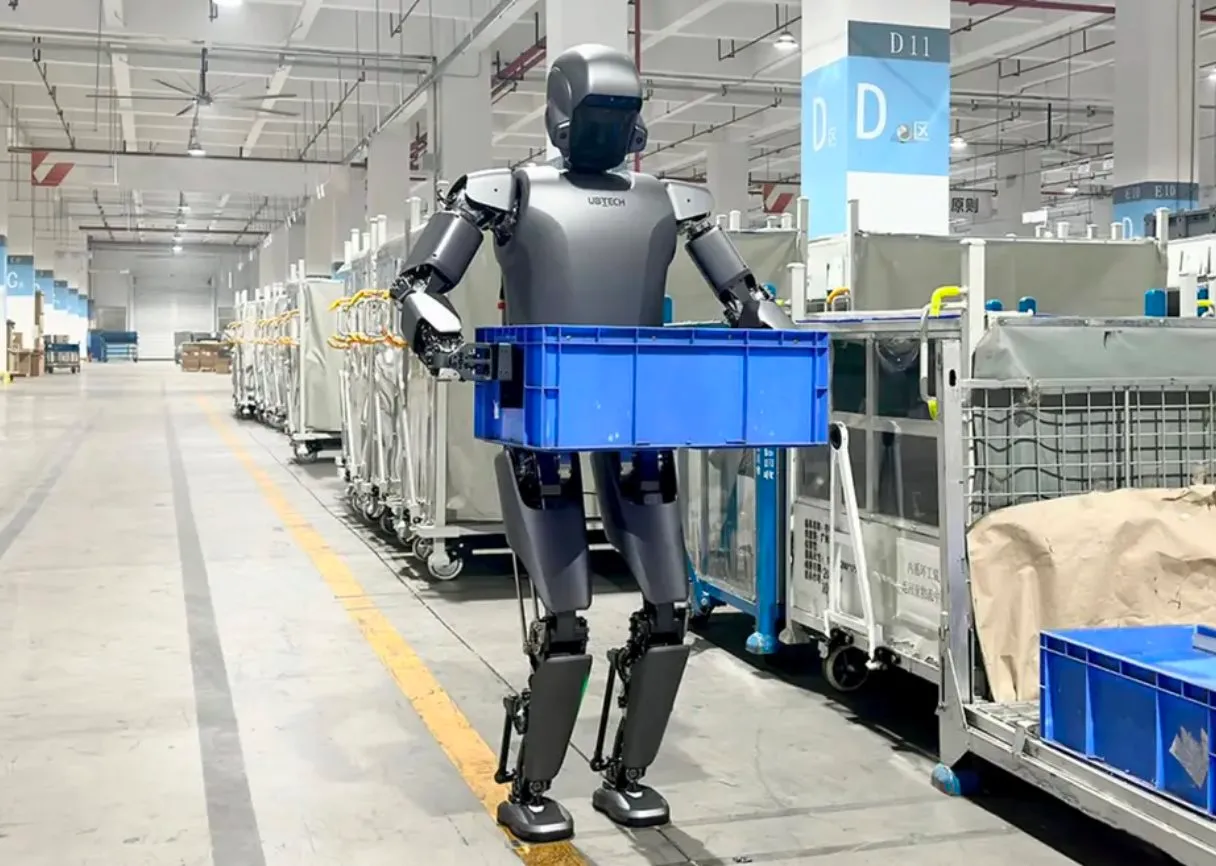
Chinese humanoid robot.
Currently, the global humanoid robotics industry is experiencing a strategic opportunity, characterized by rapid technological innovation, strong expansion of production capacity, and large-scale application scenarios. By 2025, China's humanoid robotics industry had boomed, rising to account for over 90% of total global robot shipments. Chinese domestic companies have completely dominated the market in terms of both production volume and commercialization scale.
Along with the large-scale deployment of humanoid robots, a series of new challenges have emerged. For example, businesses using different coding rules make it impossible to achieve consistent identity recognition and identification across businesses, industries, and situations; the massive influx of humanoid robots into manufacturing, daily life, and public spaces continues to increase pressure on security and social control; blurred lines of responsibility throughout the entire chain easily lead to problems such as evasion of responsibility and a lack of traceability...
To address these issues, Vu Tu Minh, Vice President of the China Institute of Electronic Technology Standardization Research, stated that in the future, each humanoid robot will have a unique, unchangeable "identification code" that will last throughout its lifespan. After extensive discussions with major manufacturers, this encoding system was finally determined to consist of 29 characters, divided into four parts, forming the "citizen ID card" of the humanoid robot and serving as the basis for a full-chain traceability system.
It is known that the product identification code consists of four parts: the country code, consisting of two characters, clearly indicates the product's origin, facilitating cross-border traceability and product export; the company name code, consisting of four characters, uniquely identifies the manufacturer, ensuring authenticity and accountability; the product code, consisting of six characters, represents the machine type and technical specifications of the product, clearly indicating the product category and production date; and the serial number, consisting of 17 characters, uniquely identifies a product of the same machine type, enabling accurate traceability down to each individual product from production to recycling.
Mr. Vu Tu Minh stated that by using unique identification information encryption, humanoid robots are equipped with social attributes, allowing them to be consistently controlled across various fields, industries, and locations. This addresses core issues such as safety, management, and governance, while accelerating the application and deployment of humanoid robots.
PUBLIC DECLARATION
Source: https://baocantho.com.vn/trung-quoc-se-som-cap-can-cuoc-cong-dan-cho-robot-hinh-nguoi-a205753.html
![[Photo] Standing Committee member of the Party Central Committee Tran Cam Tu working with the Central Inspection Committee](https://vphoto.vietnam.vn/thumb/1200x675/vietnam/resource/IMAGE/2026/05/28/1779969579668_ndo_br_bnd-2495-jpg.webp)


























































































Comment (0)