

 |
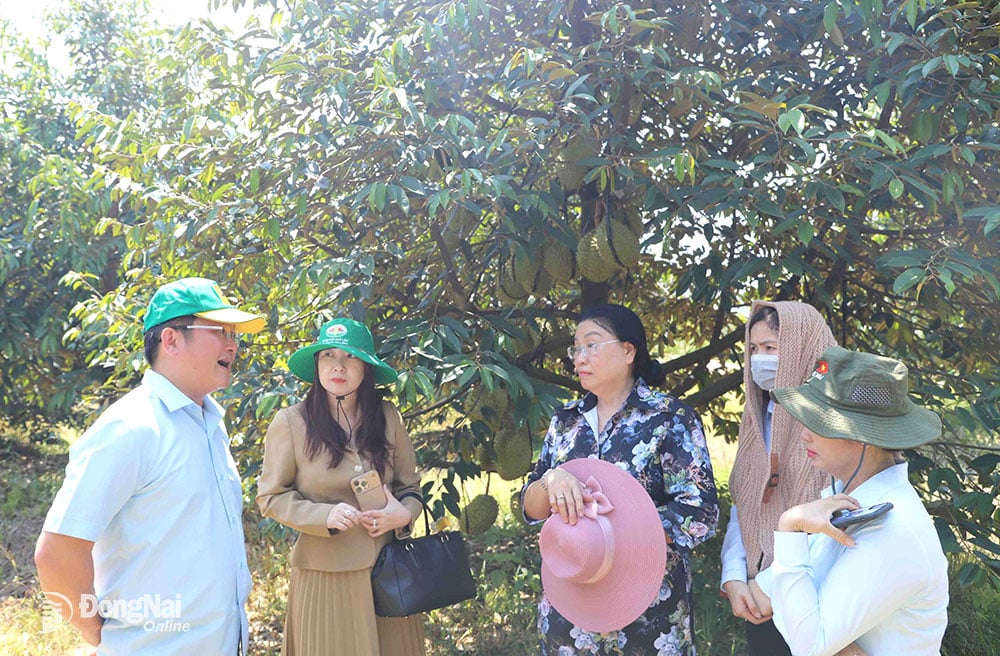
| Exporting businesses visit durian growing areas in Phu Son commune, Tan Phu district. Photo: B. Nguyen |
According to export businesses, the durian export market is being tightened by technical barriers, leading to a decrease in export volume. As a result, domestic durian prices have dropped sharply, making it difficult to find buyers.
Export bottlenecks
According to the Vietnam Fruit and Vegetable Association, fruit and vegetable export turnover in the first quarter of 2025 reached US$1.14 billion, a decrease of 11.3% compared to the same period in 2024. Durian exports, in particular, experienced a sharp decline. In the first two months of 2025, durian export value reached over US$52.7 million, a decrease of 69.4% compared to the same period last year. Exports to China alone decreased by 83%, to only US$27 million. Durian, once the leading export fruit, has now fallen to third place, behind dragon fruit and bananas.
After two years of strong growth in durian exports to China, since the beginning of this year, regulations on durian exports to China have been tightened, ranging from controlling growing areas and packaging facilities to food safety inspections.
| The Provincial Farmers' Association, in coordination with the Department of Agriculture and Environment and the Tan Phu District Farmers' Association, recently organized a program to connect durian-growing regions with durian export companies in Ho Chi Minh City. According to the Chairman of the Provincial Farmers' Association, Nguyen Huu Nguyen, the connection between export and product testing businesses and the province's durian-growing regions aims to find solutions for sustainable market access for durian. |
According to Tran Thi Thanh Dung, Director of Thinh Bach Import-Export Co., Ltd. (in Ho Chi Minh City), the company is currently processing fresh, frozen, and processed durian. For the 2025 export season, the Chinese market has ordered 1,000 containers of fresh and frozen durian, and the company has already exported approximately 300 containers of fresh durian. Recently, the company has been searching for raw material sources to boost exports. The paradox is that while export businesses are struggling to find raw materials, many durian-growing regions in the Southwestern Mekong Delta are experiencing price drops and difficulty finding buyers because their durians do not yet meet export criteria.
Currently, China implements a policy of 100% inspection of durian shipments and requires additional certification for cadmium and Yellow O. Testing centers for these two substances must be recognized by China. However, very few testing centers meet the necessary qualifications. Therefore, the market has seen the emergence of intermediaries offering testing services, driving up testing costs. This significantly impacts durian exports by prolonging customs clearance, increasing the risk of damage, and causing many durian export containers to be returned for domestic consumption at lower prices.
Numerous violations were found at the growing areas and export packaging facilities.
According to Nguyen Van Tam, Director of Viet Tin Testing and Analysis Company Limited (in Ho Chi Minh City), there are three main causes of cadmium contamination in durian: the substance is already present in the soil in some areas where it accumulates heavily; it is also present in durian trees after accumulation; and it is present in the durian tree itself. Regarding Yellow O, many people think contamination is due to dipping or brushing with chemicals. However, Yellow O does not remain in the soil; it is an external dye found in pesticides and fruit-dipping solutions.
Currently, testing durian fruit only addresses the symptoms. It's necessary to test the root cause, including soil samples, fertilizers, pesticides, and the plant itself. Farmers should test any product they use to ensure they are not introducing banned substances into the soil or plants.
Ms. Tran Thi Thanh Dung stated that businesses hope to develop raw material areas that meet export standards. Therefore, businesses are willing to cooperate with farmers and share information about the Chinese market. Recently, there has been a situation where exporting businesses buy durian from one area but label it with a different growing area code. Consequently, when problems arise, that growing area code is suspended, and the farmers are the ones who suffer the most. In addition, some orchards harvest unripe durian, affecting quality. While Thai durian may not be as delicious as Vietnamese durian, it exports well to the Chinese market because it adheres to strict quality standards at every stage. Currently, the Vietnamese durian industry needs to reform itself, achieving quality standards from planting, harvesting, and packaging…
According to Tran Thi Tu Oanh, Deputy Head of the Crop Production, Plant Protection and Irrigation Sub-Department (Department of Agriculture and Environment), the entire province has only been granted 41 planting area codes covering approximately 2,000 hectares.
In addition, the province has approximately 40 durian export zone codes and packaging facility codes that have been submitted to the Department of Crop Production and Plant Protection ( Ministry of Agriculture and Environment ) for forwarding to the General Administration of Customs of China, awaiting code issuance. Currently, the area of durian with granted zone codes accounts for a very low percentage of the total durian area in the province. The province currently has over 12,000 hectares of durian.
Plains
Source: https://baodongnai.com.vn/kinh-te/202504/trung-quoc-siet-chat-quy-dinh-ve-nhap-khau-sau-rieng-29c3eb0/

![[Photo] General Secretary and President To Lam presides over a meeting on preparations for the review of one year of operation of the three-tiered government system.](https://vphoto.vietnam.vn/thumb/1200x675/vietnam/resource/IMAGE/2026/06/02/1780391821195_a1-bnd-4595-9717-jpg.webp)






![[INFOGRAPHICS] Development goals for rural crafts and industries in the period 2026-2030](https://vphoto.vietnam.vn/thumb/402x226/vietnam/resource/IMAGE/2026/06/02/1780393054323_1780392879.webp)






































































Comment (0)