

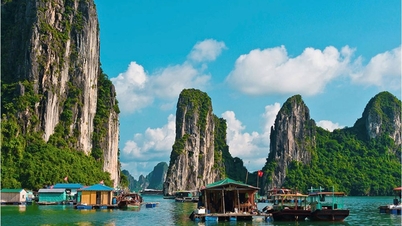
As the sun rises higher, small boats begin to move back and forth between the rows of mangrove stakes stretching endlessly across the alluvial plains of Dong Thai commune. Small huts perched precariously on the sea have become a familiar sight here. Locals call this place the "floating village," where thousands of laborers cling to the clam beds, living off the tides to make a living. Having been involved in blood clam farming for nearly 15 years, Mr. Nguyen Van Tam, a resident of Dong Thai commune, said that in 2010, he leased 30 hectares of coastal water. During favorable seasons, he could earn from tens to hundreds of millions of dong. Currently, clams are no longer as expensive as before, with traders buying them for around 50,000 dong/kg. Despite the fluctuating prices and weather-dependent yields, clam farming still helps many coastal households make a living thanks to relatively low investment costs, mainly for seedlings and hiring people to guard and harvest them.

Rows of bamboo stakes demarcate areas for oyster farming on the coastal mudflats. Photo: BAO TRAN
Coastal shellfish beds also provide a livelihood for hired laborers. From raking for shellfish, guarding the ponds, transporting them, to sorting commercial shellfish… almost every step requires manpower. For more than five years, Ms. Tran Ngoc Chuyen and her husband, residents of Dong Thai commune, have made a living guarding shellfish in the mudflats. In addition to a salary of about 5 million VND/month, during the harvest season for blood clams or green mussels, they also earn extra money by the day. “The work isn’t strenuous, but it’s always a cycle. In the morning, I follow the receding tide down to the pond to pull nets, rake for shellfish, gather green mussels, then stir the mud to create natural food sources or re-erect the stakes that have been tilted by the waves. At night, my husband and I take turns shining lights to guard the shellfish pond to prevent theft,” Ms. Chuyen said.
Recently, the bustling life in the "floating village" has attracted many tourists seeking unique experiences. The number of boats and canoes carrying passengers from the mainland to the clam beds has increased significantly. Some enjoy wading through the mud to collect clams, filming, and taking photos; others simply sit in their huts, breathing in the fresh air, watching the waves, and enjoying a seafood meal. Tran Minh Chau, a resident of Giong Rieng commune, said: “I was quite curious about clam farming after seeing it on social media. We booked a hut with the owner of the clam farm, then hired a canoe to go out to the middle of the mudflats, bringing some food to prepare seafood on the spot. Initially, I thought I'd just go to see what it was like, but after a few hours, I really liked the atmosphere out there.”
Dong Thai commune currently has over 3,000 households engaged in clam farming, covering nearly 3,200 hectares of alluvial plains, concentrated in hamlets 5 Bien A, 6 Bien, Xeo Vet, 7 Bien, and Xeo Quao A. According to Nguyen Thi Bich Thuy, Vice Chairman of the People's Committee of Dong Thai commune, clam farming is one of the local fisheries economic sectors with sustainable development potential if properly oriented and strictly managed. The commune is gradually reviewing and planning farming areas in a concentrated manner, suitable to natural conditions, ensuring a balance between economic development and protection of the coastal ecological environment.
Dong Thai commune is strengthening the management of clam farming activities by focusing on production linkages, applying scientific and technical advancements, controlling water quality, and limiting spontaneous development that could lead to overlapping farming areas or negatively impact the coastal ecosystem. Along with planning the farming areas, the commune encourages people to establish cooperatives and associations to improve production efficiency, create stable markets, and gradually build a local seafood brand. Currently, the blood clam product from Nguyen Vui tidal flat in Hamlet 6 Bien has achieved OCOP 3-star certification, opening up a new direction in enhancing the value of this tidal flat specialty.
Beyond simply providing a livelihood, coastal oyster farms are recognized by experts in Dong Thai as having potential for developing eco- tourism experiences. The trend of tourists seeking to explore traditional crafts and enjoy local specialties is increasing. Therefore, the local authorities are researching the possibility of combining aquaculture with community-based tourism development to create additional livelihoods, diversify income sources, and promote the image of the coastal region.
Ms. Nguyen Thi Bich Thuy stated that transforming potential into sustainable development still requires much work. Transportation infrastructure, environmental sanitation, tourist services, and the preservation of local cultural identity all need to be considered comprehensively, avoiding uncontrolled, rapid development. However, coastal areas are currently facing numerous impacts from climate change, coastal erosion, environmental pollution, and the decline of natural fisheries resources. Meanwhile, the majority of people still engage in small-scale production, lacking value chain linkages and not yet strongly applying science and technology to production. Therefore, for sustainable coastal economic development, comprehensive planning is needed, along with investment in production infrastructure, enhanced environmental management, support for consumption linkages, and the development of livelihood models adapted to climate change.
Furthermore, the challenges facing coastal areas are not just about shellfish or profitable harvests, but also about preserving the livelihoods of the people, maintaining the greenery of the mudflats, and developing the way of life in the floating villages that exist amidst the sea.
BAO TRAN
Source: https://baoangiang.com.vn/tu-bau-so-nhin-ra-kinh-te-ven-bo-a487012.html



![[Photo] Opening Ceremony of the National People's Council Conference on the Implementation of Directions and Tasks for the 2026-2031 Term](https://vphoto.vietnam.vn/thumb/1200x675/vietnam/resource/IMAGE/2026/05/28/1779939257690_ndo_br_bnd-1991-jpg.webp)















































































Comment (0)