

TEACH AND LEARN THINGS THAT ARE NECESSARY AND CLOSE TO LIFE.
The math exam in the two major exams – the 2025 entrance exam for 10th grade and the high school graduation exam – is considered by teachers to have an integrated element, using meaningful contexts linked to images and practical situations in life, science , and technology, which account for a large proportion of the questions. To prepare for the 2026 exams, schools need to develop a systematic study and review plan early on, including consolidating foundational knowledge, developing logical thinking, reading comprehension skills, and problem-solving skills.

The way the high school graduation exam will be designed in 2025 raises the issue of changing teaching and learning methods in high schools in line with the spirit of the new General Education Program.
PHOTO: TUAN MINH
Mr. Nguyen Ba Tuan, a teacher at Chu Van An High School ( Hanoi ), believes that the schools' preparation after receiving the sample and official exam papers further encourages teachers and students to continue innovating, knowing that it is the right direction. Regarding the high-level differentiation section, Mr. Tuan argues that it's not so difficult that no student can answer it, but rather that only truly excellent students can solve it. He also believes that an exam with too many perfect scores (10 out of 10) is not ideal.
Regarding the requirements of the new exam format, Mr. Tuan believes that students need to be equipped with reading comprehension and information processing skills; logical thinking and situational analysis skills; and the ability to apply knowledge to practical situations in order to handle them well. In addition, the questions in these two sections have a good level of differentiation, requiring learners to have a solid grasp of skills and a strong knowledge base, and to know how to connect knowledge within the learned knowledge areas to solve problems. Emphasis should be placed on developing self-learning abilities, analytical thinking, mathematical reasoning, and the ability to apply knowledge to solve practical situations, closely adhering to the requirements of interdisciplinary integration.
Associate Professor Ngo Hoang Long, Deputy Head of the Department of Mathematics and Informatics, Hanoi Pedagogical University, believes that with the competency assessment requirements of the 2018 General Education Program, mathematics needs to equip students with the ability to communicate with mathematics. Specifically, students must read long texts about mathematics, thereby recognizing and extracting necessary information and gradually building models to solve real-world problems. This is the task that the 2018 General Education Program aims for.
According to Associate Professor Ngo Hoang Long, if we want to develop students' abilities and have exams that assess their competence instead of simply testing their knowledge, then it is essential to have problems and math questions like these.
Mr. Dam Tien Nam, Principal of Nguyen Binh Khiem Secondary and High School (Hanoi), reflected that the school's math teachers believe the exam was not difficult in terms of mathematical knowledge. If the requirements remained the same but kept the simple calculation format, students would be able to complete the exam faster. However, when the exam required relating the concepts to real-world situations, students found it difficult because they were not yet familiar with it. This is something schools need to focus on more in the future.
Ms. Pham Thuy Chi, a master of educational psychology and career guidance specialist, commented: "The exam shows that preparing students with the necessary skills and abilities from high school onwards for a rapidly changing professional world is extremely important. While students may feel a bit disoriented in their first year, I believe that in subsequent years, this will help them reassess their learning, and schools will also need to adjust their teaching methods." Ms. Chi advised students to "study in depth" instead of choosing safe subjects, as this is the way to solve problems.
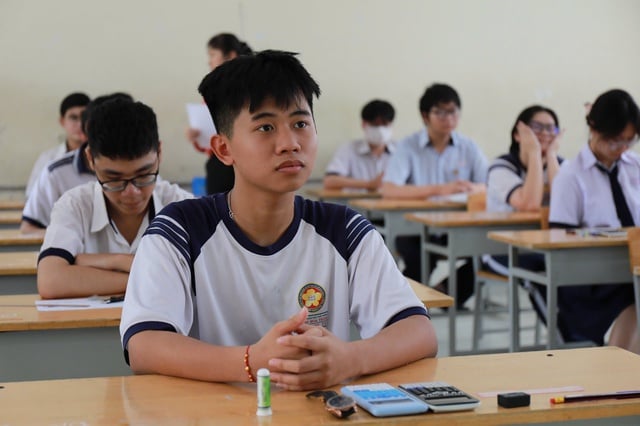
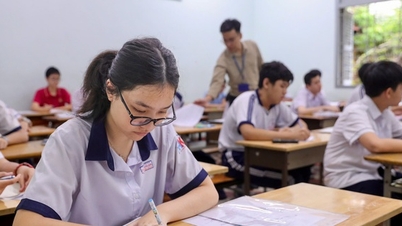
Candidates taking the 2025 high school graduation exam, the first exam under the new curriculum.
Photo: Ngoc Duong
Is studying only the textbook enough?
Analyzing the recent high school graduation exam in English, Ms. Am Thùy Linh, an English teacher at Luong The Vinh Secondary and High School (Hanoi), pointed out that studying only the current English textbooks is insufficient to meet the exam requirements. The vocabulary required by the exam is much larger than what students learn in the textbooks. Therefore, according to Ms. Linh, the question is whether the textbooks will change if the exam format continues, because at present, textbooks remain the clearest illustration of the curriculum.
However, Ms. Linh asserted that studying only textbooks is not enough. Students must explore more materials beyond textbooks. For students in urban areas with favorable conditions, this is not too difficult, but for students in rural or remote areas, it is not easy.
Mr. Nguyen Ba Truong Giang, founder of The Ivy-League Vietnam English Center, questioned: With this exam, what percentage of the questions could a student who only studied English according to the textbook curriculum possibly answer correctly? According to Mr. Giang's assessment, the exam's language quality and difficulty level are based on the CEFR (Common European Framework of Reference for Languages) standards, and the vocabulary range is relatively broad, potentially confusing many high school students, even those who have had time to practice English beyond the textbook.
Therefore, Mr. Giang believes that a comprehensive reassessment of both linguistic and educational sciences is needed to improve the quality of future examinations. Specifically, it is necessary to integrate learned knowledge into the exam questions, establishing a balance between the difficulty level of the exam and the textbook to ensure that a student studying only the textbook has sufficient vocabulary and understanding of grammar, scientific information, and social studies to be able to answer at least 70% correctly.
Self-study and self-reading are not about "outsourcing" the task to students.
Ms. Pham Ha Thanh, a literature teacher at Le Quy Don High School in Ha Dong (Hanoi), shared: "Even we teachers need time to read, understand the context in which a new work was created, and reflect on it before we can deeply appreciate it. Therefore, we cannot expect the same from students when they encounter completely new material. Consequently, teachers cannot impose strict, subjective evaluation methods during teaching and grading based on the new exam format."
Ms. Thanh and many other teachers recognize that one of the major changes is that previously, teachers used to teach by lecturing and analyzing literary works, explaining the beauty and merit of the works to students based on the teacher's understanding and feelings. Currently, teaching literature focuses on reading comprehension; teachers organize activities to help students discover the beauty and merit of the texts and works based on their own perspectives, thoughts, and feelings.
On July 3rd, in his article on some shortcomings in current literature teaching, Associate Professor Do Ngoc Thong, Editor-in-Chief of the Literature Curriculum for the 2018 General Education Program, pointed out several incorrect understandings and practices in teaching this subject. Among them is the phenomenon of neglecting works in textbooks and underestimating the importance of teaching speaking and listening. "This is a mistake. First of all, the texts in textbooks are representative of the achievements of national and world literature, very good and in the correct genre, and have been selected by the textbook authors. If we don't use the texts in textbooks, how can we teach students how to read and understand?" Associate Professor Thong questioned.
Another worrying fact he pointed out is the phenomenon of "leaving everything to students," leaving them to read and absorb information on their own. This is incorrect, because in teaching reading comprehension, the role of the teacher remains extremely important.
A reassessment is needed after the exam results are available.
According to Dr. Le Viet Khuyen, Vice President of the Association of Universities and Colleges of Vietnam, the transition in the way high school graduation exam questions are formulated this year shows that the changes are happening too quickly, while the foundation (innovation in teaching and learning) has not been ensured. Many teachers still do not fully understand the concept of "competency-based approach," and students are confused about choosing subject combinations from grade 10, leading to a passive approach in revision and examinations.
"The curriculum has been changed, but the people, methods, and conditions haven't changed in time," Dr. Khuyen remarked. However, he also argued that initial difficulties shouldn't lead to a return to old ways. A comprehensive review is needed immediately after the exam results are available, evaluating the entire curriculum, textbooks, teaching staff, and especially the students' learning capacity.
Source: https://thanhnien.vn/tu-cach-thi-nhin-lai-hieu-qua-doi-moi-chuong-trinh-sgk-185250704212652094.htm






















































































Comment (0)