

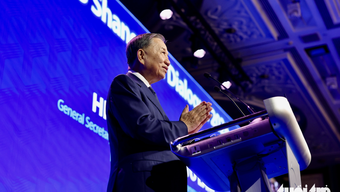
The appearance and speech of General Secretary and President To Lam at the opening session of the 23rd Shangri-La Dialogue in Singapore not only attracted special attention from international policymakers and scholars, but also left a strong impression on Vietnam's strategic thinking, development vision, and international responsibility in the context of a world undergoing profound changes.
With the theme "Proactively Building Peace, Stability, and Development in a Volatile World," the speech not only offered insightful assessments of the global strategic environment but also proposed a system of long-term, directional solutions for the Asia-Pacific region and the international community.
The most striking aspect of the speech was its new approach to peace and security: instead of merely responding to crises after they occur, it is necessary to proactively create conditions for preventing crises early and from afar. It identified three fundamental crises of the contemporary world.
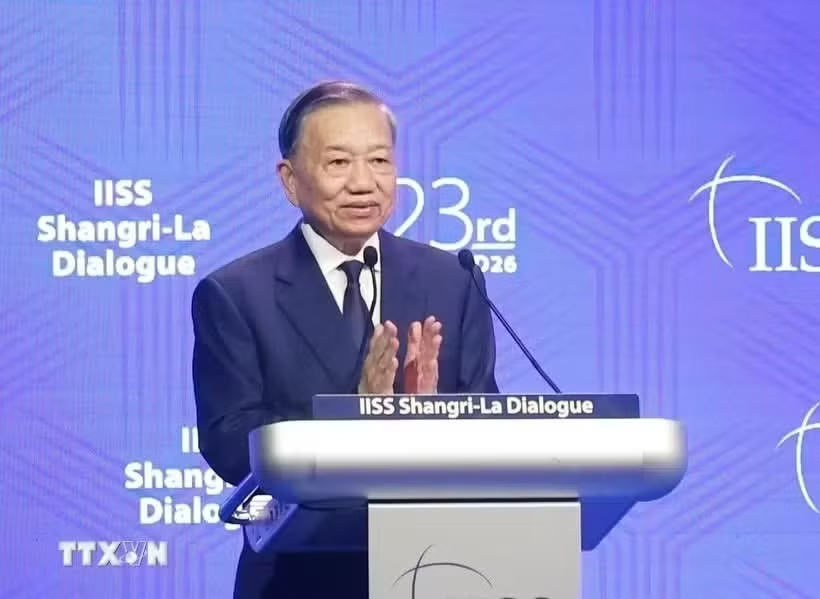
For many years, international forums have often focused on analyzing hotspots, conflicts, or specific manifestations of instability. However, General Secretary and President To Lam has approached the issue at a deeper level by pointing out three fundamental crises simultaneously impacting the global landscape: the crisis of international order, the crisis of the development model, and the crisis of strategic confidence. This is an assessment with profound theoretical and practical significance. The crisis of international order is not simply the competition between major powers, but rather the weakening of the binding nature of international law; it is a situation where widely recognized principles are applied inconsistently or dominated by a power-driven mindset. The crisis of the development model reflects the reality that the drivers that once contributed to the success of globalization are facing unprecedented challenges. Slowing growth, climate change, rising public debt, fragmented supply chains, and the technology gap are creating new risks to sustainable development.
In particular, identifying the “strategic confidence crisis” as one of the three greatest challenges of our time demonstrates a profound understanding of the nature of current security risks. In a deeply interconnected world, a lack of trust can escalate conflicting interests into confrontation, defensive actions into provocations, and minor incidents into dangerous escalations. Accurately identifying the nature of these crises is prerequisite for finding appropriate solutions for the future. This involves shifting from a crisis management mindset to a risk mitigation mindset.
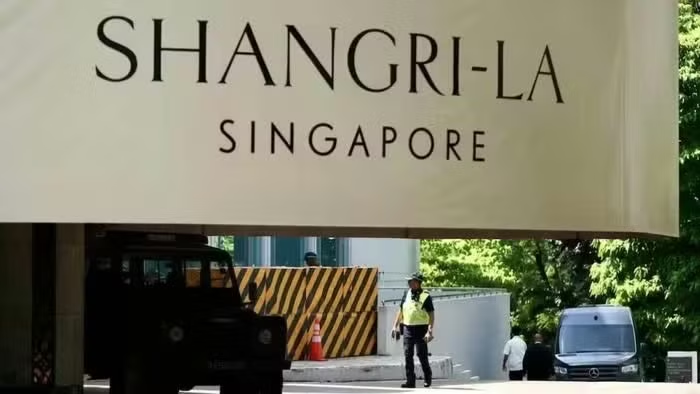
One of the standout new points of the speech was the shift in thinking from “crisis management” to “risk reduction.” For decades, international security mechanisms focused primarily on dealing with the aftermath of crises. However, practice has shown that the cost of crisis management often far exceeds the cost of prevention.
The message delivered by General Secretary and President To Lam is that it is necessary to build the capacity to identify risks early, establish early warning mechanisms, maintain regular dialogue, and strengthen confidence-building measures. This is essentially a modern strategic governance mindset, focusing on prevention rather than response; on creating rather than being reactive.
In an increasingly interdependent world, this mindset is significant not only for security but also for economic development, technological governance, and responding to non-traditional challenges. Affirming the value of international law and multilateralism, a recurring message throughout the speech is the need to strengthen the role of international law and multilateral cooperation mechanisms.
Notably, Vietnam not only defends its national interests but also offers a universal approach: international law must be the common foundation for the peaceful coexistence of large, medium, and small nations. In the context of increasingly fierce strategic competition, this message holds particular significance for developing countries and small and medium-sized nations.
Regarding the South China Sea, the position is clearly, consistently, and principled: resolving all disputes peacefully on the basis of international law, especially the 1982 United Nations Convention on the Law of the Sea. This is not only Vietnam's view but also reflects the common desire of the international community for a peaceful, stable, and rules-based environment. The central role of ASEAN in the new regional structure is emphasized. Another strategic highlight is the emphasis on ASEAN's central role in the context of the increasing number of new regional mechanisms and initiatives.
According to the approach of General Secretary and President To Lam, the region needs an open, inclusive structure capable of connecting the interests of nations, rather than creating new dividing lines. Notably, the concept of "ASEAN's central role" is seen not as an inherent privilege but as something that must be maintained through solidarity, strategic autonomy, and the capacity to create a common agenda.
This message both expresses confidence in ASEAN and calls for strong innovation within ASEAN itself in the context of increasingly complex geopolitical competition. It places human security at the center of sustainable security. While security was previously understood primarily from a military perspective, the speech significantly broadened the meaning of this concept. Accordingly, sustainable security must be people-centered. Instability stems not only from war or conflict but also from disruptions in development processes, natural disasters, epidemics, food insecurity, energy insecurity, water insecurity, and economic shocks.
This approach aligns with modern global governance trends and reflects Vietnam's consistent viewpoint on people-centered development, with people as both the subject and the goal of all policies. It also shapes new standards for technology and artificial intelligence. One of the most notable new aspects is the development of accountability standards for new technologies, particularly artificial intelligence.
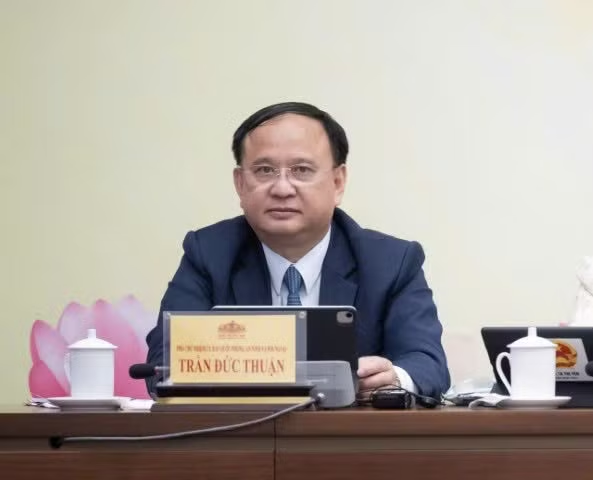
While many countries are still focused on harnessing the benefits of AI, the speech warned of the risks the technology could pose to peace and strategic stability if it spirals out of human control. The message that “humans must bear ultimate responsibility for decisions with serious security consequences” reflects a humane and responsible approach to technological development.
This is also one of the issues that will shape the global agenda for many years to come: elevating Vietnam's status and role.
It is evident that the speech at Shangri-La 2026 not only reflects Vietnam's views on international issues but also demonstrates the maturity of its strategic thinking and its capacity to contribute to regional and global issues. From a nation that once struggled to gain independence and protect its sovereignty, Vietnam today is actively participating in creating a peaceful, stable, and prosperous environment for the region.
The message of "shifting from passive response to proactive creation" is not only a foreign policy guideline but also reflects the innovative spirit in the country's development thinking.
Therefore, the speech by General Secretary and President To Lam at the Shangri-La Dialogue 2026 is not only the voice of Vietnam but also a call to action for the international community: to strengthen the rule of law, enhance trust, promote dialogue, and build effective risk mitigation mechanisms to create a more peaceful, stable, and prosperous future for humanity.
In a world full of uncertainty, the greatest value of this speech lies in affirming that peace is not a passive state of waiting, but rather the result of proactive creation through vision, responsibility, and cooperation.
Source: https://cand.vn/tu-duy-chien-luoc-moi-tu-shangri-la-2026-post812526.html









![[Video] Sunset at Lap An Lagoon – Where the sun sets over the fishing nets](https://vphoto.vietnam.vn/thumb/340x192/vietnam/resource/IMAGE/2026/05/31/1780192137701_beach-landscape-sea-water-nature-grass-745871-pxhere-com.jpeg)
![[Photo] The General Secretary, President and his wife lay flowers at the Ho Chi Minh Monument in Manila.](https://vphoto.vietnam.vn/thumb/1200x675/vietnam/resource/IMAGE/2026/05/31/1780219759477_anh-man-hinh-2026-05-31-luc-16-29-07.png)














































Comment (0)