
Scientists discuss archaeological discoveries at Thang Long Imperial Citadel in 2025 .
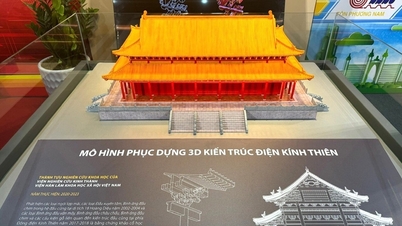
This is an important prerequisite for the restoration of the Kính Thiên Palace - a particularly crucial step in the conservation and promotion of the value of the Thăng Long Imperial Citadel World Cultural Heritage site.
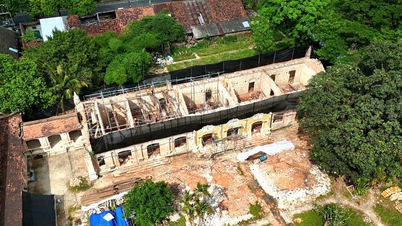
Standing beside the archaeological excavation pits of the Kính Thiên Palace foundation at the Thăng Long Imperial Citadel Heritage Site (Ba Đình Ward, Hanoi ), Associate Professor Tống Trung Tín, head of the archaeological excavation site, affirmed: For many years, we have put forward hypotheses about the size and scale of the Kính Thiên Palace, but with the 2025 archaeological excavation, for the first time in history, we have clarified the architectural layout of the palace foundation; the overall scale and dimensions of the palace, and the dimensions of each chamber. Ancient Vietnamese architecture used a load-bearing system with wooden columns, supported by stone blocks at the base of the columns, and reinforced with foundation pillars.
Scientists have identified massive foundation pillars, with cross-sections measuring approximately 3m x 6m. The largest pillar is about 4m deep and meticulously reinforced with 81 layers of interspersed earth, bricks, tiles, and other debris, all tightly compacted. Scientists assert that these are the greatest foundation pillars in the history of ancient Vietnamese architecture. This size indirectly reveals the magnificent scale of the palace above, even though it no longer exists.
Regarding the scale of the Kính Thiên Palace during the Lê Dynasty, combining archaeological excavations from 2011 and 2023, scientists have identified 15 double foundation pillars and 15 single foundation pillars, equivalent to 45 single foundation pillars. The distance between the foundation pillars gives us an accurate idea of the number of chambers and the dimensions of each chamber of the palace. The central chamber, where the throne was located, has a width of 6.9 meters.
In wooden architecture, such a large-scale building is very rare. The rooms gradually decrease in size towards the sides, with the adjacent room measuring 3.3 meters, totaling nine rooms. The total area of the Kính Thiên Palace is 1,500 square meters, situated on a foundation of approximately 3,000 square meters. This is a palace of enormous scale compared to other countries in the region.
Also during the 2025 archaeological excavation, for the first time, an excavation pit appeared containing all cultural layers, with a depth of over 6 meters. The deepest layer dates back to the Dai La period (pre-Thang Long), followed by the Ly, Tran, early Le, later Le, Nguyen, and modern periods. Previously, we knew about layers of artifacts stacked on top of each other, but never before had an excavation pit appeared with such a complete set of cultural layers. This further strengthens the hypothesis that the Kinh Thien Palace was built on the foundation of the Can Nguyen Palace and Thien An Palace – the place where the royal court was held during the Ly and Tran dynasties.
The Kính Thiên Palace was demolished by the Nguyễn dynasty, and the Long Thiên Palace, on a smaller scale, was built on the site of the old palace. After conquering Hanoi, the French demolished the Long Thiên Palace again and built an artillery headquarters on its site.
The reason the 2025 archaeological excavation will "reveal" the mysteries beneath the ground of the Kính Thiên Palace is because in 2025, UNESCO agreed to dismantle the artillery house to facilitate the excavation of the entire underground part of the building - something that was previously impossible.
The excavation results exceeded the scientists' expectations. Not only was the floor plan of the Kính Thiên Palace clearly identified, but the floor plan of the Long Thiên Palace was also clarified, with a scale of 9 bays and an area of 580m2, matching the scale of the artillery house built by the French.
Regarding studies on the Dien Kinh Thien Palace, besides its foundations, scale, and dimensions, many other aspects have been gradually clarified, but further research is still needed.
Dr. Bui Minh Tri (Institute of Imperial City Research) stated that the experience of some countries in reconstructing ancient structures is based on five criteria: name, location, physical and historical evidence, shape, and scale of the structure. Currently, we have much scientific data on the Kinh Thien Palace, but further in-depth research combining interdisciplinary studies, architectural history research, and expanded excavations around the Kinh Thien Palace foundation are still needed to clarify some hypotheses.
Meanwhile, Professor Hoang Dao Kinh emphasized: Restoration is absolutely necessary, but the best way is to combine restoration with preservation, especially preserving the excavation pit with the giant foundation pillars beneath the Kinh Thien Palace. With current technology, this is feasible.
GIANG NAM
Source: https://nhandan.vn/tung-buoc-hoan-thien-dien-mao-dien-kinh-thien-post933871.html





![[Photo] General Secretary and President To Lam presides over a meeting on preparations for the review of one year of operation of the three-tiered government system.](https://vphoto.vietnam.vn/thumb/1200x675/vietnam/resource/IMAGE/2026/06/02/1780391821195_a1-bnd-4595-9717-jpg.webp)















![[Video] Weather forecast for tonight and tomorrow, June 3, 2026: Widespread heatwave returns to Northern Vietnam, Central Vietnam has areas exceeding 39 degrees Celsius.](https://vphoto.vietnam.vn/thumb/402x226/vietnam/resource/IMAGE/2026/06/02/1780405327124_dem-2-png.webp)












































Comment (0)