

The Ministry of Education and Training has issued a directive to localities regarding the methods of admission to 10th grade in high schools, but it does not specify which subject/test will be the third exam. This is an open approach, creating conditions for localities to proactively and diversify their choices of the third exam subject/test.
Currently, following administrative unit mergers, the number of students in many provinces and cities has increased significantly. This requires the Departments of Education and Training to innovate their admissions thinking, adapting to the current reality and being ready to join the rest of the country in entering a new era of national development.
Our country's education system is pursuing a philosophy of developing students' competencies. This means that, building upon a foundation of basic, minimum knowledge, schools need to focus on comprehensively developing the inherent qualities, abilities, and potential of each student.
Primary and lower secondary education provide basic education, while upper secondary education focuses on career orientation. Therefore, the goal of upper secondary school admissions is to assess and filter foundational knowledge, serving as a basis for streaming and providing specialized academic guidance for this final stage of general education.

At the middle school age, students are not yet stable psychologically, in terms of abilities and career orientation, and their interest in learning is still fluctuating. Therefore, only a few subjects need to be tested to assess core competencies and general abilities, which is appropriate.
In my opinion, the 10th grade entrance exam only needs 2-3 subjects, and for this reason:
Mathematics aims to develop logical thinking, problem-solving skills, and a foundation for learning, especially as a basis for algorithm development, digital transformation, and strengthening the AI era.
The Literature subject aims to assess the ability to express oneself, communicate effectively, use language, and understand the Vietnamese human values system in the new era.
English (this subject is optional) is chosen because of our current context of deep integration with the international community and our preparation for making English the second language in schools, as per the government- approved plan for 2025.
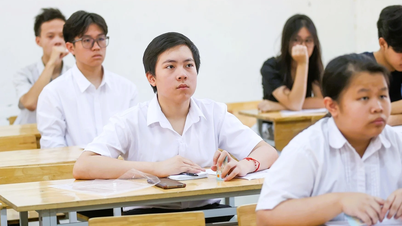
Having to take many subjects in exams puts pressure on students, forcing them to take extra classes.
If too many subjects are tested, schools, teachers, students, and society will easily focus on achieving expected scores, hindering the goal of holistic education. Students and teachers will only focus on "studying for exams" instead of developing the learners' genuine abilities.
The large number of subjects in the exam increases social pressure, leading to widespread private tutoring, which is costly for families, especially those facing financial difficulties. At the same time, this creates inequality between schools within the same province or city: stronger schools have an advantage, while schools in disadvantaged areas – due to teacher shortages and inadequate teaching facilities – suffer significant disadvantages.
The old-fashioned educational management approach of "test what you learn," and the concern that students will study "unbalanced" subjects if there are no exams, needs to be changed. It is entirely possible to combine entrance exams and selection based on academic records, for example, reviewing academic transcripts for subjects not included in the exams.
In fact, for many years, some Departments of Education and Training have organized admissions without entrance exams, demonstrating a strategic vision and preparing for the roadmap to universal high school education. At that point, the current entrance exam system would no longer be appropriate and would put an end to an exam that was considered the most stressful and demanding in Vietnamese education.
Some localities organize combined subject exams, which in reality still involve testing multiple subjects, sometimes even 2-3 more. This approach leads to the negative consequences analyzed above and creates an overloaded examination for schools and society.
More worryingly, in some places there is exploitation of the exam for personal gain, such as charging high and unreasonable exam fees and selling exam preparation materials indiscriminately. The more subjects tested, the more unnecessary materials and costs arise.
We urge local education authorities to prioritize the quality of education nationwide, and to show compassion for the people and the students. Over the years, our education system has faced numerous difficulties, disruptions, and pressures; schools and society desperately need stability, humanity, and sustainability.
High school entrance exams should be limited to testing 2-3 subjects, and if a selection process is implemented, it will further ensure a less stressful learning environment and contribute to universal high school education. Schools and teachers should focus on ensuring the quality of each subject throughout the semester and academic year, rather than only focusing on studying when exams are approaching.
International experience
Regarding high school admissions, in addition to the current methods, Vietnam also needs to study international educational experiences to understand trends and adjust accordingly to the context of global integration.
In reality, countries that do not hold entrance exams include Finland, France, the UK, and Germany. Instead of organizing a common entrance exam, they assess academic performance combined with career guidance. What's special about these countries is that streaming takes place after high school, not before university entrance exams.
With this approach, it can be affirmed that the beginning of the school year is not a time for selection through exams, but rather a time to ensure access to education for all regions. Notably, none of the countries in this group use combined exams with multiple subjects for high school entrance examinations.
Meanwhile, countries like Japan and South Korea also hold entrance exams for primary and secondary schools, testing foundational knowledge.
For example, Japan typically uses subjects like Math, Literature, and a Foreign Language for its entrance exams (with the possible addition of Natural Sciences or Social Sciences). The goal is to test basic academic ability, without complex subject combinations.
In South Korea, high school admissions are decentralized to the local level, similar to Vietnam. The method combines a limited number of subjects in the entrance exam with an assessment of academic progress, similar to a combined exam and selection model.
Regardless of the method, both Japan and South Korea share a common feature in their entrance exams: they only assess academic ability based on the high school curriculum, rather than testing broad knowledge across multiple subjects.
Countries that organize exams with many subjects put a lot of pressure on candidates, such as Singapore and China.
In Singapore, exams cover many subjects such as English, basic mathematics, advanced mathematics, science, and elective subjects. Taking so many exams requires students to study and review extensively, inevitably leading to exam pressure. However, Singapore's curriculum is considered very concise, with clear minimum standards; the teaching staff and facilities are consistent; and the government strictly controls exam preparation. This model is difficult to replicate without comparable conditions.
In China, the high school entrance exam includes a large number of subjects, putting immense pressure on students and society; exam preparation is rigorous, and regional inequality is evident. In particular, China itself is currently reforming to reduce the number of subjects and lessen exam pressure.
Based on that reality, I believe that no developed country considers a combined exam with multiple subjects as the optimal solution for high school admissions.
The general trend is: Avoid exams if conditions permit. If exams are mandatory, then focus on a few core, fundamental subjects.
Therefore, the policy message in some international countries is that we should move towards only having 2-3 compulsory subjects in the entrance exam; not adding more complex subject combinations; combining entrance exams and selection based on academic records; and differentiating and guiding students after they have entered 10th grade in high school.
For the 2025-2026 school year, several localities have announced their plans for the 10th grade entrance exam, which includes three subjects: Mathematics, Literature, and English (e.g., Ho Chi Minh City, Da Nang...). Son La province, however, plans to hold an exam covering eight subjects for 10th grade admission, including Mathematics, Literature, and a combined exam encompassing six subjects: Geography, History, Physics, Chemistry, Biology, and English. The exam will consist of 60 questions and will be completed within 90 minutes.
* This article reflects the author's personal views.
Source: https://tienphong.vn/tuyen-sinh-lop-10-nen-dung-lai-o-2-3-mon-thi-post1812133.tpo

![[Image] Hanoi Police officially crowned champions of V-League 2025/2026](https://vphoto.vietnam.vn/thumb/1200x675/vietnam/resource/IMAGE/2026/05/31/1780244769054_ndo_br_039d561b692be875b13a-jpg.webp)
![[Photo] The General Secretary, President and his wife begin their state visit to the Philippines.](https://vphoto.vietnam.vn/thumb/1200x675/vietnam/resource/IMAGE/2026/05/31/1780230559452_anh-man-hinh-2026-05-31-luc-19-28-11.png)
![[Photo] Admire the coral "masterpiece" amidst the million-year-old heritage of Dak Lak province.](https://vphoto.vietnam.vn/thumb/1200x675/vietnam/resource/IMAGE/2026/05/31/1780221235105_anh-man-hinh-2026-05-31-luc-16-53-27.png)
![[Photo] Solemn bathing ceremony and Buddha procession in Hue](https://vphoto.vietnam.vn/thumb/1200x675/vietnam/resource/IMAGE/2026/05/31/1780228263543_1-jpg.webp)












![[Video] Sunset at Lap An Lagoon – Where the sun sets over the fishing nets](https://vphoto.vietnam.vn/thumb/340x192/vietnam/resource/IMAGE/2026/05/31/1780192137701_beach-landscape-sea-water-nature-grass-745871-pxhere-com.jpeg)




























![[Photo] Admire the coral "masterpiece" amidst the million-year-old heritage of Dak Lak province.](https://vphoto.vietnam.vn/thumb/402x226/vietnam/resource/IMAGE/2026/05/31/1780221235105_anh-man-hinh-2026-05-31-luc-16-53-27.png)

























Comment (0)