

At a press conference on the afternoon of May 26th, Mr. Dang Hoang An, Deputy Minister of Industry and Trade, stated that Vietnam currently imports electricity from Laos, Cambodia, and China. However, the total import volume is approximately 10 million kW/hour, which is relatively low compared to consumption needs.
According to Mr. An, importing electricity is a long-term strategy based on Vietnam's political and economic relationships, aimed at ensuring the nation's long-term energy security and is defined in the national power development plan for each period. The import of electricity is carefully calculated based on various scenarios to ensure a small proportion, guarantee self-sufficiency, national energy security, and align with the political, economic, and trade relations with countries in the region.
Currently, the national power system, especially the northern power system, is in the peak of the dry season and operating under extremely difficult conditions due to high system load, continued low water flow to hydropower plants, and difficulties in fuel supply for coal-fired power plants.
" The Ministry has also directed EVN to urgently negotiate and mobilize renewable energy power plants to increase the capacity of the power system. Currently, the Ministry of Industry and Trade has agreed on the temporary price for 19 transitional wind and solar power plants. After these power projects fully meet the regulations, they will be able to supply electricity to the national grid ," Mr. Hoa said.
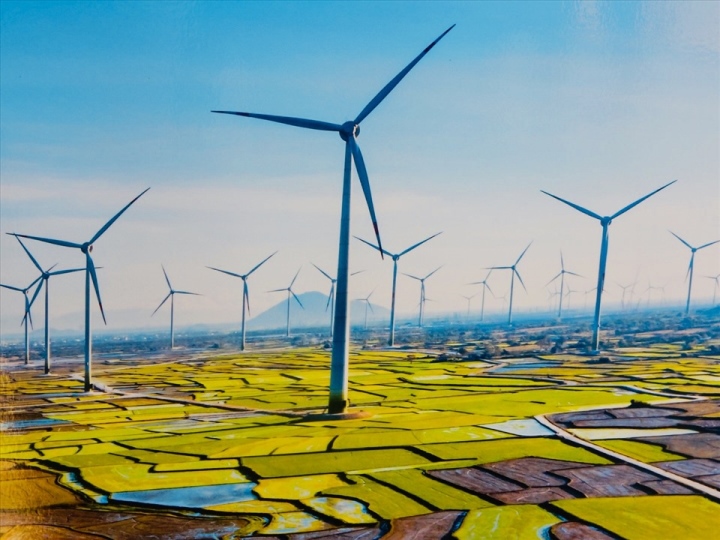
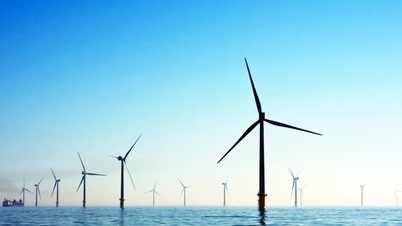
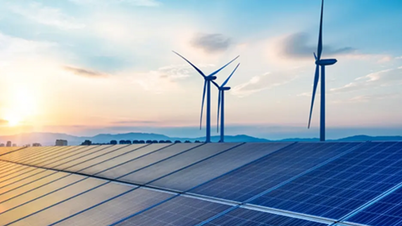
The electricity price for renewable energy projects is provisionally set at 50% of the ceiling price. (Illustrative image)
The provisional electricity price for renewable energy projects is 50% of the ceiling price.
Mr. An also stated that currently, there are 8 solar power plants and 77 wind power plants that signed power purchase agreements with EVN before January 1, 2021, but do not meet the conditions for applying the feed-in tariff (FIT) as stipulated in Decision No. 13/2020/QD-TTg dated April 6, 2020, of the Prime Minister .
To establish a mechanism for transitional projects after the FIT pricing mechanism expires, the Ministry of Industry and Trade issued Circular No. 15/2022/TT-BCT and Decision No. 21/QD-BCT as a basis for EVN and transitional projects to agree on electricity prices, ensuring that they do not exceed the electricity generation price framework issued by the Ministry of Industry and Trade.
The electricity generation price framework determined by the Ministry of Industry and Trade is based on project investment cost data, taking into account the downward trend in investment costs for solar and wind power projects worldwide. The investment cost for grid-connected solar power projects decreased from US$1,267/kW to US$857/kW (equivalent to 11% per year) during the 2018-2021 period, and the investment cost for grid-connected onshore wind power projects decreased from US$1,636/kW to US$1,325/kW (equivalent to 6.3% per year), resulting in a change in the calculated price framework compared to the previously issued FIT price.
Previously, in an interview with VTC News , Mr. Tran Viet Hoa, Director of the Electricity Regulatory Authority, stated that in the past, investors of transitional power plants have not been enthusiastic about submitting documents to negotiate electricity prices with EVN, and many investors still desire a higher price.
Regarding the electricity price negotiations, the head of the Electricity Regulatory Authority said that after the Ministry of Industry and Trade issued the price framework in January 2023, it wasn't until March that some investors submitted their applications.
As of May 26th, 52 out of 85 solar and wind power plants with a total capacity of 3,155 MW (accounting for 67%) have submitted applications to EVN. Of these, 42 plants are currently negotiating electricity prices with EVN; 36 plants with a total capacity of 2,063.7 MW have proposed a provisional electricity price equal to 50% of the price range as a basis for mobilization.
Currently, there are still 33 power plants with a total capacity of 1,581 MW that have not submitted negotiation documents (accounting for approximately 33%).
In addition, many investors have violated legal regulations regarding planning, land, and construction investment, leading to legal procedural obstacles and preventing them from negotiating prices with EVN.
To date, the Ministry of Industry and Trade has approved provisional prices for 19 investors proposing the application of temporary prices during the negotiation period, with a total capacity of 1,346.82 MW. Currently, EVN is finalizing negotiation procedures with investors for an additional 17 power plants to be submitted to the Ministry of Industry and Trade for approval in May 2023. The Ministry has also directed EVN to closely coordinate with investors to accelerate the grid connection process for plants that have agreed on provisional prices.
For solar and wind power plants that have not yet completed the legal procedures for investment and construction, the Ministry of Industry and Trade has directed its functional units and requested the People's Committees of the provinces to direct the Departments of Industry and Trade to coordinate with investors to urgently carry out the appraisal of designs, revised designs (if any), and inspection of acceptance testing according to their authority.
At the same time, the Ministry's units are requested to guide investors in resolving planning issues during the process of adjusting investment policies.
PHAM DUY
Beneficial
Emotion
Creative
Unique
Source





![[Photo] General Secretary and President To Lam and the President of the Philippines hold talks.](https://vphoto.vietnam.vn/thumb/1200x675/vietnam/resource/IMAGE/2026/06/01/1780283481955_vna-potal-tong-bi-thu-chu-tich-nuoc-to-lam-va-tong-thong-philippines-hoi-dam-8797519-1429-jpg.webp)



















































































Comment (0)