

Yen Bai - For many years, Mr. An Van Dao, Secretary of the Party Branch of Ngoi Sen village, Van Phu commune, Yen Bai city, has been growing high-yield hybrid cassava to use as poultry feed. He said that in 2022, with 3 sao (approximately 0.3 hectares) of garden land, he planted nearly 1,000 cassava plants, yielding about 3.5 tons of fresh cassava tubers.
Cassava plants are planted in March and begin to be harvested from the end of December each year. At that time, his family usually only pulls up a small amount for consumption, and the rest is harvested completely between the 15th day of the first lunar month and the 15th day of the second lunar month.
According to his family's experience, this is the time when cassava tubers are largest and contain the most starch. The difficulty in harvesting all at once is the humid weather and lack of sunshine. Cassava dried in the sun for only one day will not dry properly, becoming brittle and easily spoiled. Therefore, to preserve the harvested cassava throughout the year as a year-round feed for chickens, Mr. Dao's family has been fermenting fresh cassava using anaerobic methods for many years.
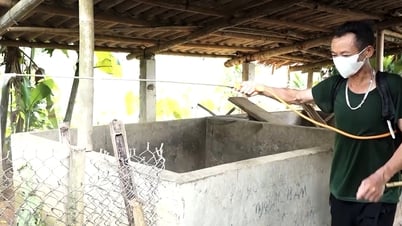
Mr. Dao shared a very simple and easy method for fermenting fresh cassava using anaerobic digestion. During the peak cassava harvest season, he and his wife harvest about 300 kg of fresh cassava tubers each morning. The soil clinging to the tubers is then washed away by pumping water and stomping on with boots.
After waiting for the cassava to dry, the next step is threshing. With the help of a threshing machine, all the harvested cassava can be threshed in just 30 minutes.
In the next step, the couple will pack about 30 kg of cassava into plastic bags in the first batch, then wait for the cassava to shrink a bit before packing it again until the bags are full, about 40 kg. At the bottom of each plastic bag containing the cassava, he cuts two holes, each 1 cm in diameter, to allow the cassava juice to drain out. He then covers the bags with burlap sacks, tying both the plastic bags and the burlap sacks tightly. He continues this process until all the cassava is harvested. Finally, he builds a raised platform of bamboo or wood about 20 cm above the ground to place the sacks on.
Mr. Dao keeps these sacks of fresh cassava right in the garden, covered with roofing sheets or plastic to protect them from the rain. After about half a month, when the cassava loses its pungent smell, he feeds it directly to his chickens. If he wants to feed it to pigs, he says it has to be cooked into bran. For the chickens, he puts the sack of cassava on the ground, cuts a slit along the side of the sack, and opens it up for the chickens to eat until it's all gone, then takes another sack.
Mr. Dao added: "According to my calculations, after 6 months of fermentation, the amount of cassava will shrink by about 33%, and after 10 months it will be 50%. To make feed for chickens, I usually mix in corn flour at a ratio of 10% of the actual amount of cassava remaining in each bag at the time of feeding the chickens."
Each year, Mr. Dao maintains a flock of 150 native chickens through a staggered farming system. He cultivates 3 sao (approximately 3,000 square meters) of fresh cassava annually, yielding 3.5 tons of fresh cassava tubers. Besides his own consumption and some sold, he ferments 50 bags of cassava pulp. This fermented cassava pulp accounts for 70% of the total feed for his chickens, with each chicken consuming an average of 100 grams of fermented cassava pulp per day.
Mr. Dao's chickens roam freely in his spacious garden, each weighing around 1.8-2 kg. Compared to feeding them corn, the chickens lay 1.5 times more eggs when fed fermented cassava. The eggs are very fragrant and delicious, with a deep yellow yolk. He sells both his own eggs and those from the surrounding villages and communes, often fetching 5,000 VND per egg when prices are high.
Having used fresh cassava to make fermented feed for his chickens for many years, Mr. Dao affirmed: "I find this method very quick, convenient, and it reduces a lot of labor compared to drying cassava, and most importantly, it's not dependent on the weather. What I like is that I can proactively manage the chicken feed year-round, without worrying about spoilage, and the results are very good."
Nguyen Thom
Source link










































































Comment (0)