

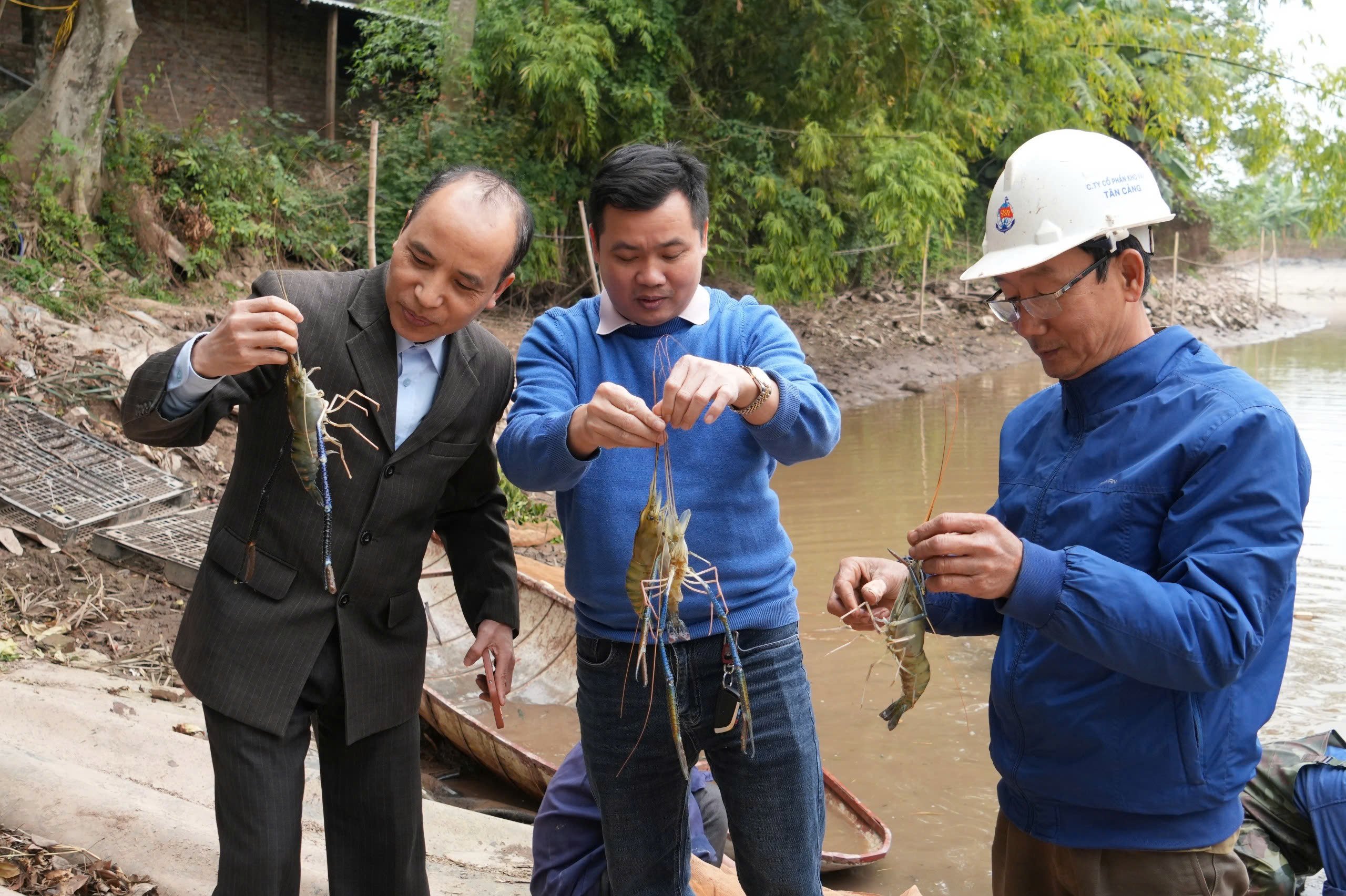
With its dense network of rivers, streams, ponds, and reservoirs, Vinh Phuc has favorable conditions for developing aquaculture. The province currently has over 6,400 hectares of aquaculture area, concentrated in districts such as Vinh Tuong, Yen Lac, and Binh Xuyen.
However, along with development, the province's fisheries sector is also facing numerous challenges such as water pollution from industrial and domestic activities; climate change; persistent and complex fish diseases; and rising feed costs...
Against this backdrop, biotechnology has emerged as an effective solution that helps farmers address environmental issues while simultaneously improving investment efficiency and product quality.
According to Mr. Pham Van Tan, a large-scale aquaculture investor in Tam Hong town (Yen Lac district), in intensive farming, where fish density is high and large amounts of feed are used, water quality is the key factor determining the success or failure of the entire farming season. Therefore, for many years, his family has been using Biofloc products to improve water quality.
"Biofloc is a biological product that helps decompose organic matter such as leftover feed, fish waste, dead algae, etc. At the same time, it absorbs and transforms toxic gases in the pond, inhibits pathogenic microorganisms, supports nutrient absorption, and increases the fish's resistance," Mr. Tan said.
Previously, Mr. Tan used biological water treatment products on a monthly basis. However, since installing an automatic sensor system to monitor water environmental indicators, the use of Biofloc products has become much more flexible.
"As soon as we see any abnormal indicators, we immediately treat the water instead of waiting until the next harvest," Mr. Tan said. Thanks to good control of the farming environment, the fish grow steadily, have a high survival rate, and rarely experience disease outbreaks. On average, Mr. Tan's family supplies 70 to 80 tons of commercial fish to the market each year, bringing significant economic benefits, many times higher than the traditional farming methods used previously.
In addition to applying biotechnology in water treatment, many fish farmers in the province have used biological preparations and active substances mixed into fish feed to enhance immunity and resistance, support digestion, help animals absorb food better, and promote growth.
In particular, the application of biotechnology in breeding has achieved significant results. Our province is currently strongly developing intensive farming of monosex tilapia created from genetic technology, sex control through crossbreeding, and V1 carp from mass selection and family selection.
During the period 2021-2024, the entire province provided support for 6.51 million fish fry of various types (hybrid carp, grass carp, and monosex tilapia) on an area of 535 hectares for 437 households in the districts, in accordance with Resolution No. 20 dated December 14, 2020, of the Provincial People's Council. These fish varieties all yield higher productivity and efficiency compared to common fish varieties due to their high survival rate, good disease resistance, rapid growth rate, and shortened rearing time.
The application of biotechnology and its multifaceted benefits has been contributing positively to the overall development of the fisheries sector. Although the cultivated area tends to decrease, the productivity, output, and value of aquaculture production have generally increased. In 2024, the average aquaculture productivity of the province reached 3.4 tons/ha, an increase of 6.3% compared to 2020; the value of aquaculture production reached nearly 800 billion VND, an increase of 8.7% compared to 2020.
Initial successes in applying biotechnology in the province have created momentum for the fisheries sector in particular and agricultural production in general to enter a new phase of development.
According to the province's orientation, in the coming time, Vinh Phuc will continue to promote the application of biotechnology in agricultural production; research and transfer of enzyme, protein and microbial technologies to prevent and treat diseases and stimulate growth in aquaculture. The goal is to have the area of organic aquaculture reach approximately 1% of the total aquaculture area of the province by 2030.
Nguyen Huong
Source: http://baovinhphuc.com.vn/Multimedia/Images/Id/127684/Ung-dung-cong-nghe-sinh-hoc-trong-nuoi-trong-thuy-san


![[Photo] Prime Minister Pham Minh Chinh attends the Conference on the Implementation of Tasks for 2026 of the Industry and Trade Sector](/_next/image?url=https%3A%2F%2Fvphoto.vietnam.vn%2Fthumb%2F1200x675%2Fvietnam%2Fresource%2FIMAGE%2F2025%2F12%2F19%2F1766159500458_ndo_br_shared31-jpg.webp&w=3840&q=75)














































































Comment (0)