

The end of the silicon era.
A revolution is imminent. In 2019 and 2020, two bombshells shook the scientific world. Two research groups announced they had reached quantum supremacy, a legendary peak where a completely new type of computer, called a quantum computer, can perform specific tasks far more powerfully than conventional digital supercomputers. This heralded a pivotal shift that could transform the entire field of computing and disrupt every aspect of our daily lives.
First, Google revealed that its Sycamore quantum computer can solve a mathematical problem in 200 seconds, while the world's fastest supercomputers would take up to ten thousand years.
According to Technology Review, a magazine of the Massachusetts Institute of Technology (MIT), Google calls this a major breakthrough. They compare it to the launch of Sputnik or the Wright brothers' first flight. It is "the threshold into a new age of computing, which could make today's most powerful computers no different from an abacus."
Later, the Institute for Quantum Innovation of the Chinese Academy of Sciences went even further. They claimed their quantum computer was 100 trillion times faster than a conventional supercomputer.
Bob Sutor, vice president of IBM, commenting on the meteoric rise of quantum computing, stated unequivocally, "I think this will be the most important computing technology of this century."
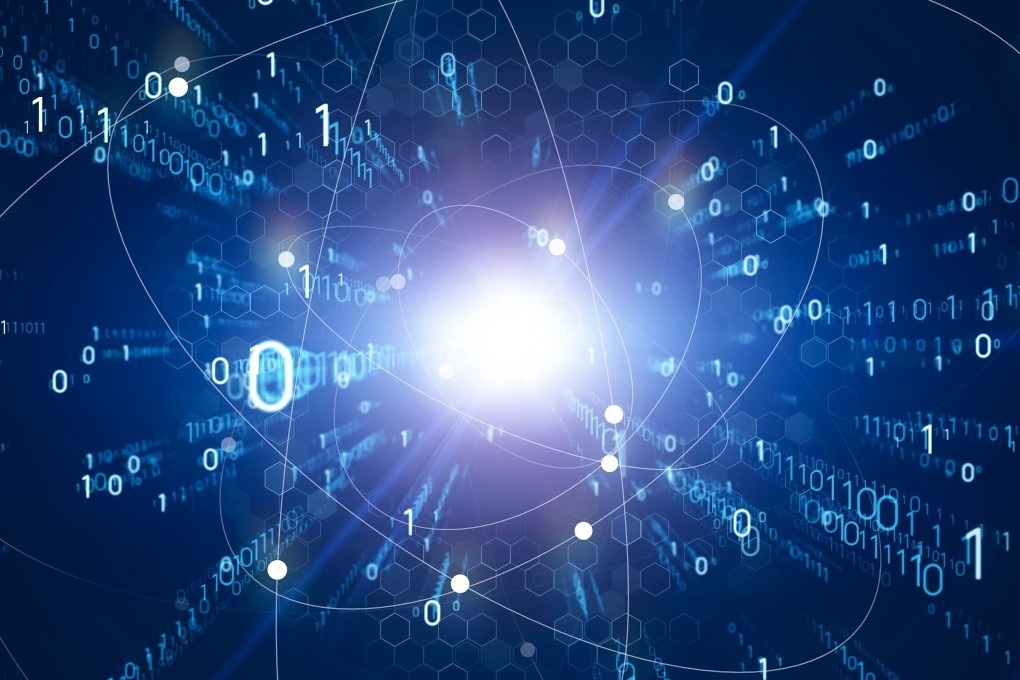 |
The advent of quantum computers is a new revolution in technology. Photo: South China Morning Post. |
Quantum computers, also known as “ultimate computers,” represent a decisive technological leap with profound implications for the entire world. Instead of computing using tiny transistors, these new types of computers compute using the smallest possible objects—atoms themselves—and thus can easily surpass the power of our most powerful supercomputers. Quantum computers could usher in an entirely new era for our economy , society, and way of life.
But quantum computers are more than just another type of computer. They are a new kind of computer capable of solving problems that digital computers cannot, even if given unlimited time.
For example, digital computers can never accurately calculate exactly how atoms combine to create crucial chemical reactions, especially those that make life possible.
Digital computers can only perform calculations on digital tape consisting of sequences of zeros and ones, a cruder way of describing the magical, dancing waves of electrons deep within molecules.
For example, when painstakingly calculating the paths of a mouse in a maze, a digital computer has to painstakingly analyze each possible path, one after another. Meanwhile, a quantum computer analyzes all possible paths simultaneously at lightning speed.
In turn, this has intensified the fierce competition among major computer manufacturers, all racing to create the world's most powerful quantum computer. In 2021, IBM unveiled its own quantum computer, called Eagle, which rose to the top with computing power exceeding all previous quantum computers.
But those records are like the crust of a pie—made to be broken.
Given the profound implications of this revolution, it's no surprise that many of the world's leading corporations have invested heavily in quantum computing technology. Google, Microsoft, Intel, IBM, Rigetti, and Honeywell are all building quantum computer prototypes. Silicon Valley leaders are aware that they need to keep up with this revolution if they don't want to be left behind.
Source: https://znews.vn/may-tinh-luong-tu-tiet-kiem-duoc-1-van-nam-giai-toan-post1655391.html
![[Photo] General Secretary and President To Lam presides over a meeting with the Central Organizing Committee.](https://vphoto.vietnam.vn/thumb/1200x675/vietnam/resource/IMAGE/2026/06/03/1780482764658_a1-bnd-4741-3342-jpg.webp)

![[Photo] First session of the 14th Congress of the Vietnam Trade Union](https://vphoto.vietnam.vn/thumb/1200x675/vietnam/resource/IMAGE/2026/06/03/1780465947883_ndo_br_img-3852-jpg.webp)
![[Photo] Secretary of the National Assembly Party Committee, Chairman of the National Assembly presides over the meeting of the Standing Committee and Executive Committee of the National Assembly Party Committee.](https://vphoto.vietnam.vn/thumb/1200x675/vietnam/resource/IMAGE/2026/06/03/1780480353201_ndo_br_bnd-2585-jpg.webp)














































![[Video] Sunset at Lap An Lagoon – Where the sun sets over the fishing nets](https://vphoto.vietnam.vn/thumb/1200x675/vietnam/resource/IMAGE/2026/05/31/1780192137701_beach-landscape-sea-water-nature-grass-745871-pxhere-com.jpeg)

























![[Infographic] Over 1.2 million candidates registered for the 2026 High School Graduation Exam](https://vphoto.vietnam.vn/thumb/402x226/vietnam/resource/IMAGE/2026/06/03/1780496872518_w_20260603205412.jpeg)










Comment (0)