

 |
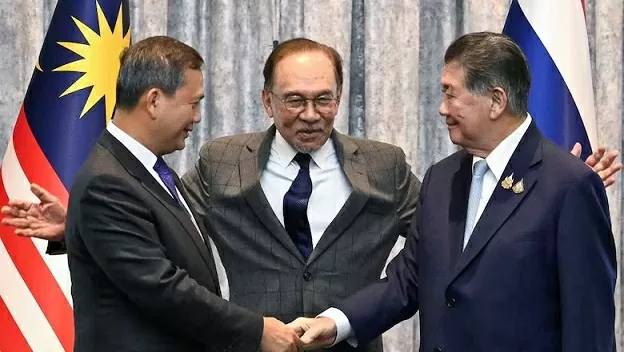
| From left to right: Cambodian Prime Minister Hun Manet, Malaysian Prime Minister Anwar Ibrahim, and acting Thai Prime Minister Phumtham Wechayachai at a press conference following their talks on July 28 in Malaysia. (Source: CBC) |
Affirming ASEAN's central role
Bernama (Malaysia) recently published an analysis including expert opinions assessing how Malaysia's proactive approach to crisis management contributes to promoting ASEAN's central role.
Specifically, Dr. Rahul Mishra, Associate Professor at the Centre for Indo-Pacific Studies at Jawaharlal Nehru University (India), and scholar Asma Rassy, a researcher at the University of Malaya (Malaysia), noted that Malaysia's successful mediation in the Thailand-Cambodia border dispute marked a turning point in ASEAN diplomacy , and this could be further strengthened if the Myanmar crisis were also handled skillfully.
On July 28, Malaysia surprised the region by brokering a swift and unconditional ceasefire between Cambodia and Thailand, with Prime Minister Anwar Ibrahim personally inviting Cambodian Prime Minister Hun Manet and then-Thai Acting Prime Minister Phumtham Wechayachai to Malaysia's administrative capital, Putrajaya, to persuade both leaders to cease border clashes between the two countries.
While the immediate outcome was humanitarian aid, scholars say the broader significance lies in Malaysia's leveraging its ASEAN chairmanship into a de facto crisis management role, facilitating negotiations.
Furthermore, Malaysia has pioneered the use of observer teams, providing updates on compliance and ceasefire plans that are accessible to all 10 ASEAN member states. According to analysts, the ASEAN Chair 2025 responded with extraordinary speed, deploying defense attachés and establishing an ASEAN Monitoring Group within just a few days.
The Malaysian Prime Minister has put forward a specific three-point ceasefire framework based on on-the-ground verification. This systematic approach has helped position the ASEAN Chair in 2025 as a de facto crisis management hub for the region.
Internal solidarity, elevating status.
Analysts argue that by convening both sides in Putrajaya, facilitating inter-party discussions, establishing an ASEAN-backed ad hoc monitoring group, and integrating monitoring into ASEAN's solutions, Malaysia has ensured this mediation process is free from outside influence.
Malaysia laid the groundwork for reconciliation based on ASEAN principles and conducted negotiations within its borders. Such a step clearly reinforced ASEAN's central role, demonstrated its importance, and affirmed the Association's internal solidarity.
The mediation efforts of the ASEAN Chair in 2025 demonstrate that ASEAN's central role is not merely "empty rhetoric" but can be manifested through robust ASEAN-coordinated mechanisms. This practical approach also contributes to enhancing ASEAN's standing in an increasingly volatile Indo-Pacific region.
Analysts argue that by inviting both the US and China to participate in the crisis management framework while keeping them within ASEAN-defined limits, the Malaysian Prime Minister has transformed external competition into a regulated process coordinated by the region. Therefore, according to experts, Malaysia is doing well in its role as ASEAN Chair in 2025 by skillfully shaping a constructive diplomatic mechanism.
Source: https://baoquocte.vn/vai-role-trung-tam-cua-asean-khong-vo-hinh-327189.html
![[Photo] First session of the 14th Congress of the Vietnam Trade Union](https://vphoto.vietnam.vn/thumb/1200x675/vietnam/resource/IMAGE/2026/06/03/1780465947883_ndo_br_img-3852-jpg.webp)


![[Photo] Secretary of the National Assembly Party Committee, Chairman of the National Assembly presides over the meeting of the Standing Committee and Executive Committee of the National Assembly Party Committee.](https://vphoto.vietnam.vn/thumb/1200x675/vietnam/resource/IMAGE/2026/06/03/1780480353201_ndo_br_bnd-2585-jpg.webp)
![[Photo] General Secretary and President To Lam presides over a meeting with the Central Organizing Committee.](https://vphoto.vietnam.vn/thumb/1200x675/vietnam/resource/IMAGE/2026/06/03/1780482764658_a1-bnd-4741-3342-jpg.webp)





































![[Video] Sunset at Lap An Lagoon – Where the sun sets over the fishing nets](https://vphoto.vietnam.vn/thumb/1200x675/vietnam/resource/IMAGE/2026/05/31/1780192137701_beach-landscape-sea-water-nature-grass-745871-pxhere-com.jpeg)



























Comment (0)