Having "found its connection" with the Dak Lak region since the early 19th century, and having weathered many historical changes, Buon Ma Thuot coffee has become an internationally recognized brand. In recent years, promotional activities linked to geographical indications have been implemented, creating a strong advantage for Buon Ma Thuot and Dak Lak coffee.
To date, Buon Ma Thuot coffee has met clean agricultural product standards and has been exported to the most demanding markets. This has contributed to making Vietnam one of the world's leading coffee exporting countries.
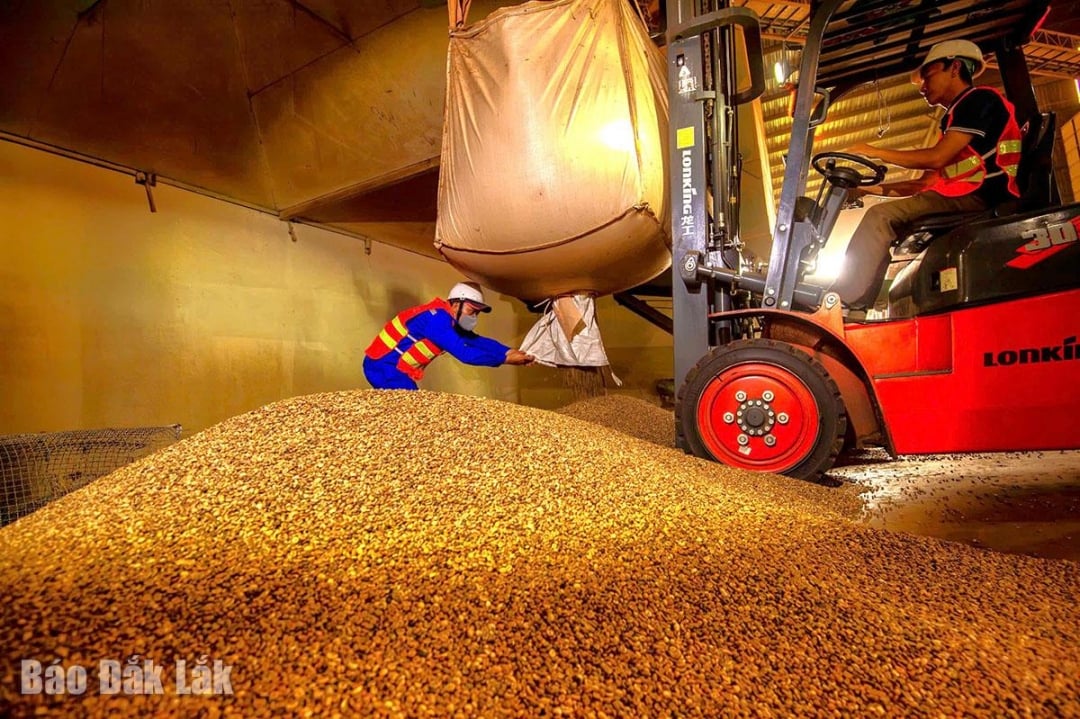
|
Coffee processing at the factory of Dak Lak 2-9 Import-Export Company Limited. |
Over the years, coffee exports have become a bright spot in the province's economic growth. Between 2020 and 2024, Dak Lak exported over 1.4 million tons of coffee (accounting for 18.1% of the country's total coffee exports), generating nearly US$3.4 billion in export revenue. The main export markets remain Germany, Switzerland, Japan, Italy, and the United States. Simultaneously, efforts are being made to explore new, potentially lucrative markets in Latin America, the Middle East, and Africa, and to leverage free trade agreements to boost exports to major markets such as the European Union (EU), ASEAN, Northeast Asia, and Oceania.
According to Nguyen Van Nhiem, Deputy Director of the Department of Industry and Trade, Dak Lak's coffee plays a crucial role in making Vietnam the world's second-largest coffee exporter (after Brazil) and a global leader in Robusta coffee exports. Coffee exports have affirmed the position and competitiveness of Vietnamese agricultural products in the world market. Dak Lak's coffee products alone have penetrated more than 70 countries and territories worldwide, including many notoriously demanding markets such as the United States, the EU, Japan, and South Korea. In particular, pure roasted and ground coffee products, and coffees using advanced technologies such as freeze-drying and cold brewing, are favored by many customers.
Ms. Tran Thi Chang, President of the Malaysia-Vietnam Friendship Association, shared that Buon Ma Thuot – the "coffee capital" of Vietnam – is not only a source of pride for the domestic coffee industry but also an important destination on the world coffee map. Malaysia has a rich coffee culture with a growing demand for coffee. In particular, the trend of consuming pure coffee, cold brew coffee, and premium instant coffee products is developing strongly.
This presents an opportunity for Vietnamese coffee businesses to strongly exploit and gain deeper access to the Malaysian market. Currently, Vietnam is the second largest exporter of coffee to Malaysia. Malaysia is not only a consumer market but also a gateway for Vietnamese coffee to the world. If Vietnamese businesses can meet Halal standards (a requirement for exporting to Muslim countries), their coffee products will not only easily reach over 60% of Malaysia's population, who are Muslim, but also have the opportunity to penetrate large markets such as Indonesia, Brunei, the Middle East, and North Africa.
Recognizing that coffee remains the province's key industry, with ever-increasing market demand, Simexco Daklak (2-9 Dak Lak Import-Export Company Limited) is focusing on supply chain linkages, digital transformation, and green transformation to ensure stable production, high quality, and outstanding performance.
Simexco Daklak has completed its sustainable supply chain by digitizing maps of 40,000 farming households across 50,000 hectares (accounting for 20% of the total coffee area in Dak Lak province). This supply chain fully meets the traceability and transparency requirements under the EU's Anti-Deforestation Regulation (EUDR), which will come into effect on January 1, 2026.
Recently, Simexco Daklak signed a Memorandum of Understanding with Highlands Coffee, a Vietnamese chain of coffee shops and fast-food restaurants, marking an important milestone in establishing a strategic partnership between the two businesses in the Vietnamese Robusta coffee value chain.

|
The Director-General of the International Coffee Organization (ICO), Vanusia Nogueira (left), learns about coffee products from a Dak Lak business at the International Trade Conference - Connecting and Elevating Vietnamese Coffee. |
According to Simexco Daklak Chairman Le Duc Huy, only with close linkages from raw material areas to processing and final consumption can the coffee value chain meet the increasingly high demands for quality, traceability, and sustainable development.
This is a significant step, not only reflecting a commitment to sustainable development but also opening up opportunities to elevate Vietnamese Robusta coffee on the world coffee map. This collaboration also demonstrates that Vietnamese businesses are not only proactively responding to global fluctuations but are also gradually asserting their role as an important link in the global agricultural and food supply chain.
Investing in raw material sources, processing technology, and market linkages is fundamental to realizing the goal of becoming the "kitchen of the world." This is a crucial step in the journey to affirm that Vietnamese coffee is not just a raw export product, but a cultural and quality symbol, standing alongside leading coffee-producing nations worldwide.
Professor Dang Hung Vo, former Deputy Minister of Natural Resources and Environment, once affirmed that Buon Ma Thuot coffee has a fairly solid position in the world coffee market, but that is still not enough because the road ahead is still long. Therefore, a comprehensive development plan for Buon Ma Thuot coffee is very necessary. The planning problem must consider four factors: landscape, culture, high-quality coffee, and experiential tourism. Other issues such as farming models, production relations, and brand promotion also need to be studied and developed simultaneously.
With its favorable natural conditions, high-quality agricultural products, and strategic orientation, Dak Lak is expected to continue maintaining its export growth momentum, enhance product value, aim for sustainable development, and firmly establish its position on the world agricultural export map.
Dak Lak is considered the "coffee capital" of Vietnam, with the largest area and production in the country, accounting for approximately 30%. In the 2023-2024 crop year, the province had over 212,000 hectares of coffee, with a production of over 535,000 tons. Of this, 264,404 tons were exported, generating export revenue of 915.8 million USD. |
Source: https://baodaklak.vn/tin-noi-bat/202505/vang-danh-tren-ban-do-ca-phe-the-gioi-abd0400/



































































Comment (0)