


The pair of mats is equivalent to the entire amount of gold.
One day at the end of April, we visited the traditional mat weaving village of Long Cang. Contrary to our expectations of lush green fields of sedge stretching as far as the eye could see, with people busily harvesting and drying the sedge in the sun for weaving mats, Long Cang now has many operating companies and factories, leaving only a few sedge fields.
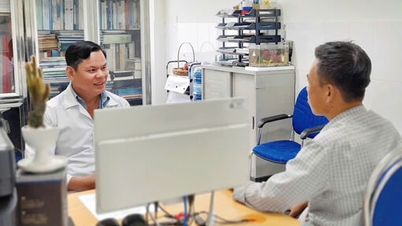
Hearing someone inquire about mat weaving, Ms. Huynh Thi Lien Anh (Hamlet 4) shared: “I don't know when mat weaving originated, I only know it's a 'hereditary' craft that used to be the main source of income for the people of Long Cang. Back then, sedge grew abundantly in the fields, and the harvest season was as joyful as Tet (Vietnamese New Year), with people cutting, transporting, and splitting the sedge... Now, the area for growing sedge is shrinking, giving way to the development of companies and factories. Those of working age are working as factory workers, earning a more stable income. Only the elderly or those who have to take care of their families remain with this traditional local craft.”
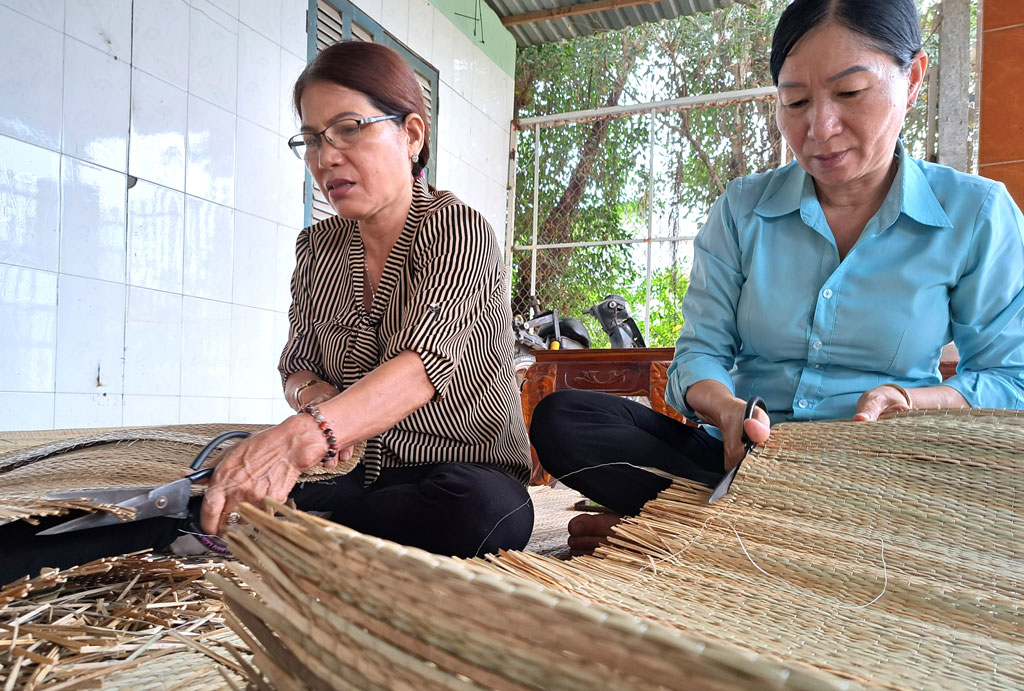
Ms. Huynh Thi Lien Anh (on the left) recounts the golden age of mat weaving.
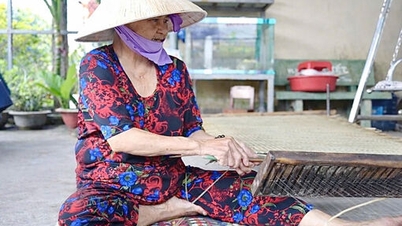
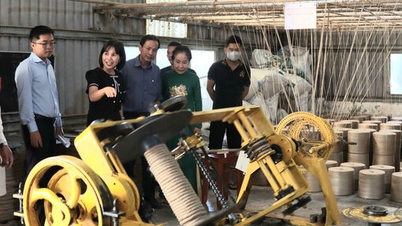
After saying that, she took us to visit the family of Ms. Duong Thanh Thuy (Hamlet 4) - one of the households still practicing the traditional craft in the area. As soon as we entered the house, we heard the clicking sound of the mat weaving machine mingling with the rustic aroma of reeds. Taking a sip of tea, Ms. Thuy recounted: “The mat weaving craft once had a golden age in Long Dinh, Long Son, and Long Cang, but Long Cang reed mats were the most famous. Reed mats were renowned for their meticulous weaving with many patterns serving various purposes, such as dragon and phoenix motifs for weddings, and auspicious couplets for Tet (Lunar New Year). In the past, only well-off families could afford reed mats; a pair of mats was equivalent to a large amount of gold. However, nowadays, few people know how to make reed mats because the raw materials are hard to find, and the market is unstable, so no one wants to learn the craft, leading to the decline of the reed mat weaving profession. Currently, my family only makes reed mats using machines, not by hand as before.”
To make a pair of woven mats, the craftsman must be very skillful and meticulous in every step, from selecting the raw materials to the weaving technique. The raw materials must be carefully selected, including beautiful sedge fibers, which are then dried, dyed evenly, and air-dried again. In particular, the sedge fibers used in the loom must be cut from burlap sacks and then spun by hand until they are perfectly even. After preparing the materials, two people are needed: the main craftsman sits beside the loom, the second person threads each sedge fiber into the loom, and the main craftsman must press firmly to tightly bind each fiber together. The pressing motion must be decisive and forceful enough to keep the fibers aligned, but also skillful enough to prevent them from overlapping.
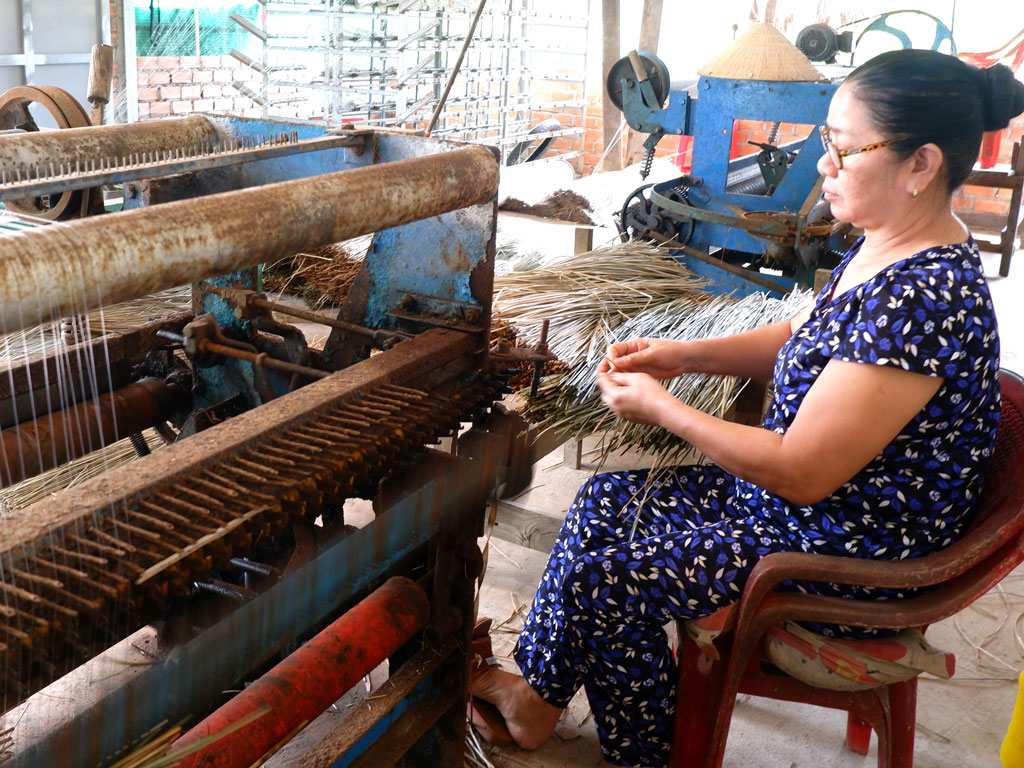
Ms. Duong Thanh Thuy's family mainly produces woven mats.
Preserving traditional crafts
In 2012, the Provincial People's Committee decided to recognize Long Cang Mat Weaving Village as a traditional craft. However, currently, only a few dozen households still practice the craft, mainly concentrated in Hamlet 4 and Hamlet 1. They cling to the craft not only for their livelihood but also out of love for their homeland's traditional craft, preserving a part of its memories. Ms. Huynh Thi Anh Tuyet (Hamlet 4) shared: “When I was 7 years old, I already knew how to help my grandmother weave mats. Back then, during Tet (Lunar New Year), we couldn't weave fast enough to sell them because mats were considered assets, dowry for children, and lucky charms. Now, many people have switched to bamboo mats and nylon mats, which are both beautiful and durable, so rush mats are becoming increasingly difficult to sell. I don't know how much longer our homeland's traditional craft will be able to survive.”
After saying goodbye to those still clinging to the mat weaving craft, we went to the Long Cang Commune People's Committee to learn about the future development direction of the craft village. The Vice Chairman of the Long Cang Commune People's Committee, Lai Thi Kim Minh, confided: "Currently, the craft village is facing difficulties with raw materials because the area for growing sedge is shrinking, now only 10 hectares remain."
In the future, the commune will seek out some people who previously made woven mats, such as the "lây" mat, "hoa râm" mat, "phệt" mat, and "mặt gối" mat, to pass on the craft to the next generation, as these types of mats have unique characteristics of the Long Cang Traditional Mat Weaving Village. At the same time, the local authorities will coordinate with relevant levels and sectors to revive the craft village and combine it with community tourism . Here, tourists will be guided by skilled artisans in weaving mats, and can then purchase products as gifts for family and friends during their trip.”
Hearing about the commune's People's Committee's plans for developing the Long Cang traditional mat weaving village warmed our hearts. However, for the village to develop, it needs attention and investment from all levels and sectors; at the same time, a well-structured implementation plan is necessary. We believe that the village will develop strongly in the near future, contributing to preserving the culture and traditional beauty of Long Cang.
Le Ngoc
Source link





![[Photo] General Secretary To Lam attends the opening session of the Peace Council on Gaza.](https://vphoto.vietnam.vn/thumb/1200x675/vietnam/resource/IMAGE/2026/02/19/1771516865192_tbttolam5-jpg.webp)







































































Comment (0)