

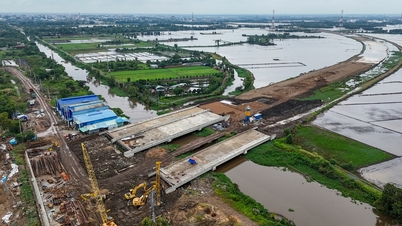
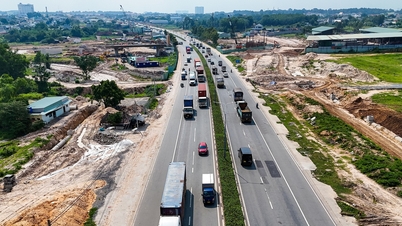
This information is included in the report on the disbursement of funds for compensation, support, and resettlement (referred to as compensation) submitted by the Ho Chi Minh City Department of Natural Resources and Environment to the Standing Committee of the City Party Committee and the People's Committee of Ho Chi Minh City.
Actual expenditures have fallen short of 50% of the estimated capital.
The Department of Natural Resources and Environment stated that at the time of the pre-feasibility study report for the Ho Chi Minh City Ring Road 3 project, four localities (Thu Duc City, Cu Chi District, Hoc Mon District, and Binh Chanh District) recognized the need for sufficient funding to avoid budget shortfalls that would necessitate reporting to the National Assembly for adjustments to the total investment. Therefore, the localities estimated compensation costs based on the following principle: comparing the map boundaries provided by the investor (Ho Chi Minh City Project Management Board for Investment and Construction of Transportation Works) with the existing boundaries on Google Maps, locations with houses on Google Maps were considered residential land, and the compensation was calculated according to the prescribed limits (from 200 m² to 300 m² ).
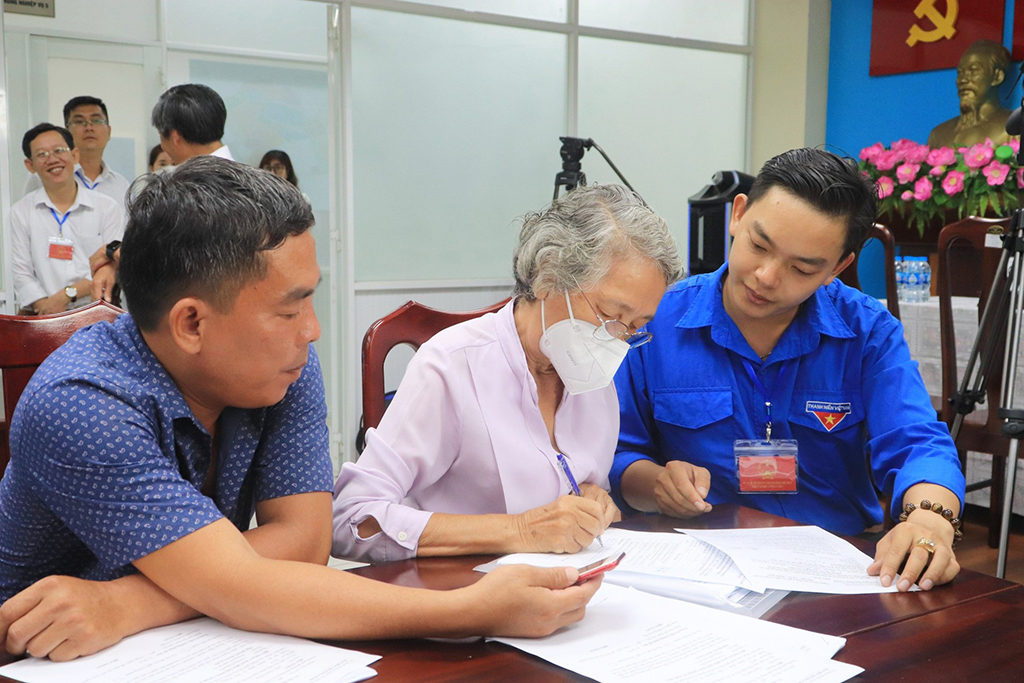
Residents in Thu Duc City processed their compensation payments in May 2023.
Compensation rates are also estimated based on the highest rate within the land price adjustment coefficient framework. For example, in Binh Chanh District, the land price adjustment coefficient framework for residential land is from 6 to 22 and for agricultural land is from 15 to 38. The People's Committee of Binh Chanh District chose a coefficient of 22 for residential land and a coefficient of 38 for agricultural land. In Thu Duc City, agricultural land is only calculated based on the unit price of land for perennial crops, without differentiating between land for annual and perennial crops.
Similarly, compensation for buildings, structures, and support for training, career chuyển đổi, and job search is projected at the highest level. Furthermore, land directly managed by the state, which is not eligible for compensation according to regulations, is included in the preliminary cost estimate as if it were. Therefore, the estimated compensation cost is very high, exceeding 25,600 billion VND.
By the time the compensation project was approved, the compensation rates were updated in the feasibility study report. In December 2022, the Ho Chi Minh City People's Committee approved the compensation project with a total budget of 18,906 billion VND. According to the Department of Natural Resources and Environment, at that time, people had not yet provided complete legal documents, so the compensation costs were still higher than the actual costs. Once the localities reviewed the legal documents provided by the people and deducted the land directly managed by the state, the capital was significantly reduced.
Specifically, Thu Duc City needs 6,225 billion VND, Cu Chi District needs 1,718 billion VND, Hoc Mon District needs 1,614 billion VND, and Binh Chanh District needs 1,687 billion VND. In addition, the total cost for relocating technical infrastructure, constructing resettlement area infrastructure, and other expenses is 453 billion VND. Thus, the total compensation cost for the four localities is only 11,688 billion VND, a reduction of 7,206 billion VND compared to the decision at the end of 2022, and a reduction of more than 50% compared to the preliminary feasibility study estimate.
TRANSFER CAPITAL TO PROJECTS WITH GOOD ABSORPTION RATE
The Ring Road 3 project is not the only one with excess funding in Ho Chi Minh City. According to a survey by the Department of Natural Resources and Environment, the list of projects with excess funding also includes Duong Quang Ham road (Go Vap District) with a reduction of 225 billion VND, D8 road (section from Bui Minh Truc to Ta Quang Buu, District 8) with a reduction of 50 billion VND, Dam Sen Ring Road (District 11) with a reduction of 40 billion VND, Ong Nhieu Bridge (Thu Duc City) with a reduction of 195 billion VND, and Tang Long Bridge (Thu Duc City) with a reduction of 147 billion VND due to over-estimated costs and no longer being needed. Conversely, some projects in Thu Duc City have increased compensation capital, such as My Thuy intersection with an increase of 366 billion VND, and La Xuan Oai road (section from Lo Lu road to Nguyen Duy Trinh) with an increase of 260 billion VND…
Mr. Do Anh Khang, Vice Chairman of the People's Committee of Go Vap District, said that the issue of excess or insufficient funds is a common situation for compensation projects. For example, the Duong Quang Ham road project (the section from Binh Thanh District to Go Vap District Cultural Park) was approved with a budget of 1,750 billion VND, but when it came to actual payments, Go Vap District calculated that only 1,525 billion VND was needed.
According to Mr. Khang, the reason is that at the time of preliminary assessment, the local authorities did not have sufficient legal grounds to request residents to provide documents and conduct surveys of the current situation, so they often assessed the legal status that would receive the highest compensation. However, when compensating for each specific case, many documents did not meet or only partially met the regulations.
Specifically, in some cases, land use rights certificates and house ownership certificates were issued, but upon legal review, some certificates had to be revoked due to improper issuance. These cases were initially expected to receive compensation, but later switched to receiving only residential land support or compensation based on agricultural land prices.
Furthermore, cases involving land and houses originally allocated by the military that partially encroach on public land are ineligible for compensation and will only receive support. Cases involving encroachment on public land will only receive support for the land itself, not compensation. Similarly, land encroached upon and built on after July 1, 2004, will not be compensated or receive support for the land or the building structure.
Regarding the solution for handling the remaining 225 billion VND in compensation funds for the Duong Quang Ham road project, Mr. Khang stated that Go Vap District proposed that Ho Chi Minh City transfer the funds to the Xuyen Tam canal renovation project, which runs through the district, to accelerate disbursement. At a recent specialized meeting on public investment, the Chairman of the Ho Chi Minh City People's Committee, Phan Van Mai, requested that project owners and localities urgently propose to the Department of Planning and Investment to transfer the unspent funds to projects with good absorption rates in order to increase the overall disbursement rate across the city.
Encourage people to provide documents and allow for preliminary measurements.
To address the issue of insufficient or excessive compensation funds, the Ho Chi Minh City Department of Natural Resources and Environment suggested that investors should coordinate with local authorities to fully assess and accurately determine the scope and boundaries of the project during the pre-feasibility study. Consulting firms should closely cooperate with local authorities, referencing current project unit prices, similar locations with recently approved prices, and factoring in inflation to estimate compensation costs.
Surveying the project boundaries requires comparing them with cadastral maps based on the VN 2000 coordinate system to determine whether houses were built before July 2004, serving as the initial basis for compensation or support. For land areas directly managed by the state, a thorough review is necessary to reduce estimated compensation costs. After investment approval, project approval must be expedited to avoid increased land prices that would lead to higher compensation costs.
Furthermore, local authorities need to encourage residents to agree to land surveying, inventory, and the provision of legal documents before issuing land acquisition notices. This will allow for the accurate determination of the affected area and the legal status of the land, which will serve as the basis for calculating compensation costs before project approval.
Source link





![[Image] Hanoi Police officially crowned champions of V-League 2025/2026](https://vphoto.vietnam.vn/thumb/1200x675/vietnam/resource/IMAGE/2026/05/31/1780244769054_ndo_br_039d561b692be875b13a-jpg.webp)





















![[Photo] The General Secretary, President and his wife begin their state visit to the Philippines.](https://vphoto.vietnam.vn/thumb/1200x675/vietnam/resource/IMAGE/2026/05/31/1780230559452_anh-man-hinh-2026-05-31-luc-19-28-11.png)
























































Comment (0)