

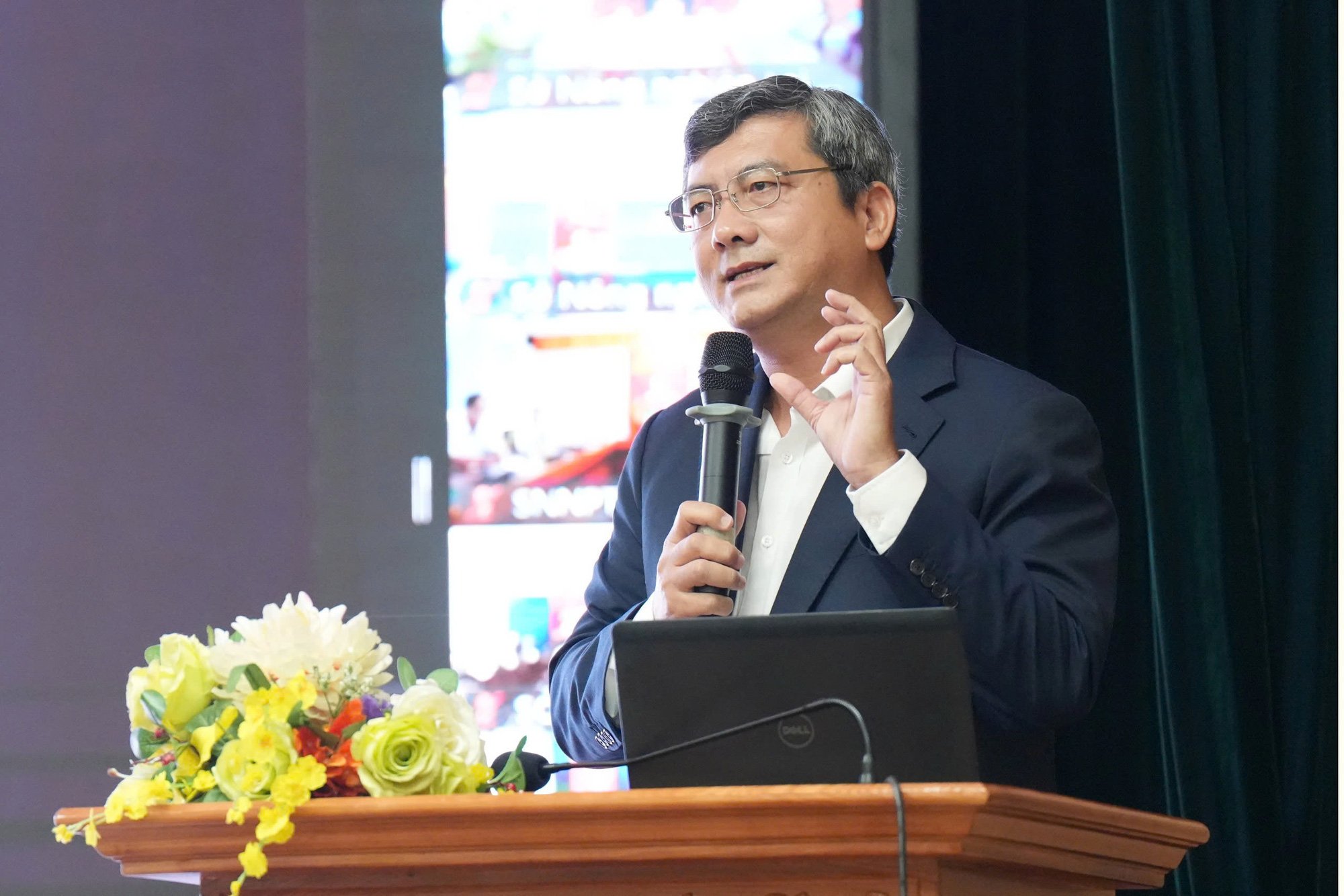
Dr. Tran Minh Hai - Vice Principal of the School of Public Policy and Agricultural Development - Photo: N. BINH
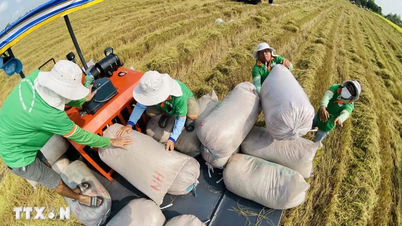
On August 16th, at a workshop on the carbon credit market organized by the Vietnam Agriculture Newspaper, Dr. Nguyen Minh Hai, from the School of Public Policy and Agricultural Development, stated that the project "Sustainable Development of One Million Hectares of High-Quality, Low-Emission Rice Specialization Linked to Green Growth in the Mekong Delta by 2030" aims to build a high-quality rice specialized cultivation area, linked to production along the value chain.
From there, good agricultural practices will be applied to increase the value of rice products and promote sustainable development. In particular, it will increase income for rice farmers.
Therefore, reducing carbon credit emissions in rice production is one of the elements of this project, and Vietnam is the first country in the world to implement a low-carbon rice project.
In the project, in addition to counterpart funding, Vietnam will receive a non-refundable loan of $40 million from the World Bank (WB). Furthermore, a $360 million loan mechanism is underway with national-level procedures being implemented in collaboration with WB experts, and 12 provincial-level projects are in the process of finalizing their procedures.
As of July 2024, seven pilot models have been implemented, each with an average area of 50 hectares, in the provinces and cities of Kien Giang, Can Tho , Soc Trang, Tra Vinh, and Dong Thap.
Currently, the Department of Crop Production, in collaboration with the Institute of Agricultural Environment, is developing a plan to establish and refine the Measurement, Reporting, and Verification (MRV) system. As of July 4th, the department had submitted the plan for implementing MRV on pilot models under the project to the Ministry of Agriculture and Rural Development for approval.
"We borrow money to achieve low carbon emissions. If we don't earn emission reduction credits, we'll 'lose' rather than 'profit'. We need personnel who can implement and manage new production processes, understand and effectively apply technical measures to optimize carbon absorption and emission reduction in agriculture," Mr. Hai affirmed.
According to calculations, producing 8 tons of rice will emit 8 tons of carbon. Currently, the Ministry of Agriculture and Rural Development is cooperating with the Transitional Carbon Finance Fund (TCAF) to price carbon credits at $10 per credit. If farmers fully comply with the procedures, they can reduce emissions by 30%, equivalent to a reduction of 2 carbon credits.
"The biggest economic benefit of the project lies not only in the sale of carbon credits but also in reducing input costs through more efficient production processes. In addition, building a brand for low-emission rice and reorganizing production on a large scale also brings significant added value," Mr. Hai emphasized.
He also noted that participation in the carbon market for rice should not be pursued at all costs. Instead, the focus should be on implementing proper and sustainable production processes, ensuring long-term benefits for both farmers and the agricultural economy.
According to Mr. Dang Thanh Long, Head of Training and Sustainable Development at Intertek Vietnam, Vietnamese export businesses will generally suffer losses if the carbon market operates late. Therefore, manufacturers in third countries need to calculate the amount of emissions "embedded" in the volume of exported goods, including both direct and indirect emissions.
Ho Chi Minh City has 60 projects related to carbon credits.
According to Mr. Cao Tung Son, Director of the Resource and Environment Monitoring Center (Department of Natural Resources and Environment of Ho Chi Minh City), Ho Chi Minh City has issued an Action Plan to respond to climate change for the period 2021-2030, with a vision to 2050. Currently, Ho Chi Minh City has about 60 projects related to carbon credits, which is a large number.
According to government regulations, 2,400 Vietnamese businesses will be required to declare and inventory their carbon emissions. Of these, Ho Chi Minh City has 140 businesses subject to quotas, a relatively high percentage compared to the average.
Source: https://tuoitre.vn/vay-tien-de-phat-thai-carbon-thap-lam-khong-dung-se-lo-2024081611052374.htm


![[Image] Nearly 125,000 Hanoi students completed the Literature exam for the 10th grade entrance exam.](https://vphoto.vietnam.vn/thumb/1200x675/vietnam/resource/IMAGE/2026/05/30/1780117233041_ndo_br_thiet-ke-chua-co-ten-2-png.webp)

























![[Photo] Admire the coral "masterpiece" amidst the million-year-old heritage of Dak Lak province.](https://vphoto.vietnam.vn/thumb/1200x675/vietnam/resource/IMAGE/2026/05/30/1780107638639_y25-jpg.webp)

























































Comment (0)