.jpg)
The imprint of the ancient temple
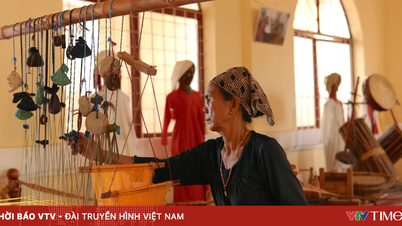
The village of Vạc has long been renowned for its tradition of studiousness, traditional crafts, and rich community cultural life. Within this Northern Vietnamese village setting, the Hoạch Trạch shrine is one of the typical spiritual structures that has been preserved to this day.
According to historical documents, the temple was built during the Ly Dynasty to worship the village's guardian deities. Over the centuries, the structure has been renovated and restored many times. The temple faces southwest, in the shape of the Chinese character "二" (two), consisting of five main halls with curved eaves and tiled roofs. The truss system is of the "con chồng giá chiêng" type, and the decorative patterns are painted with leaf motifs. The three rear halls have two truss structures similar to the main hall. In front is a pond and two ancient banyan trees, creating a peaceful and ancient atmosphere.
Hoach Trach Temple is dedicated to four tutelary deities: Dong Hai Dai Vuong Doan Thuong, Huong Thien Cu Si, Nam Khe Dai Vuong, and Nguyet Thai Princess. These are all figures associated with the Ly Dynasty and have been revered by the local people for generations.
Inside the temple is an altar dedicated to the founder of the bamboo comb making craft, Doctor Nhữ Đình Hiền (1659 - 1716). He passed the doctoral examination in 1680, served as an official up to the rank of Bồi Tụng, Minister of Justice, went on an embassy to China , and brought the bamboo comb making craft back to teach the people of Hoạch Trạch village.
The temple still preserves many ancient artifacts such as horizontal plaques, scrolls, large inscriptions, ancestral tablets, and stone steles of historical value. In addition to the main structure, the site also includes several other elements such as the outer gate, inner gate, pavilion, side hall, and auxiliary areas.



The stone inscriptions only tell stories of the land of scholars.
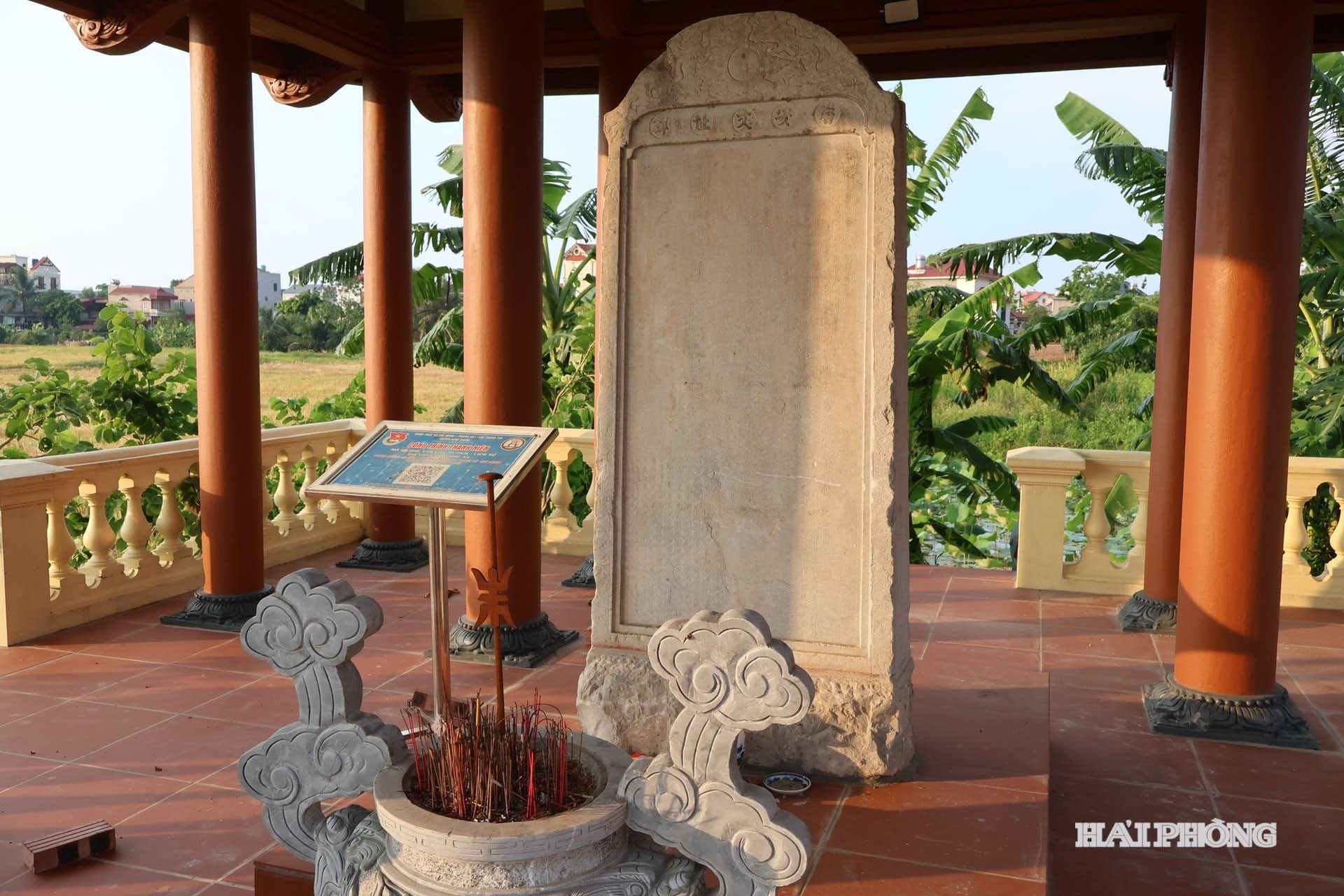
While the Hoach Trach temple preserves memories of community religious life, the Duong An stele clearly reflects the tradition of studiousness in the ancient Binh Giang region.
According to the inscription on the stele, the Đường An Confucian Temple was formerly a fairly large structure, a place to honor those who had passed examinations and contributed to the local education system.
In the 1970s, the land where the temple was located was divided among households for housing, and the stele was moved to the street and for a period was left unattended and unprotected. In 1990, local people brought the stele back to the courtyard of Hoach Trach temple for safekeeping. In 2007, the People's Committee of Binh Giang district (formerly) invested funds to build a protective stele house within the grounds of Hoach Trach temple.
In 2024, the land area for the Confucian temple was approved by the competent authorities to be relocated to a new position (in front of the pagoda) with an area of 8,200 m² , and the Confucian temple stele was also moved to this location (about 60 m southwest of the old Confucian temple).
The stele, measuring 135 x 68 x 17 cm, was erected in the fourth year of the reign of Emperor Thieu Tri (1844). Approximately 1,800 Chinese characters are inscribed on both sides. The front side records the construction and renovation of the temple and the names of those who contributed to the project. The back side lists the names of 108 prominent figures from the former Binh Giang region, including 100 who passed the doctoral examination, two who passed the examinations in the Three Religions, and six who made significant contributions to local education.
Not only is it valuable as an artifact, the stele is also a precious source of information about the history of education and the tradition of studiousness in the Binh Giang region, serving the research of history, culture, and scholarship. On December 27, 2024, the People's Committee of Hai Duong province (formerly) decided to classify the Hoach Trach temple complex - Duong An stele as a provincial-level historical and cultural relic.



Mr. Hoang Van Dac, Head of the Culture and Social Affairs Department of Duong An Commune People's Committee, said that the locality considers the preservation and promotion of the value of the cluster of historical relics as an important task to preserve cultural identity and educate the younger generation about traditions. In the coming time, the commune will continue to coordinate with specialized agencies to promote propaganda and effectively exploit the value of the relics in conjunction with educational activities, tours, and experiences.
Through the vicissitudes of time, the Hoach Trach temple and the Duong An stele still stand as silent witnesses of history. Not only do they preserve the memories of the community's religious life and the scholarly traditions of the ancient Binh Giang region, but this complex of relics also contributes to fostering pride and a sense of preserving cultural identity in each local person.
HUYEN TRANGSource: https://baohaiphong.vn/ve-lang-vac-tham-nghe-hoach-trach-545093.html
![[Image] Schools organize meetings and introduce teaching models to students admitted to grade 10.](https://vphoto.vietnam.vn/thumb/1200x675/vietnam/resource/IMAGE/2026/06/25/1782368077271_ndo_br_z7970052192242-1ec8daeb77a6eed1a4e9f58c564ddd3e-jpg.webp)
![[Photo] General Secretary and President To Lam receives Palestinian Ambassador Saadi Salama](https://vphoto.vietnam.vn/thumb/1200x675/vietnam/resource/IMAGE/2026/06/25/1782365384740_a1-bnd-9423-8322-jpg.webp)
![[Image] Ho Chi Minh City: Ma Lang area, Chicken-Rice Market about to change its appearance](https://vphoto.vietnam.vn/thumb/1200x675/vietnam/resource/IMAGE/2026/06/25/1782377698627_ndo_br_m1-jpg.webp)