

Pregnancy is a period when a woman's body undergoes a series of hormonal changes to accommodate the developing fetus. These fluctuations not only affect her health but are also clearly visible on her skin.
Some expectant mothers experience a more radiant and supple complexion than before, while others face skin darkening, acne breakouts, or persistent stretch marks. Most of these changes are normal and usually improve after childbirth.
Brighter and more radiant skin.
According to Hopkins Medicine, many women notice their skin becoming more radiant during pregnancy, often referred to as a "pregnancy glow." This occurs due to increased blood flow, elevated pregnancy hormones, and more active oil glands. These factors contribute to a more supple and vibrant complexion.
Acne
For many, pregnancy brings radiant skin, rosy cheeks, and lustrous hair. However, some may experience skin changes including acne. Hormonal changes can cause oil glands to produce more sebum, leading to clogged pores, breakouts, and oily skin. Some women experience acne for the first time during pregnancy, while those with a history of acne may find their condition worsens.
Melasma and hyperpigmentation
During pregnancy, the body produces more melanin, causing the skin to darken in certain areas such as the cheeks, forehead, nose, and upper lip. This condition is called melasma or "pregnancy-related melasma."
Additionally, many women notice darker areolas, darker freckles, darker moles, and a dark line running down their abdomen (linea nigra).
Stretch marks
This is one of the most common skin issues during pregnancy. While most women experience some stretch marks on their abdomen during pregnancy, many also develop these pink or red streaks on their breasts, buttocks, and thighs.
In fact, stretch marks can appear anywhere the skin grows and stretches rapidly. They will fade over time but rarely disappear completely.
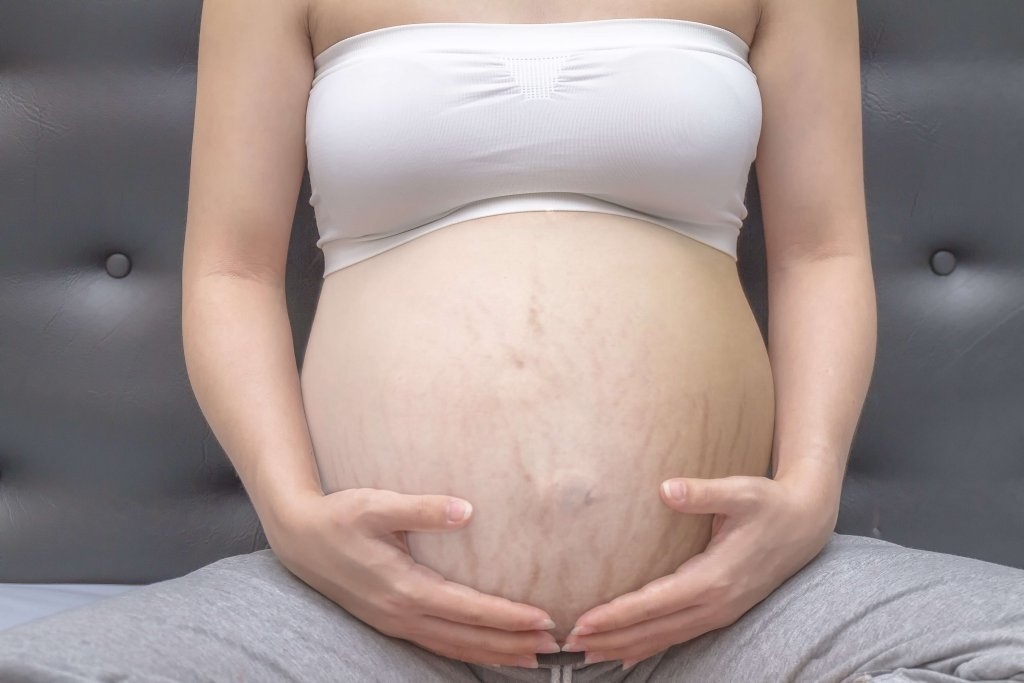 |
Stretch marks are one of the most common problems that occur during pregnancy. Photo: Shutterstock. |
Varicose veins and spider-like capillaries
Spider veins appear due to hormonal changes and increased blood volume during pregnancy. They manifest as small, red veins on the face, neck, and arms. The redness usually fades after the baby is born.
Varicose veins occur because the weight and pressure from the growing uterus compress the veins, reducing blood flow from the lower body back to the heart. As a result, the veins in the legs can become swollen, painful, and appear bluish-purple under the skin. Varicose veins can also appear in the vulva, vagina, and rectum (hemorrhoids). In most cases, this is primarily a cosmetic issue and usually improves or disappears after childbirth.
Itchy skin
Itchy skin is quite common during pregnancy. Itching during pregnancy often occurs on the abdomen, breasts, thighs, or arms due to the skin stretching as the fetus grows. Additionally, hormonal changes and dry skin can also make the itching sensation more pronounced.
In most cases, this is a normal physiological phenomenon. However, if the itching is severe, especially on the palms or soles of the feet, and accompanied by other unusual symptoms, pregnant women should seek medical attention promptly as this can sometimes be a sign of certain pregnancy-related health problems that require monitoring and treatment.
Source: https://znews.vn/lan-da-khi-mang-thai-thay-doi-the-nao-post1655646.html





















![[Photo] Reception to welcome General Secretary and President To Lam and his wife on their State visit to the Philippines](https://vphoto.vietnam.vn/thumb/1200x675/vietnam/resource/IMAGE/2026/06/01/1780295488620_vna-potal-chieu-dai-chao-mung-tong-bi-thu-chu-tich-nuoc-to-lam-va-phu-nhan-tham-cap-nha-nuoc-toi-philippines-8798060-7855-jpg.webp)





































































Comment (0)