

 |
| The La Bang tea-growing region has become an attractive destination for many domestic and international tourists. |
Where excellence converges
“La Bang tea has a very unique aroma, unlike any other region,” said Mr. Nguyen Van Phuc, 65, a long-time tea maker in La Bang, before taking a sip of hot tea. “It has a mild astringency on the tip of the tongue, but then a lingering sweetness, and the aroma is like young rice grains, subtle but memorable.”
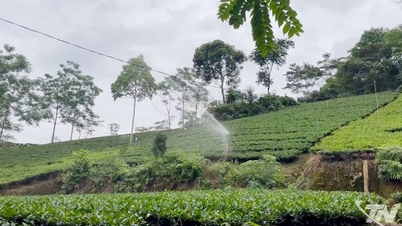
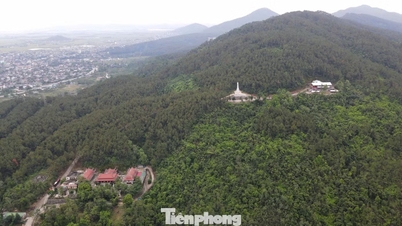
La Bang is located on the eastern slopes of the Tam Dao mountain range, where the altitude and characteristic midland climate create a unique microclimate. Early mornings are shrouded in thick mist, while midday sun is gentle enough to dry the dew drops clinging to the young tea buds without being harsh. In the evening, gentle breezes from the mountains softly blow, bringing a refreshing coolness to the entire area. The four seasons revolve like a peaceful rhythm; nature seems to have intentionally reserved this land for tea plants to take root and flourish. These favorable natural conditions have created the unique flavor of La Bang tea – a flavor that tea connoisseurs call "fairy tea," because the tea buds here not only glow green, bathed in morning mist and warmed by the morning sun, but also encapsulate the spirit of heaven and earth, the springs, and the mountains.
Legend has it that tea plants have existed in La Bang for hundreds of years. Initially, only a few local households brought the seeds and planted them on the gentle slopes of the hills. But thanks to the suitable soil and weather, the tea plants thrived, their leaves thick and glossy, their buds plump and full, and their aroma unusually fragrant. From a few small, initially green and proud rows, they gradually spread across the mountain slopes, becoming an integral part of La Bang's life. People going to the market, people in the village, everyone is attached to the tea plantations as if they were their own flesh and blood. Thus, from a humble plant, the entire area has transformed into a "tea land," where every household and every person dedicates their lives to the endless expanse of green. Now, after 65 years, La Bang has become one of the four tea-producing regions in Thai Nguyen that yield high-quality, high-yield tea products. After the merger (of Hoang Nong and La Bang communes), La Bang's tea plantation area currently covers about 800 hectares.
To make a delicious cup of tea, the people of La Bang consider it not just a job, but an art, a ritual requiring meticulousness and skill. Every movement of picking, roasting, and rolling the tea leaves seems to infuse their soul and dedication to create the most distinctive, rich, and exquisite flavor.
 |
| Nestled at the foot of Tam Dao mountain, La Bang tea region possesses a unique beauty, reflecting the essence of nature and the land. |
For tea growers in La Bang, the timing of tea harvesting is a rigorous selection process, requiring early morning when delicate dew drops still cling to the young buds. Harvesting must also adhere to the "one bud, two leaves" technique. According to Ms. Nguyen Thi Hai, Chairwoman and Director of the La Bang Tea Cooperative, if these dew-covered buds are left for more than half a day, their aroma will fade and their flavor will diminish. Therefore, the harvested tea must be immediately roasted over a wood fire in a thick, black cast-iron pan, polished through generations of smoke and fire. The roaster stands beside the stove, their hands constantly stirring, each movement rhythmic as if immersed in a unique dance. The glowing heat permeates each leaf, blending with the scent of smoke and fire, creating a subtle, lingering aroma. The fire used for roasting tea must be just right, like a heartbeat – too strong, and the tea will burn, losing its aroma; too weak, and the leaves will wither, losing its flavor. Tea makers, therefore, must be sophisticated, using all five senses: their eyes to see the smoke, their noses to smell the aroma, their ears to listen to the gentle sizzling sound, their hands to feel the heat, and their hearts to patiently maintain a rhythm. Experienced artisans only need to look at the swirling smoke, smell the tea aroma carried on the wind, or listen to the rustling of the young tea leaves in the pan to know whether the tea is ready – a supreme level of sophistication that no book can teach.
The people of La Bang still pass down the saying: To enjoy tea, you must have "first water, second tea, third brewing method, and fourth teapot," but making tea requires an additional "five skills"—the meticulousness of the artisan. Just one wrong move, one moment of excessive heat, and the entire batch of tea can be ruined. Therefore, a good cup of tea is not just a product, but also the culmination of the sweat, effort, experience, and love of labor of generations in this place.
Mrs. Hoang Thi Hoi, now over 70 years old, recounted with sparkling eyes, unable to hide her pride: "In the past, I roasted tea leaves by hand. It was scorching hot, sometimes my skin would blister, but I still had to stir constantly. Back then, there were no machines, and sometimes I could only process a few kilograms a day. But it was precisely that manual method that preserved the natural flavor, the sweet aroma, in each tea leaf, which you can't find anywhere else to match."
Tea in life and history
In La Bang, tea is not just a crop or a simple agricultural product. For the people here, tea leaves have become an integral part of their lives, an indispensable element in the souls and memories of generations. Every dawn, when the tea buds are still covered in morning dew, people go to the fields to pick them, then gather around a steaming pot of green tea. A cup of tea to start the new day warms the heart and serves as a bridge for stories of the harvest, the weather, and village life, making them longer, more harmonious, and closer. Tea is present in every aspect of life. On wedding days, a pot of green tea is offered as a blessing for the couple; at ancestral commemorations, a cup of tea is placed on the altar as a heartfelt tribute to ancestors; at festivals, a cup of tea connects people and villages, bringing them closer together. It can be said that for the people of La Bang, a day without the familiar taste of tea is a day that feels somewhat diminished in terms of emotion and the spirit of their homeland.
 |
| La Bang tea undergoes rigorous testing to ensure that the product delivered to consumers meets food safety requirements. |
La Bang tea is not merely an everyday beauty but also imbued with sacred stories of history and national pride. During the resistance war against French colonialism (1945-1954), this land served as a revolutionary base, sheltering and nurturing brave soldiers with unwavering patriotism. At that time, tea was not only for enjoyment but also a silent "bridge" of faith and aspirations for peace. During that arduous resistance war, from 1945 to 1946, the people of La Bang commune actively participated in the self-defense movement, preparing for the struggle for national liberation. Some villagers silently carried tea through the deep forests, sending it as a gift to the soldiers, conveying their sincere feelings. There were families who carefully collected tea leaves, selling them to buy rice and support the revolutionary movement. There were also courageous patriots who, from La Bang, crossed the Tam Dao forest to neighboring areas like Phuc Linh and Tan Thai, even reaching Tuyen Quang , to send tea and support revolutionary cadres. From then on, the green tea leaf became a sacred symbol of the people's resilience, loyalty, and devotion to their country. Through bombs, bullets, and hardships, La Bang tea remained steadfastly green on the gently sloping hillsides, spreading its delicate fragrance like the breath of the homeland. From these tea plantations, the people of La Bang built not only a livelihood but also cultivated a spiritual value, an irreplaceable identity. The simple yet noble green tea leaf witnessed countless changes in the land and its people over time, while also encapsulating the hardships of making a living and carrying the memories of glorious historical years.
While Tan Cuong tea is renowned for its delicate, sweet aftertaste, La Bang tea is likened to a "Tam Dao girl"—gentle, shy, yet profound and captivating. Tea connoisseurs only need a sip to notice the distinct difference: the initial astringency quickly fades, leaving a sweet, refreshing aftertaste in the throat, lingering like a long, melodious tune. It's not just the flavor, but the essence of the mountains and forests, of the earth and sky, of the skillful hands and heartfelt dedication of the people of La Bang. This unique characteristic has made La Bang one of the most famous specialty tea regions, sought after by tea enthusiasts both domestically and internationally as a land imbued with a pure soul. For many, a cup of La Bang tea is not simply a beverage, but a silent dialogue between humanity and nature, between the present and the memories of generations.
 |
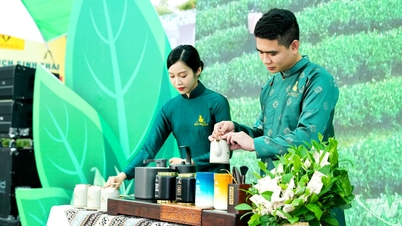
| The product range of La Bang tea is becoming increasingly diverse and varied, meeting food safety requirements. |
Today, visitors from all over flock to Thai Nguyen – the capital of the thousand winds – and La Bang is an unmissable stop. They come not only to buy a few kilograms of tea to take home for themselves or to give as gifts to relatives, but also to enjoy a complete experience: walking amidst vast, lush green tea hills, listening to the wind whispering through the leaves, and inhaling the cool, refreshing aroma of young tea buds still covered in morning dew. Many visitors also enjoy picking tea leaves themselves, listening to artisans share their secrets of processing, and then sitting by the babbling Kem stream, sipping a hot cup of tea, feeling a sense of calm and tranquility. In that moment, people not only enjoy tea, but also appreciate a cultural space. In the bittersweet taste of the tea, there is the simplicity of rural life, the resilience of the land and people through the years of history, and the warmth and hospitality of the local people. That is what creates the unique identity of La Bang tea - an unmistakable soul of the homeland, both simple and familiar, yet profoundly moving and deeply touching.
Source: https://baothainguyen.vn/van-nghe-thai-nguyen/chuyen-muc-khac/202605/vung-che-trong-suong-nui-e2a4125/
![[Photo] National Assembly Chairman Tran Thanh Man working with the Standing Committee of the National Assembly's Delegation Affairs Committee.](https://vphoto.vietnam.vn/thumb/1200x675/vietnam/resource/IMAGE/2026/05/20/1779294340023_ndo_br_1-1691-jpg.webp)
![[Photo] General Secretary and President To Lam works with the Party Committee of the Ministry of Health on the work of Vietnamese traditional medicine.](https://vphoto.vietnam.vn/thumb/1200x675/vietnam/resource/IMAGE/2026/05/20/1779294323718_a1-bnd-2978-3319-jpg.webp)
![[Image] "Journey of Hope" promotes the organ and tissue donation movement in Vietnam.](https://vphoto.vietnam.vn/thumb/1200x675/vietnam/resource/IMAGE/2026/05/20/1779294400833_1-8910-jpg.webp)
































































Comment (0)