

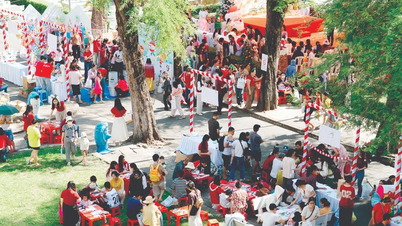
The first day of the event, October 20th, featured the second Vietnamese culinary map record-breaking program. The program included chefs from the Ho Chi Minh City Professional Chefs Association and highly skilled chefs from over 20 provinces and cities across the country.

The chef placed the dishes in their respective provinces and cities to complete the culinary map. Photo: Bich Phuong
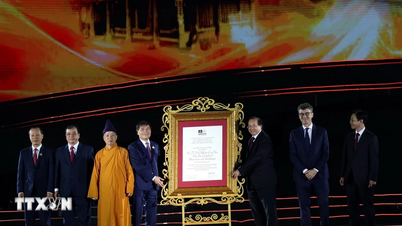
Ms. Vo Luu Lan Uyen, Deputy Secretary General of the Vietnam Record Organization, read the decision establishing the Vietnam record for "the event of preparing and performing specialty dishes from 63 provinces and cities to create the shape of a map of Vietnam using the most dishes".
The map is filled with dishes representing each province and city, totaling 126 dishes. This year's number of dishes on the map broke last year's record, more than doubling, according to a representative from the Vietnam Record Organization.
According to Ms. Nguyen Thi Khanh, President of the Ho Chi Minh City Tourism Association, establishing a record for a map featuring 126 dishes from 63 provinces and cities signifies "preserving the value of traditional cuisine." It also provides an opportunity for chefs to showcase their creativity, acting as "culinary ambassadors" to share the values of Vietnamese cuisine with international friends.
The unique feature of the Vietnamese culinary map is that all the dishes on display are "prepared live" by chefs within the framework of the festival. The dishes displayed on the map will be evaluated by a team of culinary experts, and the chefs who prepared them will be awarded prizes. On the first day of the festival, the dishes displayed on the map are those prepared live. On subsequent days, the dishes on the map will be displayed as models for visitors to see.
The chairman of the Ho Chi Minh City Tourism Association said that the dishes were prepared in just the right quantities for display, saving on ingredients and spices.
"The organizers only prepared enough food for display, saving on spices and ingredients. Dishes that can be reused will be used. However, some dishes, due to their specific characteristics, cannot be preserved for long," Ms. Khanh said.

The Hai Duong specialty rice cake with mung beans is shaped like the S-shaped map of Vietnam. Photo: Bich Phuong
The map features 126 dishes, including many familiar ones associated with Vietnamese cuisine, as well as unique and exotic specialties from various regions. These include grilled sand lizard with chili and salt (Binh Thuan), Chưmomray grass-fed beef with yellow ant salt (Kon Tum), catfish hotpot (Hau Giang), lam nho (Lai Chau), Hanoi's bun cha and bun dau mam tom, and Saigon's banh mi.
Mr. Pham Son Vuong, Chairman of the Ho Chi Minh City Professional Chefs Association, said that the criteria for evaluating dishes participating in the Vietnamese culinary map record setting are "not too complicated in terms of taste" but rather focus on the chef's "creativity" and how they use local produce in their dishes.
These dishes must offer the public and judges a fresh, unique experience and create new specialties for local cuisine. According to Mr. Vuong, creativity and innovation are also the "current trend" in the culinary industry, playing a crucial role in the process of "opening up to the world." Vietnamese chefs have now begun to learn cooking techniques from around the world, finding ways to incorporate new elements into old dishes "to both preserve traditional cuisine and create modern products," meeting the needs of domestic and international diners.
Mr. Nguyen Trung Khanh, Director of the Vietnam National Tourism Administration, said that the festival contributes to promoting Vietnamese cuisine to the world, while also boosting culinary tourism, making Vietnam an attractive destination to attract international tourists. The Vietnam Tourism Development Strategy until 2030 identifies culinary culture as a key cultural element.
"To promote Vietnamese cuisine internationally, Vietnamese tourism promotion activities need to be linked with promoting the culture and cuisine of different regions across the country," said Mr. Nguyen Trung Khanh.
Prior to the Vietnamese Culinary Festival, Ho Chi Minh City organized the first Bread Festival in Vietnam in March, attracting 100,000 visitors. The three-day food festival in October is expected to attract around 50,000 visitors.
The festival is organized by the Ho Chi Minh City Tourism Association, the Saigon Professional Chefs Association, and the Center for Research, Preservation and Development of Vietnamese Cuisine.
Source: VNE
Source


![[Photo] Prime Minister Pham Minh Chinh presides over a meeting on private sector economic development.](/_next/image?url=https%3A%2F%2Fvphoto.vietnam.vn%2Fthumb%2F1200x675%2Fvietnam%2Fresource%2FIMAGE%2F2025%2F12%2F20%2F1766237501876_thiet-ke-chua-co-ten-40-png.webp&w=3840&q=75)






















































Comment (0)