

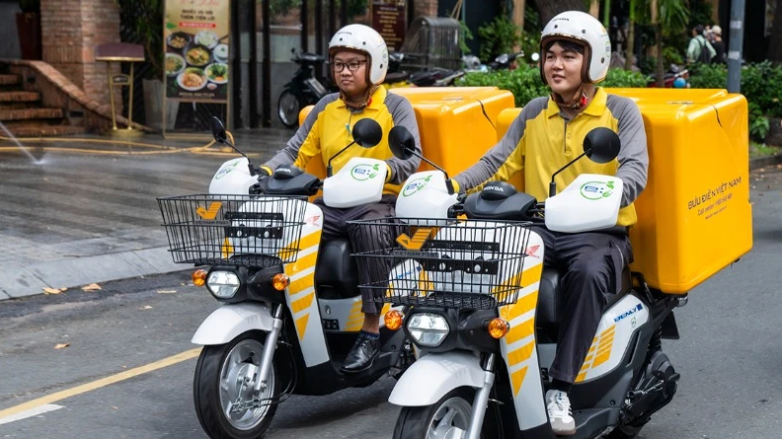
 |
| Vietnam Post is a pioneer in implementing solutions for transporting goods using electric vehicles. |
Pioneering logistics businesses are embracing "greening."
As one of the leading enterprises in Vietnam's logistics industry, Vietnam Post has implemented numerous solutions over the years to "green" its goods transportation operations.
Specifically, Vietnam Post has implemented the Postgreen Project since 2019 to build a green postal environment. This includes even the smallest actions, such as employees not using plastic bags, single-use plastic items, or utensils in offices, processing areas, and on transport vehicles.
In addition, the campaign to create a "green office" included designing open post offices to foster a friendly environment between customers and tellers, and encouraging customers to change their habit of wrapping goods in plastic bags to using standard cardboard boxes, ensuring both the safety of goods and environmental protection.
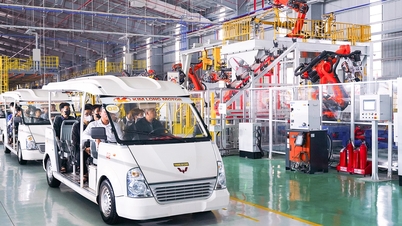
In particular, stemming from a desire to be "green" in every aspect of its operations, in 2021, Vietnam Post became the first postal enterprise in Vietnam to collaborate with Honda Vietnam to introduce electric motorcycles for delivery services.
Efforts in innovation, improvement, and enhancement of service quality, along with the promotion of digitalization and "greening" of postal activities, have enabled Vietnam Post to play a leading role in raising Vietnam's Postal Development Index from level 5 to level 6, placing Vietnam among the countries with a good postal development index.
Vietnam Post is one of the pioneering enterprises in applying green logistics solutions in its production and business operations. Mr. Dao Trong Khoa, Chairman of the Vietnam Logistics Services Association (VLA), stated that climate change is one of the biggest global challenges of the 21st century. The logistics industry alone contributes significantly to carbon emissions, estimated at 7-8%. This is why awareness of green logistics within the Vietnamese business community has made significant progress.
“Many businesses belonging to the Vietnam Logistics Business Association (VLA) have proactively implemented environmentally friendly solutions such as using low-emission transport vehicles, applying digital technology to optimize routes, reduce fuel consumption, and improve operational efficiency. Some seaports of VLA member businesses have achieved “Green” certification from international organizations. Meanwhile, some other businesses have begun conducting carbon emission inventories and participating in the carbon credit market. However, the application of green logistics in practice is still on a small scale, not yet widespread, and Vietnam is still in the early stages of this transition,” Mr. Dao Trong Khoa shared.
However, alongside businesses that have rapidly embraced green transformation, many others remain uninterested in this issue. According to the Ministry of Industry and Trade, the number of logistics businesses implementing this green transformation is still very limited out of more than 34,000 logistics businesses nationwide.
A survey conducted by the Vietnam Logistics Research and Development Institute (VLI) from August 2023 to July 2024 revealed some worrying realities. Despite increasing awareness of green logistics, the majority of businesses have yet to proactively fulfill their environmental commitments.
Specifically, 12.5% of businesses have yet to implement any green production policies or processes, while 87.5% have already implemented or are planning to implement sustainable solutions.
However, the majority of these have not yet defined a specific timeline for fulfilling their commitments. Notably, as many as 65.63% of logistics service providers have not implemented environmental impact mitigation measures, while only 34.37% have either implemented or are planning to implement green solutions.
Meanwhile, Vietnam's logistics currently relies heavily on road transport and has uneven development across different modes of transport. 75% of goods are still transported by road, while 12% are transported by sea and only 2% by rail. Notably, up to 95% of vehicles in Vietnam still rely heavily on fossil fuels.
In addition, e-commerce is also developing rapidly in Vietnam. Logistics plays a crucial role in the e-commerce supply chain, but the transportation of goods is also a significant source of greenhouse gas emissions and environmental pollution.
Furthermore, in the online retail sector, two stages have a negative impact on the environment: delivery and packaging. Each product delivered from an online store has its own packaging, usually cardboard boxes, plastic bags, styrofoam containers, or disposable plastic items.
Every day, thousands of trucks, cars, motorcycles, etc., deliver orders to customers and pick up unclaimed orders, generating enormous amounts of carbon emissions. These impacts are even higher in the case of express delivery services.
Suggesting solutions for businesses
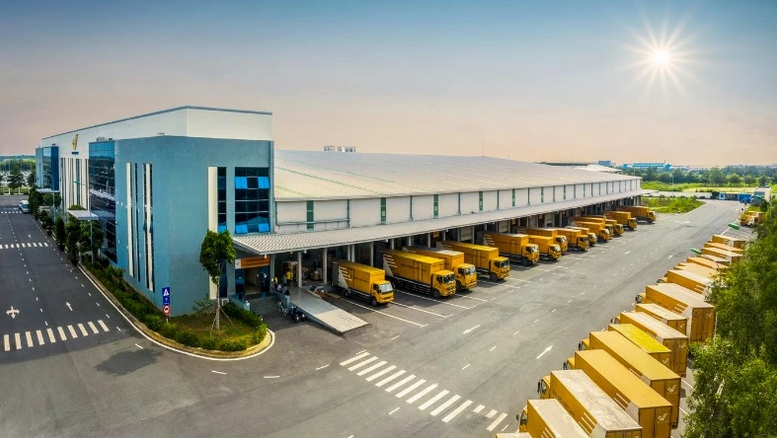 |
| A green transition is an urgent requirement to contribute to achieving the goals set at COP26. |
In the current context, developing green logistics and reducing emissions is becoming a crucial component of any supply chain amidst geopolitical instability and increasing demands for "greening" to reduce emissions from countries worldwide, including Vietnam, as it fulfills its commitment to achieving net-zero emissions by 2050.
Despite offering many practical benefits, the transition to green logistics remains a challenge for businesses, especially small and medium-sized enterprises.
Firstly, there are challenges related to the human factor, reflected in awareness and responsiveness to the green transformation of logistics services. In addition, transportation infrastructure in Vietnam remains incomplete, especially in remote areas. Cost is also a concern for businesses…
Suggesting solutions for green transformation in the logistics industry, Mr. Pham Thien An, Director of Vinacontrol Inspection Company, believes that the State currently has many mechanisms and policies to support businesses, in addition to the market for carbon credit trading. This can be a powerful financial tool for businesses in their green transformation.
Therefore, businesses need to develop greenhouse gas reduction strategies with specific, precise, and clear plans to achieve the most effective and rapid carbon emission reduction goals.
Accordingly, businesses need to invest in green transportation technologies such as researching and investing in electric vehicles, hybrid trucks, and fuel-saving technologies. At the same time, businesses need to transform intermodal transport in developing intermodal transport systems between road, sea, and rail; and apply digital solutions to supply chains by investing in digital platforms to optimize transportation routes.
In addition, it is necessary to encourage the use of sustainable fuels (biofuels); strengthen international cooperation and participate in or develop carbon offset projects.
To support logistics service businesses in enhancing their competitiveness, in October 2025, Vietnam will host the FIATA World Congress 2025 – a significant event bringing together leading logistics experts and businesses from around the world.
With the theme "Green and Resilient Logistics," the event not only demonstrates Vietnam's strong commitment to sustainable development but also opens up opportunities to access new trends, learn from international experience, and promote cooperation in the industry.
This will be a forum connecting experts and businesses from both domestic and international backgrounds, creating momentum to promote the greening of logistics, contributing to enhanced competitiveness and moving towards a sustainable economy.
Source: https://huengaynay.vn/kinh-te/xanh-hoa-hoat-dong-dich-vu-logistics-150850.html


![[Photo] General Secretary and President To Lam presides over the meeting to approve the draft report on the results of the second inspection by the Politburo of the Standing Committee of the Hanoi City Party Committee.](https://vphoto.vietnam.vn/thumb/1200x675/vietnam/resource/IMAGE/2026/05/26/1779789811432_a2-bnd-4430-9620-jpg.webp)



























































Comment (0)