

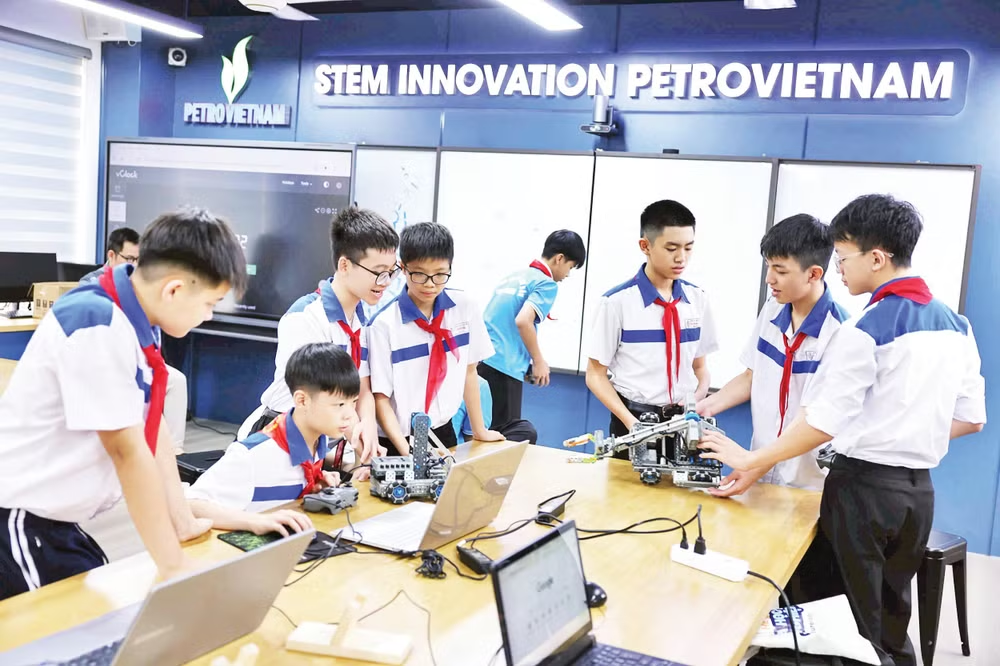
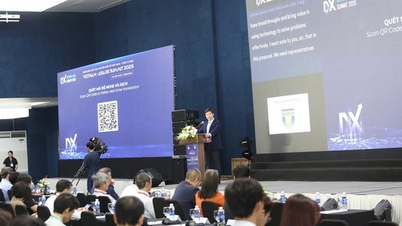
Along with the rest of the country, the education sector has recently focused on and effectively implemented Resolution No. 57-NQ/TW of the Politburo on breakthroughs in the development of science, technology, innovation, and national digital transformation. To date, hundreds of STEM practice rooms meeting international standards have been built in secondary schools, management and administration have been strengthened, and teaching methods have been changed in the digital environment... all aiming towards the goal of building a digital education ecosystem.
Implementing the digital classroom effectively.
Based on an idea from General Secretary and President To Lam, the Vietnam National Energy and Industry Corporation has collaborated with the Ministry of Education and Training and local authorities to build 100 internationally standardized STEM practice rooms in 34 provinces and cities by 2025.
This is a large-scale educational project aimed at upgrading educational infrastructure and supporting the training of young people with science, technology, engineering, and mathematics skills, meeting the country's requirements for developing high-quality human resources in the new era. These classrooms will become centers for disseminating knowledge, serving as places for students to experience STEM levels and as "incubators" for training core teachers, creating a ripple effect across tens of thousands of schools nationwide.
The classrooms are designed according to the "rapid-standardized-sustainable" model, fully equipped with advanced equipment such as: interactive whiteboards, AI-IoT systems, VEX Robotics, 3D printers, CNC cutting machines, and themed energy-environment experiment kits…
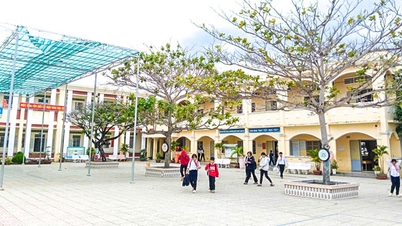
In the 2025-2026 school year, Le Quy Don Junior High School (Tuyen Quang province) will receive investment for the construction and operation of an internationally standardized STEM practice room. The school's Vice Principal, Dang Thi Bich Ngoc, shared that upon receiving the STEM practice room in November 2025, both teachers and students were initially surprised by its modernity. To operate it effectively, the school sent 10 key teachers from various subjects to participate in in-person training in Hanoi; simultaneously, online training was conducted every Thursday evening. Teachers were instructed on how to operate the equipment, effective teaching methods, and received technical support (maintenance and warranty) in case of malfunctions.
The opening of the classroom is a great joy and source of excitement for the entire staff, teachers, students, and parents, helping to resolve obstacles in applying technology to teaching.
The opening of the classroom is a great joy and source of excitement for the entire staff, teachers, students, and parents, helping to resolve obstacles in applying technology to teaching.
In the classroom, students are introduced to programming (writing code), assembling robots, learning about the Internet of Things (IoT), and applying artificial intelligence (AI) to create sensor devices. The school has organized hands-on experiences in the STEM lab for all students and plans to incorporate this content into the main curriculum.
According to Ms. Ngoc, STEM activities have helped students change their learning approach, even in seemingly unrelated subjects. For Math, students reported that the logical thinking developed through STEM helped them learn Math and other subjects better. For example, Pham Binh Minh (6A), who usually wrote poorly, improved his Literature score significantly after practicing operating the VEX robot – a process requiring meticulous procedures and careful attention to detail.
In Hanoi, to foster students' qualities and abilities and to help them become global digital citizens, starting from the 2025-2026 school year, Giang Vo Secondary School will implement the "Google Digital Classroom" model with three "key" classes: Mathematics, Literature, and English.
According to Ms. To Thi Hai Yen, the school principal, the digital classroom is implemented using a positive educational method, based on technology, and student-centered to contribute to the formation and development of students' qualities and abilities; ensuring students have safe access to digital information and content on all devices used in the school. From the 2026-2027 school year, based on the actual situation, the school plans to expand this model to the entire school.
Meanwhile, drawing from the experience of Quoc Oai High School (Hanoi), Principal Nghiem Hong Trung stated that digital transformation is a long-term process requiring synchronized innovation from administration to teaching organization; with the core "key" being the development of digital skills for the teaching staff. The school has implemented digital transformation by digitizing data on staff, teachers, and performance evaluations; increasing the application of AI to analyze exam results, thereby addressing limitations in teaching. Teachers have proactively utilized digital learning materials and organized virtual classes; used data to track student progress; and selected appropriate technologies to enhance the effectiveness of lessons.
Electronic student transcript data integration
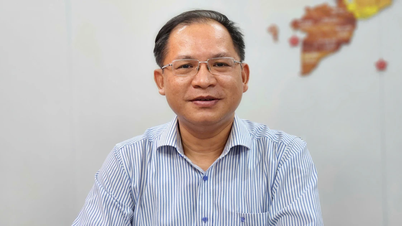
According to Nguyen Van Hien, Director of the Hanoi Department of Education and Training, the digital transformation and AI revolution are reshaping all aspects of life, and education in the capital city also needs to innovate and adapt. The 2025-2026 school year was a foundational year for education. Following the spirit of Resolution No. 57-NQ/TW of the Politburo, Hanoi's education sector has decisively reformed its management thinking, organized safe and scientific entrance exams; organized teaching and learning in a substantive way and aimed for international integration. The quality of mass and advanced education in the capital continues to affirm its solid position; the high school graduation rate has risen to the top group nationwide. In preparation for the 2026-2027 school year, Hanoi's education sector is focusing on comprehensive digital transformation, using data and AI as leverage.
"Hanoi's education system will not stop at simply applying technology, but will move towards building a synchronized digital education ecosystem. This will include promoting STEM/STEAM education, robotics, and especially enhancing the status of English so that students in the capital city can confidently integrate globally," Mr. Hien affirmed.
Hanoi's education system will not stop at simply applying technology, but will move towards building a synchronized digital education ecosystem. This will include promoting STEM/STEAM education, robotics, and especially enhancing the status of English so that Hanoi students can confidently integrate into the global community.
Meanwhile, according to Vu Dinh Hung, Director of the Department of Education and Training of Tuyen Quang province, the digital transformation and application of information technology and AI in management and teaching have always been a priority for the education sector. The information technology infrastructure of educational institutions continues to be invested in towards standardization and modernization; all educational institutions are provided with internet access; and the IT application capacity of management staff and teachers is gradually improving to meet the requirements of innovative management, teaching methods, and assessment. More than 95% of primary schools and 100% of secondary and high schools are equipped with computer labs; 222 out of 695 general education schools have online classrooms to support online teaching, professional development, and online observation; and most teachers are proficient in using and applying several digital platforms in teaching.
Nationwide, the school management software has been largely implemented synchronously, connecting the provincial education department, communes, and schools. The online enrollment system on the National Public Service Portal has been perfected to a "full-scale" level, allowing candidates to register for the high school graduation exam and university/college admissions entirely online, ensuring transparency and convenience. The application of AI and big data analytics has been initially integrated into software supporting teachers in creating exam questions, grading papers, and managing data; the initial steps are being taken to digitize academic records, moving towards the interconnection of electronic academic transcripts.
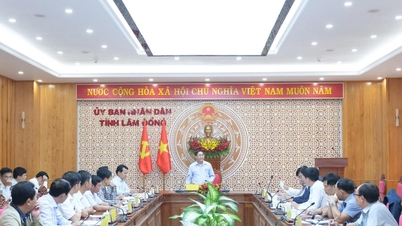
According to the Permanent Deputy Minister of Education and Training, Pham Ngoc Thuong, the Ministry of Education and Training has focused on perfecting the legal framework to promote digital transformation and the application of science and technology in education. Specifically, it has issued a set of indicators to assess the level of digital transformation for Departments of Education and Training, general education institutions, and preschools nationwide. The education sector's database system has been largely completed, with nearly 24.55 million electronic records digitized and connected to the national population database.
Nationwide, the school management software has been largely implemented synchronously, connecting the provincial education department, communes, and schools. The online enrollment system on the National Public Service Portal has been perfected to a "full-scale" level, allowing candidates to register for the high school graduation exam and university/college admissions entirely online, ensuring transparency and convenience. The application of AI and big data analytics has been initially integrated into software supporting teachers in creating exam questions, grading papers, and managing data; the initial steps are being taken to digitize academic records, moving towards the interconnection of electronic academic transcripts.
Source: https://nhandan.vn/xay-dung-he-sinh-thai-giao-duc-so-post965159.html

![[Photo] Life on both banks of the river returns to its bustling pace on the day the Long Bien Bridge opens to traffic.](https://vphoto.vietnam.vn/thumb/1200x675/vietnam/resource/IMAGE/2026/05/28/1779949763708_cau-long-bien-minh-duy-7-3610-jpg.webp)


![[Image] Checking the security conditions at the exam site, ready for the 10th grade exam.](https://vphoto.vietnam.vn/thumb/1200x675/vietnam/resource/IMAGE/2026/05/28/1779943458889_z7872507660648-d764421a26e8cd7b61d70d142a48a685-jpg.webp)












![[Video] Vietnam aims to have research direction in the top 5% globally.](https://vphoto.vietnam.vn/thumb/402x226/vietnam/resource/IMAGE/2026/05/28/1779951274644_khoa-hoc-jpg.webp)


![[Photo] Life on both banks of the river returns to its bustling pace on the day the Long Bien Bridge opens to traffic.](https://vphoto.vietnam.vn/thumb/402x226/vietnam/resource/IMAGE/2026/05/28/1779949763708_cau-long-bien-minh-duy-7-3610-jpg.webp)
![[Video] Long Bien Bridge officially reopens to traffic.](https://vphoto.vietnam.vn/thumb/402x226/vietnam/resource/IMAGE/2026/05/28/1779948569792_img-3589-565-png.webp)

![[Photo] Opening Ceremony of the National People's Council Conference on the Implementation of Directions and Tasks for the 2026-2031 Term](https://vphoto.vietnam.vn/thumb/1200x675/vietnam/resource/IMAGE/2026/05/28/1779939257690_ndo_br_bnd-1991-jpg.webp)































































Comment (0)