

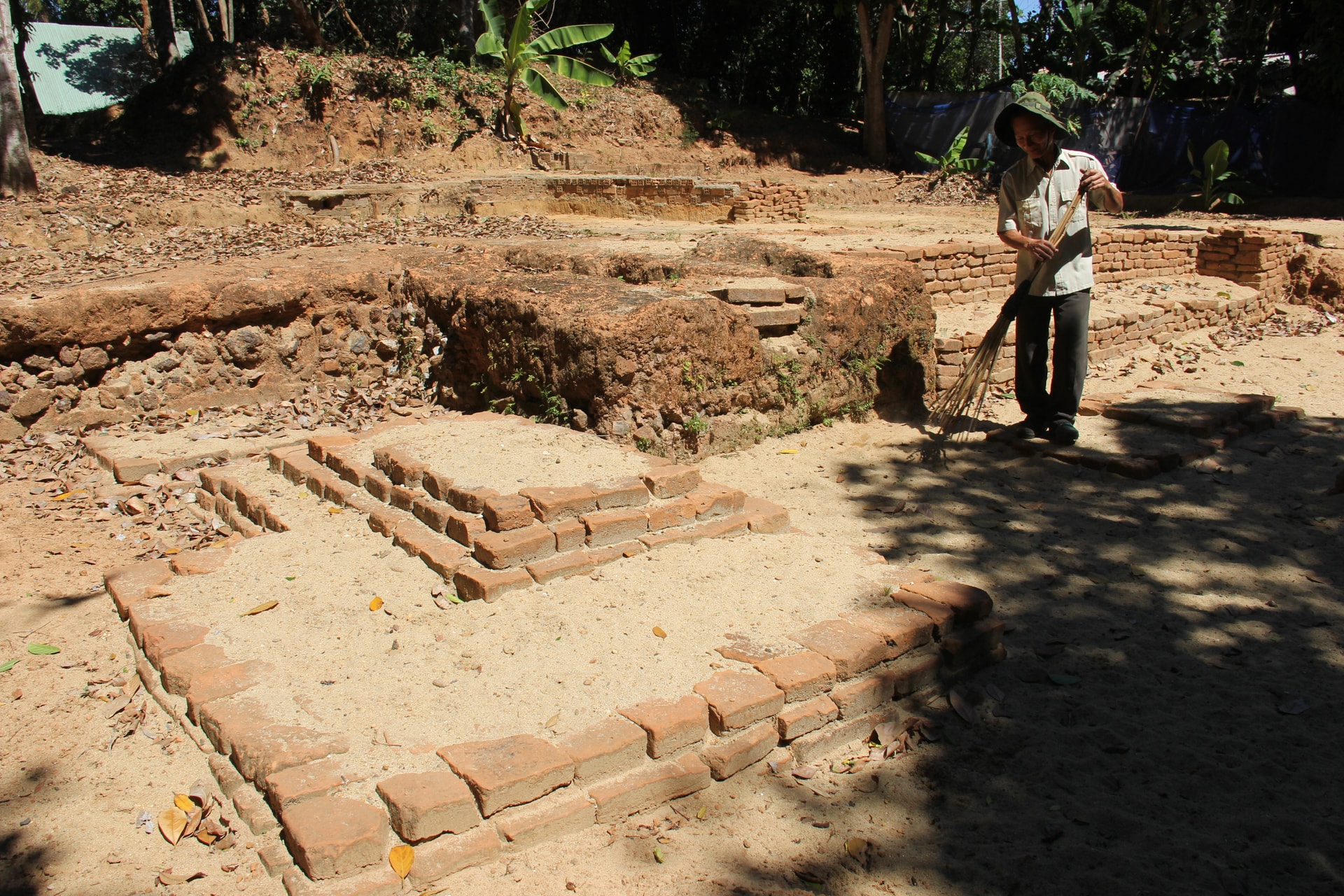
Over the years, the Phong Le Cham relic site has remained surprisingly intact. This is because the entire neighborhood has become the "guardian of the relic."
The historical site is "open" in the hearts of the people.
The afternoon sun casts a weak light on the closely packed rooftops of Phong Le residential area (formerly Hoa Tho Dong ward). The neighborhood retains its traditional village charm, with towering trees interspersed among newly built multi-story houses. Without signage, many would find it difficult to recognize the remnants of a Champa architectural complex dating back over 1,000 years.
Nestled amidst lush greenery, the Phong Le Cham relic site is surrounded by approximately 14 households. Houses are built close together, with winding narrow alleys. Just stepping past the low wall behind each house leads to the area where the foundations of a Cham tower were once unearthed.
The boundary between historical sites and everyday life is almost nonexistent. Unlike many isolated historical sites, Phong Le, despite being classified as a historical site, retains the characteristics of a truly "open site." The people living near the site are the witnesses to the awakening of layers of ancient memories.
The current house of Ms. Ngo Thi Vui, head of group 4 of the HTD (Cam Le ward), located at alley 85/62 Truong Chinh, is one of the main entrances to the historical site. According to Ms. Vui, this area was formerly a cooperative. In 2011, Ms. Le Thi Ut's family discovered many Cham artifacts while digging the foundation for their house. The information was reported, and the authorities and cultural sector quickly intervened, organizing several large-scale excavations.
Ms. Vui said that in the past, people around the village occasionally found old bricks but didn't think they were Cham bricks, only thinking they were foundations of structures left behind by the French. "Ms. Ut's house was moved to make room for archaeologists to excavate. When they first dug it up, everyone was surprised to find statues and foundations. Archaeologists came continuously, and only then did the villagers realize they were living on a major historical site," Ms. Vui recounted.
The existence of a thousand-year-old monument in the middle of a residential area has repeatedly raised concerns in the press about the risk of encroachment and damage from daily life. However, remarkably, over the years, most of those concerns have not materialized.
Although there are no written regulations or contracts of responsibility, an unspoken rule has formed in the neighborhood: the historical site is common property, and no one is allowed to trespass. "The neighborhood committee always talks about the historical site at meetings, because it's a source of pride for the people. People tell children not to dig or climb; adults remind each other not to litter, and they immediately ask strangers if they see them," said Mrs. Vui.
It is this voluntary preservation that keeps the relics alive in the memories of the people. After excavations, before the relics received proper restoration investment, there was almost no dedicated security force. In that gap, the surrounding residents took on the role of unpaid guardians. Not only did they look after the relics, but many households also voluntarily cleared weeds, cleaned up trash, and maintained cleanliness around the relic site – small but persistent tasks thanks to the consensus of the community.
Phong Le Street awaits the dawn.
In the former Cam Le district (now Cam Le ward), the government and various organizations regularly organized visits for residents and students to explore this "living" historical site. It seems that even before the Phong Le archaeological site was classified as a city-level historical site in 2021, the conservation efforts had already begun with the simple awareness of the local people, who understood that they were living on land steeped in history.
Preserving a historical site is one thing, but bringing it back to life is a much longer and more difficult endeavor. This is especially true considering that for many years, the Phong Le Cham relic site has remained dormant. Mr. Le Hien, a resident of Phong Le, believes that despite being protected, the site has not been exploited to its full potential. During the conversation, Mr. Hien and many others expressed their anticipation when discussing projects aimed at transforming the relic site into a driving force for development in the Cam Le riverside area.
Especially since the City People's Council has approved the investment plan for the second phase of the Cham Sculpture Museum in Phong Le, with the expectation of creating an "open museum" that both preserves heritage and develops cultural tourism . According to the plan, the historical site will be clearly zoned: a conservation core, a protection zone, and an open space for the community. If implemented correctly, Phong Le will not only be a tourist attraction but also a cultural living space where heritage is closely intertwined with the lives of the local people.
Mr. Vo Van Thang, former Director of the Da Nang Cham Sculpture Museum, believes that with the rich historical value of the site, the city should seize the opportunity to develop it into a key destination for river tourism.
According to Mr. Thang, Cham researchers consistently believe that within the former Da Nang area, archaeological discoveries at Phong Le further confirm that the city was once a major religious center of the ancient Cham people. Besides the thousand-year-old relics, Phong Le also boasts rich and humane folk festivals such as the Shepherd Festival and the Clam Procession Festival, along with traditions associated with famous figures like Ong Ich Khiem and Ong Ich Duong… These are all potentials for developing tourism linked to heritage preservation.
For the people of Phong Le, they all believe that if this thousand-year-old historical site truly "shines brightly" one day, that light will not only come from investment projects, but also from the unity of the ordinary people who have quietly guarded the memories of the past for so many years.
Source: https://baodanang.vn/xom-phong-le-gac-di-tich-3319414.html






















![[Video] Sunset at Lap An Lagoon – Where the sun sets over the fishing nets](https://vphoto.vietnam.vn/thumb/340x192/vietnam/resource/IMAGE/2026/05/31/1780192137701_beach-landscape-sea-water-nature-grass-745871-pxhere-com.jpeg)





![[Photo] The General Secretary, President and his wife lay flowers at the Ho Chi Minh Monument in Manila.](https://vphoto.vietnam.vn/thumb/1200x675/vietnam/resource/IMAGE/2026/05/31/1780219759477_anh-man-hinh-2026-05-31-luc-16-29-07.png)

































































Comment (0)