

The Yikatong Card in China allows visitors to use the metro, buses, taxis, and to shop at supermarkets, convenience stores, fast food restaurants, and vending machines.
Reader Trinh Hang (40 years old, Hanoi) shared her experience using the card while traveling in China after a two-week trip in June.
Yikatong (also known as the Beijing Municipal Administration Traffic Card) was introduced by the Beijing municipal government in 2003 with the goal of increasing convenience for citizens and reducing the use of cash. Initially primarily a replacement for traditional subway tickets, Yikatong is now widely used on all modes of transportation and can be used to pay for many products and services within the city.
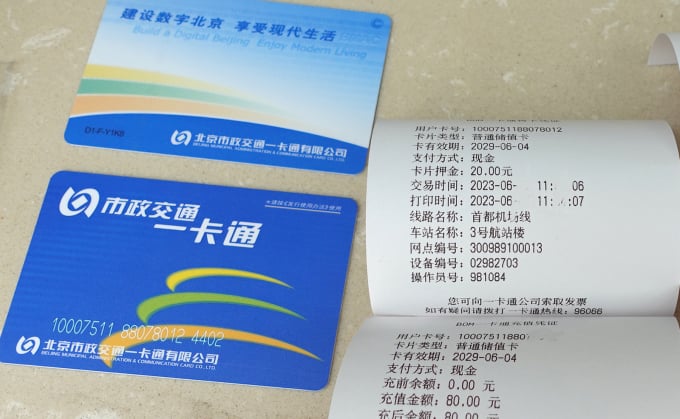
Using a Yikatong card allows you to purchase all kinds of goods and services in the city. Photo: Trinh Hang
Using Yikatong, tourists receive discounts on certain services and products, but more importantly, it saves them a lot of time and effort because they don't have to buy tickets for each trip in the city, wait in line at vending machines, or struggle to prepare small change when paying for services and products. While most Chinese people now pay via apps, foreign tourists often find these apps difficult to use, making Yikatong an effective alternative.
Besides the Yikatong physical card, most Chinese people use the Yikatong app installed on their phones. Foreign tourists are not familiar with this app, so most still use the physical card.
How to buy and use
Yikatong cards can be purchased at airports, subway stations, bus terminals, and numerous card sales points and vending machines throughout Beijing. Simply present your passport and cash to the seller. A 20 yuan (approximately 65,000 VND) deposit is required, which will be refunded upon returning the card when you leave Beijing. Because this is a small amount, many tourists choose to keep the card as a souvenir.
In theory, users can top up their cards, but foreigners cannot do so because the system only recognizes Chinese national ID cards. Therefore, estimate how much you will spend before topping up your card. If you are in Beijing for 2-3 days, you can top up 100 yuan (approximately 330,000 VND), with 20 yuan as a deposit and 80 yuan for transportation on the metro, buses, and taxis. All card-accepting points have card readers. The machine will deduct the amount corresponding to the services used and display the remaining balance on the card. Therefore, for tourists who do not speak Chinese, using the card makes traveling and shopping more convenient as they do not have to communicate with drivers or vendors.
If you've used up all the money on your card but still have time in Beijing, you can buy single journey tickets to travel by metro, or pay cash per trip if you take the bus.
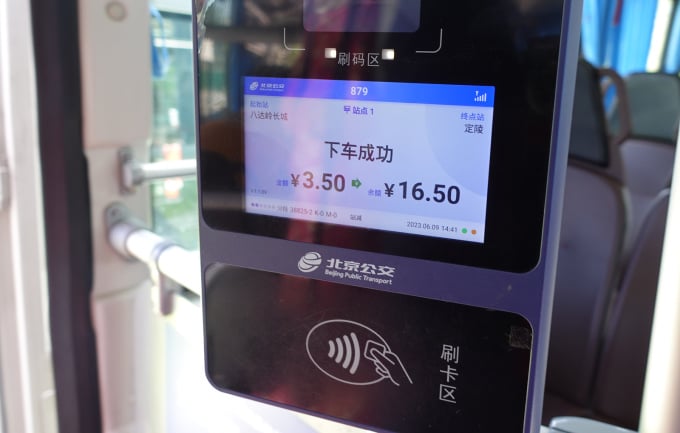
The card reader displays the deducted amount and the remaining balance. Photo: Trinh Hang
How to use Yikatong to get to tourist attractions.
The Great Wall of China (UNESCO heritage site)
From anywhere in the city, take the Yikatong subway (3-4 yuan per ride) to Jishuitan Station. There you'll find a large bus terminal; locate the designated stop for bus route 877 – which takes passengers from central Beijing to Badaling – the Great Wall. To board, swipe your Yikatong card; the fare is 12 yuan, and the journey takes approximately 70 minutes.
Summer Palace (Upper House) (UNESCO heritage site)
This famous scenic spot has a history of 800 years. During the Qing Dynasty, it was rebuilt and renovated into a luxurious summer palace by Emperor Qianlong, and later by Empress Dowager Cixi. You can take subway line 4 to Beigongmen station in Yikatong or take bus number 74, 374, or 437 to Yiheyuan Xinjiangongmen bus stop. The fare is approximately 4-5 yuan.
Thirteen Tombs (UNESCO heritage site)
This is a vast and uniquely designed complex of tombs built by the emperors of the Ming Dynasty. To get there, take bus number 314 from Yikatong to Dingling, Zhaoling, or Sacred Way bus stops.
Temple of Heaven (UNESCO heritage site)
The Altar of Heaven, built in 1420 during the Ming Dynasty and continuously expanded throughout the Ming and Qing Dynasties, was one of the most important architectural works of its time. Located in the heart of Beijing, the Temple of Heaven is easily accessible by various means: metro line 5 to Tiantandongmen Station (Exit A2) or buses number 36, 958, 122, 2, 20, 120, 6, 34, 35, 106, 110, 128, 525, 623, and 684.
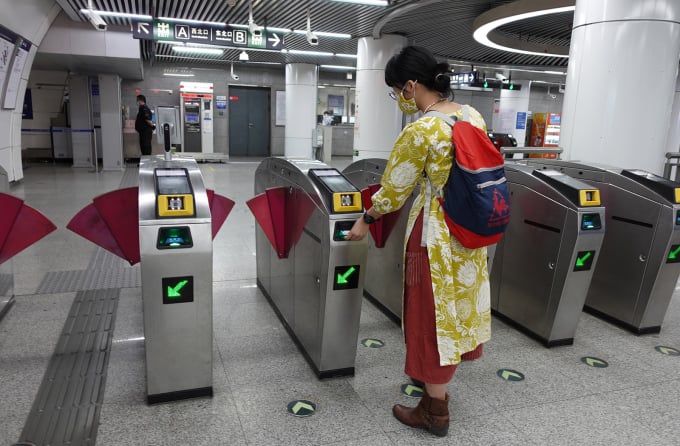
Use your Yikatong card to travel by subway to tourist attractions. Photo: Trinh Hang
The Forbidden City (UNESCO heritage site)
This is one of the most outstanding architectural works in China. The Forbidden City is located in the heart of Beijing. Use a Yikatong card to take subway line 1 to Tian'anmendong station, or take bus numbers 1, 120, 2, 52, 59, 82, or 99 to Tian'anmendong bus stop. The Forbidden City has many gates; you can buy tickets and enter through the Meridian Gate.
National Stadium (Bird's Nest Stadium)
This iconic modern structure of Beijing is located within Olympic Park, alongside many other magnificent sports facilities. Take subway line 8 or line 15 to Olympic Green station (Beijing Olympic Park station), exit D, or take bus routes 82, 419, 538, or 645 to National Stadium East.
National Museum of Art
This is a place showcasing many masterpieces of painting, sculpture, and calligraphy. Visitors can use a Yikatong card to take metro line 5 to Dongsi station or bus number 101, 103, 109, 111, 128, or 58 to Art Museum Stop.
With the Yikatong card, you can also travel to any airport, long-distance bus station, and high-speed train station in the city, from where you can travel to other locations. The card is valid for three years from the last use.
Trinh Hang
Source link
![[Photo] General Secretary and President To Lam presides over a meeting on preparations for the review of one year of operation of the three-tiered government system.](https://vphoto.vietnam.vn/thumb/1200x675/vietnam/resource/IMAGE/2026/06/02/1780391821195_a1-bnd-4595-9717-jpg.webp)




































































Comment (0)