

In Vietnam, banh mi is not only a quick and convenient food but also a proud symbol of Vietnamese culinary culture. However, if you are interested in building a healthy menu, you should be aware of the weight and calorie content of this food.
How many grams does a loaf of bread weigh?
When asked "how many grams does a loaf of bread weigh?", many consumers are often confused because there is no standardized measurement for this street food.
The weight of a loaf of bread depends on the size of the baking pan, the dough recipe of each bakery, and the culinary characteristics of each region. According to market surveys, a non-standard loaf of bread with a crispy crust and moderately soft interior usually weighs between 80 and 100 grams. The most common average weight recorded is 90 grams.
Furthermore, the market also shows a diverse range of sizes. Traditional, dense loaves of bread, which feel substantial in the hand, can weigh between 110 and 120 grams. Conversely, mini loaves or soft, hollow loaves often used as accompaniments to steak or dumplings weigh only a modest 50 to 60 grams. Understanding this variation is the first step in accurately controlling your food intake.
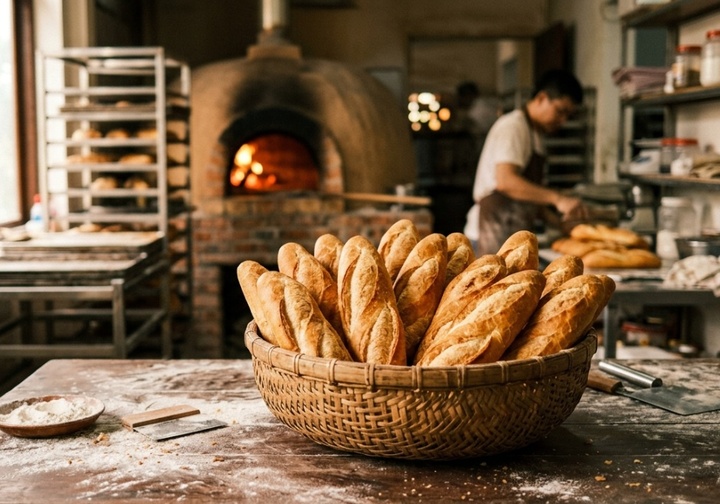
A loaf of bread weighs approximately 90 grams, according to the most commonly recorded average. (Illustrative image: AI)
How many calories are in one loaf of bread?
Traditional bread is made primarily from refined wheat flour, yeast, water, and a little salt. According to the National Institute of Nutrition and reputable food composition tables, 100 grams of white bread provides an average of 230 to 250 calories. Based on this ratio, a non-standard 90-gram loaf of bread would provide approximately 200 to 225 calories.
In terms of macronutrient composition, a 90-gram loaf of bread contains approximately 45-50 grams of carbohydrates, 7-8 grams of protein, and a very low fat content (only about 1-2 grams). Notably, due to the use of refined flour, the bran and germ of the wheat are completely removed, resulting in extremely low fiber content (less than 2 grams), and a significant reduction in B vitamins and natural minerals.
With an energy content of around 200 calories, a loaf of bread isn't exactly within the safe range for a snack or a basic breakfast. However, why do many nutrition experts warn about the risk of weight gain and fat accumulation when consuming white bread?
The answer lies in the glycemic index (GI). White bread, made from refined starch, has a very high GI, usually above 70. When it enters the digestive system, this starch is quickly broken down into glucose and absorbed rapidly into the bloodstream. The body's natural physiological response is for the pancreas to secrete a large amount of insulin to clear the sugar from the blood, converting the excess energy into stored fat tissue.
The sudden drop in blood sugar right after that insulin peak sends false hunger signals to the brain. As a result, just 1 to 2 hours after eating plain bread, you feel hungry again and tend to look for more food. Moreover, in reality, we rarely eat plain bread. When combined with fillings like pâté, butter, grilled meat, Vietnamese sausage, or rich sauces, the total calorie count of a meat sandwich can easily reach 400 to 600 calories, equivalent to a hearty main meal.

Eating bread with fried eggs and cucumber is both nutritious and helps maintain your figure. Photo: IG
Eating bread the right way
Bread isn't an enemy of health if we know how to consume it intelligently and systematically. To protect your figure and maintain stable energy levels, you can apply the following scientific principles.
First, optimize your food combinations. To slow down the glycemic index of white bread, pair it with foods rich in fiber and high-quality protein. Sandwiching bread with fried eggs, chicken breast, and plenty of green vegetables, cucumber, and tomatoes will help slow down digestion, prolong feelings of fullness, and provide sufficient micronutrients.
Secondly, the timing of consumption plays a crucial role. Make bread a quick energy source for breakfast or lunch, when the body needs more fuel to function. Avoid eating bread late at night, when metabolism slows down and excess energy is more easily converted into fat.
Finally, if you're particularly health-conscious or on a strict weight-loss diet, consider switching to whole-wheat bread, rye bread, or whole-grain bread. These options weigh similarly but boast higher fiber content and a lower glycemic index, allowing you to fully enjoy your favorite flavors while maintaining good overall nutritional control.
Source: https://vtcnews.vn/o-banh-mi-nang-bao-nhieu-gram-cung-cap-bao-nhieu-calo-ar1020746.html

![[Photo] First session of the 14th Congress of the Vietnam Trade Union](https://vphoto.vietnam.vn/thumb/1200x675/vietnam/resource/IMAGE/2026/06/03/1780465947883_ndo_br_img-3852-jpg.webp)



































![[Photo] Delegation attending the 14th Congress of the Vietnam Trade Union visits the Mausoleum of President Ho Chi Minh.](https://vphoto.vietnam.vn/thumb/1200x675/vietnam/resource/IMAGE/2026/06/03/1780451842301_ndo_br_img-3824-jpg.webp)








































































Comment (0)