



AI agents have the ability to automatically coordinate many tasks, from security and smart devices to managing people's personal lives - Photo: LinkedIn
In that journey, AI is not the one determining the answer; it is ultimately how humans use and control this "double-edged sword" that will be the deciding factor.
AI is infiltrating our lives.
Over the past year, AI has begun to subtly infiltrate work, study, and personal life through work tools, digital assistants, and AI agents that manage schedules, information, and daily habits.
The greatest value of this shift lies in reducing the "cognitive burden"—the most scarce resource of modern humans—as AI reorganizes users' lives, thereby freeing them up more time and space for creative thinking.
In education , AI is not just a supporting tool but is gradually reshaping how people learn. AI systems are capable of tracking progress, detecting knowledge gaps, and adjusting learning paths to individual abilities, competing with the standardized teaching and learning model that has existed for decades.
According to a Microsoft thematic report, approximately 86% of global educational institutions will have adopted AI by 2025 – the highest rate across all sectors – indicating that AI is becoming the new infrastructure of education.
AI and the geopolitical race
According to Time magazine, by 2025, AI will have transcended the boundaries of a conventional technology to become a tool for competing for power in global geopolitics.
The year 2025 also clearly shows that the AI race is no longer about "who has the smarter model," but rather who controls the key inputs: advanced semiconductors, energy, data, and computing infrastructure.
The US-China competition in the semiconductor sector, chip export controls, and the efforts of nations to keep data within their borders reflect the direct integration of AI into national strategic thinking. AI has therefore become a geopolitical lever: both a tool for enhancing power and a means of exerting pressure and containing rivals.
2026 is predicted to witness a race for "AI sovereignty ," as many countries seek to build or deploy AI on their domestic infrastructure to control data. Simultaneously, the industry is shifting from "scale competition" to "efficiency competition," with the emergence of smaller, more compact language models trained on high-quality data.

Source: Tracking AI; Data: Ha Dao - Graphics: Tuan Anh
The era of transparent AI
The explosion of AI-generated content is transforming the global information landscape. As the lines between reality and virtuality blur with incredibly realistic deepfake images and videos, society faces not only the problem of "AI slop" (data garbage) but also a greater threat: the systemic erosion of trust.
The natural human reaction to a flood of unverified information will no longer be an attempt at verification, but rather an attitude of complete skepticism.
In a world where the cost of producing content is approaching zero, official credibility has become the most scarce and expensive resource. At this point, the role of journalism and fact-checking organizations is no longer simply to report the news, but to act as institutions protecting the truth.
Their core value lies in their ability to ask questions, cross-check information, and most importantly, to take legal responsibility – ethical barriers that AI, however sophisticated, cannot replace.
This requirement for transparency has also become a vital standard for AI systems themselves. As Professor Russ Altman (Stanford University) points out, as AI penetrates sensitive fields such as healthcare or law, society will reject decisions coming from a mysterious "black box."
Explainable AI and transparency in the reasoning process are not just technical requirements, but also the only weapon against the proliferation of deepfakes and copyright disputes.
Setting the "rules of the game" for AI
2025 will see the first steps towards more systematic management of AI. Policies are beginning to emphasize transparency, accountability, and traceability of AI-generated content. The European Union's Artificial Intelligence Act (EU AI Act) – the world's first comprehensive legal framework for AI – demonstrates how governments are beginning to set the "rules of the game" for AI.
Instead of a complete ban, the EU is adopting a risk-based approach: banning applications deemed to infringe on human rights, tightening regulations on high-risk AI systems (such as healthcare, immigration, and justice), and requiring transparency for AI-generated content.
In contrast to Europe's assertiveness, other major powers present a fragmented governance picture: the US still prioritizes directive executive orders, while China focuses on tight control of content and data in the private sector.
By 2026, this fragmentation will force countries and organizations to choose: transparency for survival or elimination from demanding markets. At this point, trust will no longer be a luxurious moral slogan but a crucial economic "passport." Countries and businesses that establish transparent rules will reassure consumers, transforming risk control into a tangible competitive advantage.

Source: Microsoft - Data: Ha Dao - Graphics: Tuan Anh
Labor market changes
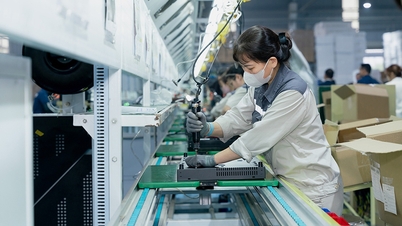
The emergence of AI agents is profoundly changing the labor market, as AI not only automates individual tasks but begins to take over entire workflows. A company's advantage no longer lies in the size of its workforce, but in the speed of adaptation and the ability to reorganize the way people and machines work.
Repetitive tasks are gradually being taken over by AI, while labor demand shifts to new roles such as AI monitoring, risk control, and accountability for final decisions.
According to Gavin Yi, CEO of Yijin Hardware Group, the development of AI is creating a demand for new positions such as prompt engineers, AI ethics specialists, AI competency educators, and AI system maintenance and monitoring experts.
McKinsey estimates that AI could force hundreds of millions of global workers to switch careers by 2030, but the technology is also creating entirely new roles in the coming years.
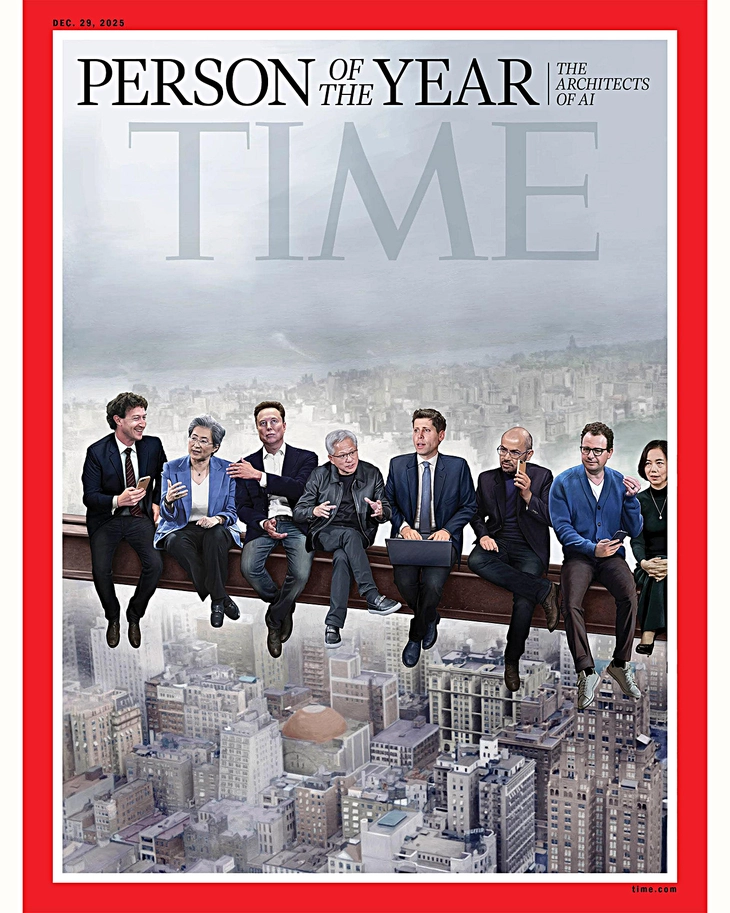
The cover of Time magazine, released on December 29th, named "AI architects" as Person of the Year 2025, honoring leaders in the technology field.
From left to right: Mark Zuckerberg (CEO of Meta), Lisa Su (CEO of AMD), Elon Musk (CEO of Tesla), Jensen Huang (CEO of Nvidia), Sam Altman (CEO of OpenAI), Demis Hassabis (CEO of DeepMind), Dario Amodei (CEO of Anthropic), and Fei-Fei Li (leading computer vision scientist).
The cover is inspired by the famous 1932 photograph, "Lunch on the Skyscraper Roof," which captures workers sitting and eating lunch on a steel beam high above the New York City skyline.
Source: https://tuoitre.vn/2026-nam-thu-lua-ai-20260101100403179.htm







































































































Comment (0)